fetching data ... 
Background: Behçet’s syndrome (BS) is a systemic vasculitis characterized by recurrent oral and genital ulcers. Despite the availability of multiple therapeutic options, refractory mucosal manifestations remain a clinical challenge for some patients. Given the central role of immune dysregulation in BS, immunomodulatory agents such as lenalidomide may represent a potential therapeutic option. To date, however, clinical experience with lenalidomide in BS remains limited to a few case reports [1–3].
Objectives: To evaluate the efficacy, safety, and potential mechanisms of lenalidomide in refractory mucosal BS.
Methods: This single-center, prospective, open-label, single-arm study was conducted at Peking Union Medical College from July 2022 to December 2025. BS patients with refractory oral ulcers (OUs) who showed inadequate response or intolerance to conventional, biologic, or targeted synthetic DMARDs were consecutively enrolled. Lenalidomide was administered at doses ranging from 5 to 10 mg/day. The primary endpoint was the complete response (CR) at week 12, defined as participants who were OU-free in the previous 28 days. Partial response (PR) was defined as a 50% or greater reduction in OUs, and no response (NR) was the failure to achieve either CR or PR [4]. Other efficacy outcomes included OU pain measured by a 100-mm visual analog scale (VAS), genital ulcers (GUs), Behçet’s Disease Current Activity Form (BDCAF), and quality of life (36-Item Short-Form Survey V.2, SF36V2). In addition, the steroid-tapering and DMARDs-sparing effects of lenalidomide were evaluated. All adverse events were recorded for safety assessments. Immune mechanisms were investigated through bulk RNA sequencing of peripheral blood mononuclear cells (PBMCs) and flow cytometry for regulatory T (Treg) cell analysis at baseline and Week 12.
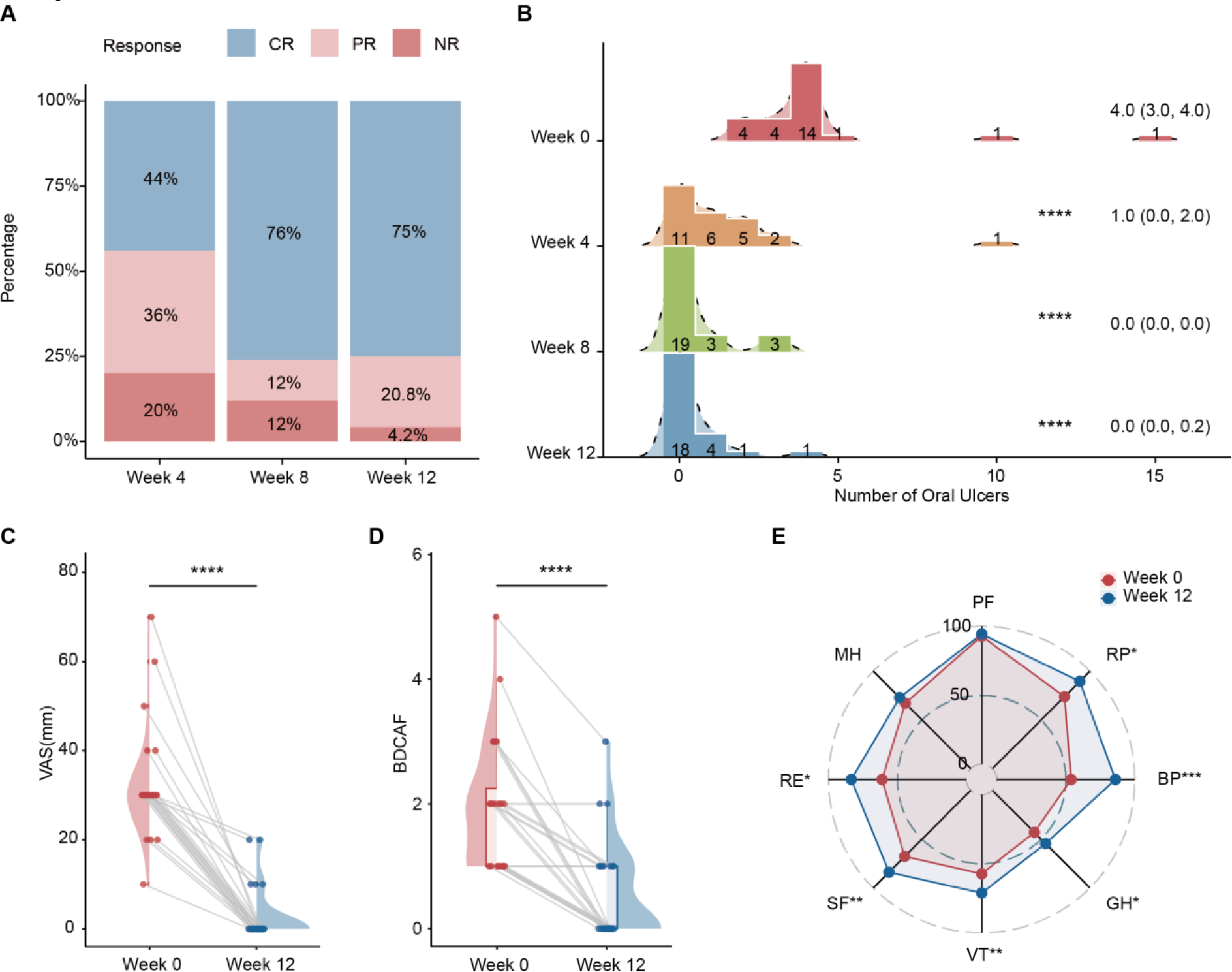
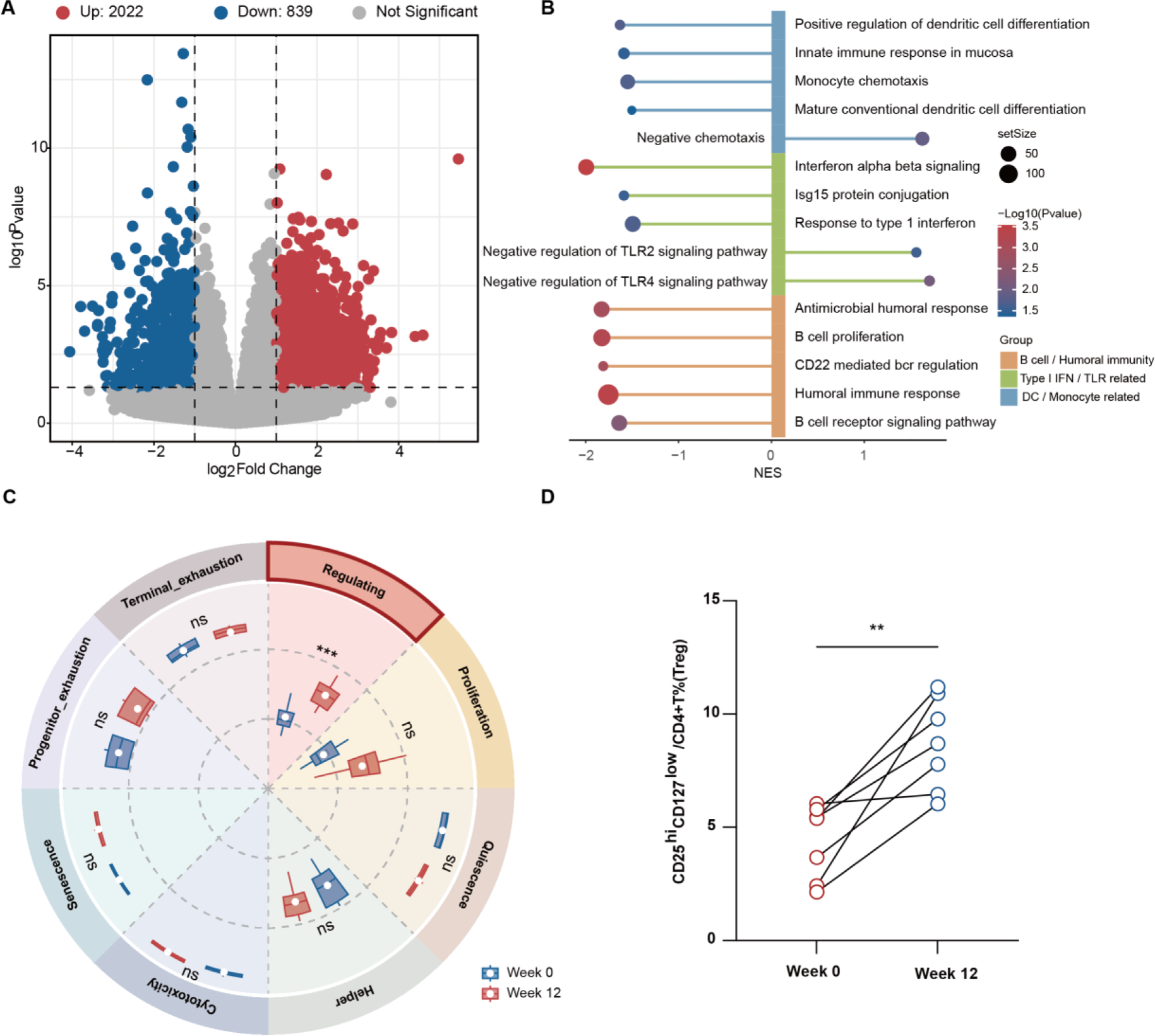
Results: In total, 27 patients with refractory mucosal BS (18 females and 9 males, mean age 37.8±9.0 years) were enrolled in this study. At baseline, all patients presented with active oral ulcers and 22.2% had genital ulcers. Three patients discontinued treatment due to adverse effects. Consequently, 24 patients completed the full 12-week treatment course. At Week 12, 23 (95.8%) patients achieved a response for OUs, including 75% CR (18/24) and 20.8% PR (5/24) (Figure 1A). Median counts of oral ulcers decreased significantly from 4.0 (IQR 3.0, 4.0) at baseline to 0.0 (IQR 0.0, 0.2) by Week 12 (p < 0.0001, Figure 1B). Of the four patients with GUs at enrollment and completed the 12-week study, three achieved CR by Week 12, while one remained refractory. Additionally, pain VAS, BDCAF, and SF-36v2 scores decreased from baseline to Week 12 (all p < 0.05, Figure 1C-1E). Lenalidomide showed a significant steroid- and immunosuppressant-sparing effect. The overall incidence of adverse events was 48.2% (13/27), most commonly rash (n = 4, 14.8%) and leukopenia (n = 4, 14.8%). Transcriptomic profiling of paired PBMC samples identified 2861 differentially expressed genes (DEGs) (Figure 2A). Gene Set Enrichment Analysis (GSEA) revealed a significant shift toward immune regulatory signatures following treatment (Figure 2B). Consistently, transcriptome-based immune profiling suggested an expansion and functional enhancement of regulatory T cells, which was further validated by flow cytometry, showing increased CD25 hi CD127 low Tregs at Week 12 (p < 0.01, Figure 2C-2D).
Conclusions: This prospective study provides the first systematic evidence that lenalidomide is both clinically effective and well tolerated in patients with refractory mucosal BS, potentially through the expansion of Tregs.
Clinical efficacy of lenalidomide in patients with refractory mucosal BS.
A Efficacy of lenalidomide in OUs manifestation. B Ridge plot for the number of OUs. C Changes in OU pain VAS. D Changes in BDCAF. F Changes in physical and mental component scores of SF-36v2.
Transcriptional profiles at Week 12 versus baseline in PBMCs from BS patients achieving CR with lenalidomide.
A Volcano plots showing DEGs between baseline and week 12. B Lollipop Diagram of selected enriched pathways modulated by lenalidomide in GSEA analysis results. C T cell state score computed using the T cell state identifier (TCellSI). D The statistical results of Treg proportion in CD4+T cell by flow cytometry.
REFERENCES: [1] Green J, Upjohn E, McCormack C, Zeldis J, Prince HM. Successful treatment of Behçet’s disease with lenalidomide. Br J Dermatol 2008;158:197–8.
[2] Ossorio-García L, Jiménez-Gallo D, de la Varga-Martínez R, Linares-Barrios M. Lenalidomide for treatment of recurrent oral aphthae in Adamantiades-Behçet’s disease. J Dtsch Dermatol Ges 2018;16:1029–31.
[3] Brazão SG, Crespo J, Carvalho A. Lenalidomide: An Alternative Treatment for Refractory Behçet’s Disease and Relapsing Polychondritis. Eur J Case Rep Intern Med 2019;6:001117.
[4] Atienza-Mateo B, Martín-Varillas JL, Graña J, Espinosa G, Moriano C, Pérez-Sandoval T, et al. Apremilast in refractory orogenital ulcers and other manifestations of Behçet’s disease. A national multicentre study of 51 cases in clinical practice. Clin Exp Rheumatol 2020;38 Suppl 127:69–75.
Acknowledgments: NIL.
Disclosure of Interests: None declared.