fetching data ... 
Background: The gut–enthesis axis is a central component of the pathophysiology of spondyloarthritis (SpA). Several IL-17A–producing lymphocyte populations are involved, notably Th17 cells, mucosal-associated invariant T (MAIT) cells, and tissue-resident memory T cells (TRM). Although their pathogenic role is well established, the temporal dynamics of their involvement during disease development remain poorly defined.
Objectives: The aim of this study was to characterize, in the SKG murine model, the comparative temporal evolution of Th17, MAIT, and TRM populations, as well as their cytokine production profiles, at different stages of SpA development across three key compartments: spleen, ileum, and synovium.
Methods: Arthritis was induced in 12-week-old SKG mice by intraperitoneal injection of curdlan. Three disease stages were analyzed (n = 6 mice/group): day 4 (D4, preclinical phase), day 11 (D11, arthritis onset), and day 21 (D21, established arthritis). Ileum, synovium from all four limbs, and spleen were harvested and dissociated by mechanical (spleen) or enzymatic digestion. Immune cell populations were analyzed by flow cytometry and defined as follows: Th17 (CD3 + CD4 + IL-17A + ), MAIT (CD3 + TCRVβ6-8 + MR1–5-OP-RU + ), and TRM (CD45 + CD3 + CD4 + or CD8 + CD69 + CD103 + ). Intracellular production of IL-17A and IFN-γ was assessed, as well as expression of the gut-homing marker integrin α4β7. Plasma levels of TNF, IL-22, IL-17A, IL-17F, IL-23, IL-33, soluble ST2 (ST2L), and zonulin were quantified at each time point by ELISA.
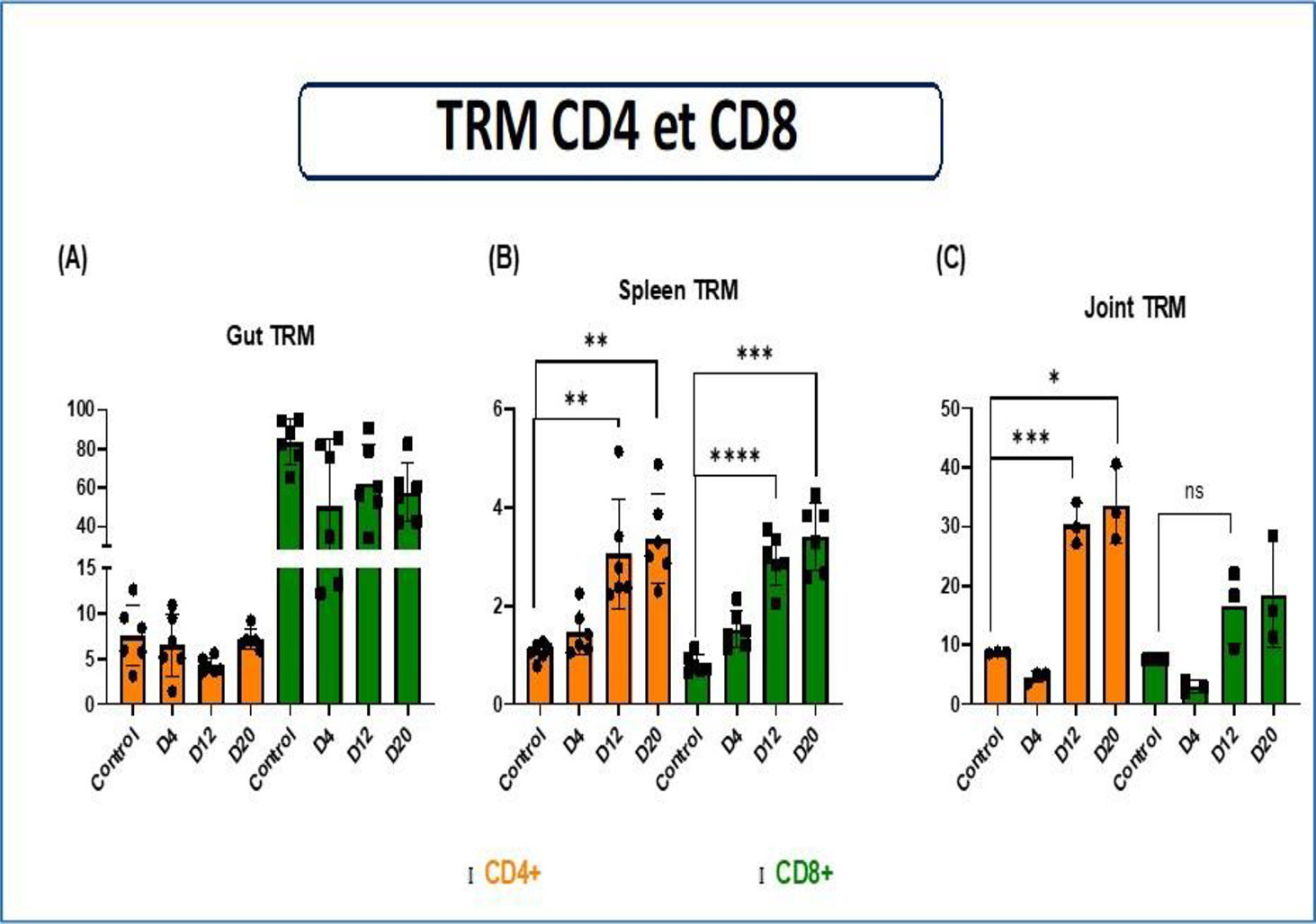
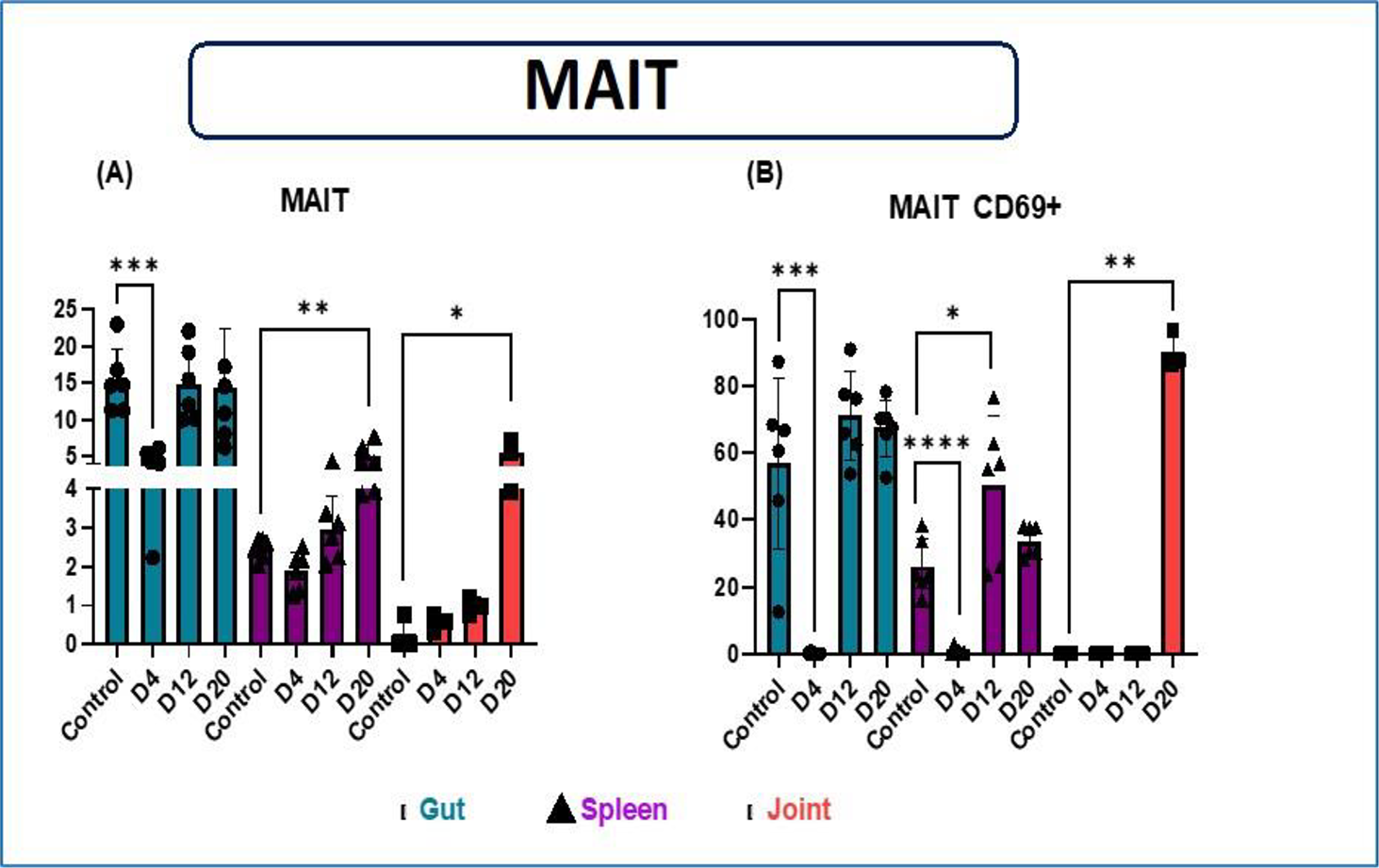
Results: At the preclinical stage (D4), a significant decrease in ileal MAIT and Th17 cells was observed (p<0.001), concomitant with an increase in highly inflammatory IL-17A + /IFN-γ + Th17 cells (p=0.05). At arthritis onset (D11), an accumulation of CD4 + and CD8 + TRM was detected in the spleen (p<0.01 and p<0.001, respectively) and in the joints (p<0.001 and trend, respectively). Synovial CD4 + TRM exhibited an IL-17 + TRM phenotype (p<0.05), whereas CD8 + TRM displayed a highly inflammatory IL-17A + /IFN-γ + profile (p<0.01). Th17 cells were also detected in the synovium and persisted during established arthritis (D21, p<0.01). At the established arthritis stage (D21), while synovial Th17 and IL-17 + TRM accumulation persisted (p<0.05), a marked emergence of IL-17A–producing MAIT cells was observed in the synovium (p<0.01), concomitant with a reduction of IFN-γ production in the ileum and spleen. Among synovial MAIT cells, approximately 20% expressed the gut-homing marker α4β7, suggesting an intestinal origin of these inflammatory cells at the established disease stage. Plasma analyses showed increased TNF, IL-17F, and IL-23 levels during the preclinical phase. During the clinical phase, IL-17F, IL-22, and IL-33 levels were increased, with a subsequent decrease in ST2L (the IL-33 receptor). At the established arthritis stage, IL-17A, IL-17F, and IL-22 levels were elevated. Zonulin levels were increased exclusively during the early phase.
Conclusions: This study is the first to dynamically characterize intestinal, splenic, and synovial IL-17–producing immune cell populations throughout arthritis development. We demonstrate that Th17 cells and TRM17 are early drivers of the immune response, whereas MAIT cells emerge at later stages, displaying a gut-homing signature in a context of increased intestinal permeability. These findings reinforce the central role of the gut–enthesis axis and suggest that MAIT cells may represent a key mediator in this process
Temporal evolution of Tissue Resident Memory T-cell populations in the gut, spleen, and synovium during arthritis development
Temporal evolution of Mucosal associated invariant T-cell populations in the gut, spleen, and synovium during arthritis development
REFERENCES: NIL.
Acknowledgments: NIL.
Disclosure of Interests: None declared.