fetching data ... 
Background: Spondyloarthritis (SpA) is a prototypic MHC class I–associated inflammatory disease driven by CD8 + T cells [1–3]. Despite their central role, it remains unclear how inflammatory cytokines are coupled to metabolic and transcriptional programs to license pathogenic CD8 + T-cell function in SpA.
Objectives: To define integrated cytokine, metabolic, and transcriptional mechanisms that license pathogenic CD8 + T-cell function in SpA.
Methods: Fresh whole blood, synovial fluids, and paired samples from treatment-naïve patients with active SpA (n=60), rheumatoid arthritis (RA; n=70), and healthy donors (n=22) were comprehensively profiled to identify cytokine, metabolic, and transcriptional programs using multicolor flow cytometry, western blotting, quantitative PCR, bulk RNA sequencing, glucose uptake assays, and functional cytokine analyses. Candidate pathways were functionally interrogated by glucose deprivation, GLUT1 inhibition, cytokine stimulation, JAK inhibition, and direct manipulation of Aiolos by siRNA-mediated knockdown and pharmacologic degradation. Joint glucose metabolism was assessed by fluorodeoxyglucose positron emission tomography–computed tomography (FDG PET–CT), and longitudinal analyses were performed in SpA patients treated with JAK inhibitors.
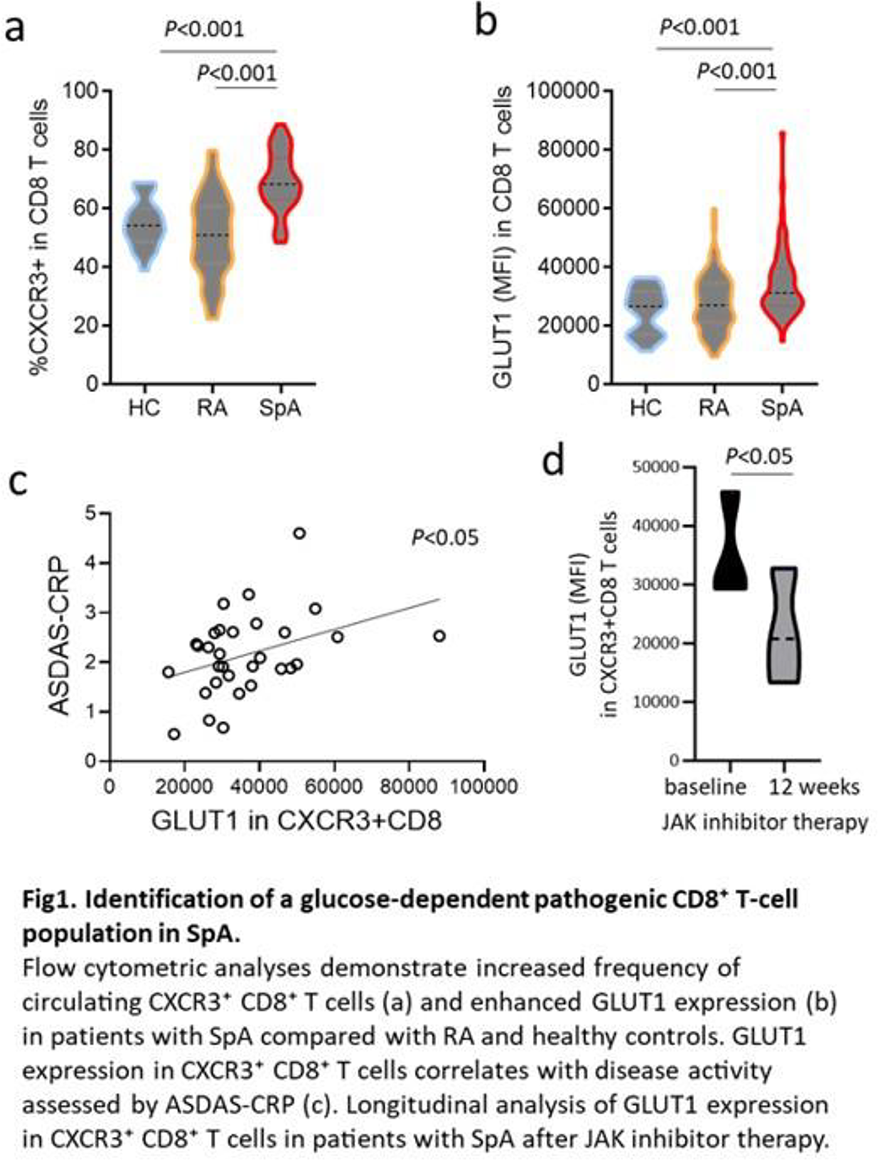
Results: We first sought to identify metabolic features that distinguish pathogenic CD8 + T cells in SpA. Among major nutrient transporters, circulating CD8 + T cells exhibited higher expression of the glucose transporter GLUT1 compared with CD4 + T cells ( P <0.0001), whereas expression of amino acid transporters (LAT1 and ASCT2) was comparable. Strikingly, within the CD8 + T-cell compartment, dependence on glucose availability was selectively confined to CXCR3 + cells. This metabolic dependency was independent of differentiation status (naïve vs memory), activation markers (CD38, HLA-DR), or exhaustion (PD-1). Consistent with this selective vulnerability, bulk RNA sequencing revealed significant enrichment of glycolytic enzyme gene expression in CXCR3 + CD8 + T cells compared with CXCR3 − cells, whereas pathways related to amino acid metabolism, oxidative phosphorylation, fatty acid metabolism, and nucleotide metabolism were not differentially regulated. Functionally, CXCR3 + CD8 + T cells produced substantially higher levels of IFN-γ and TNFα, and both glucose deprivation and pharmacologic inhibition of GLUT1 suppressed those cytokines production. We next investigated upstream signals licensing this metabolic program. Among cytokine receptors involved in T-cell homeostasis, IL-7 receptor (IL-7R) expression was specifically upregulated in CXCR3 + CD8 + T cells compared with CXCR3 − cells ( P =0.0027). IL-7 stimulation induced GLUT1 expression and glucose uptake in a dose-dependent manner through JAK–STAT5 signaling, directly linking inflammatory cytokine signaling to metabolic reprogramming in this subset. To define downstream transcriptional mechanisms, we compared key regulators of CD8 + T-cell differentiation and function. Whereas TOX, T-bet, Eomes, and Ikaros expression did not differ between CXCR3 + and CXCR3 − CD8 + T cells, expression of the transcriptional repressor Aiolos was selectively and profoundly reduced in CXCR3 + CD8 + T cells (mean 1.94% vs 9.68%, P <0.0001). Importantly, IL-7–driven glucose uptake suppressed Aiolos expression, identifying Aiolos as a glucose-sensitive transcriptional brake. Consistent with this, siRNA-mediated knockdown or pharmacologic degradation of Aiolos significantly enhanced IFN-γ and TNFα production in CXCR3 + CD8 + T cells. We then assessed disease specificity and clinical relevance. In patients with SpA—but not in RA or healthy controls—this CXCR3 + CD8 + T-cell program was selectively amplified, with increased frequency and enhanced GLUT1 expression, and correlated with disease activity as assessed by ASDAS-CRP (Figure. 1a–c). CXCL10, the ligand for CXCR3, was enriched in synovial fluid compared with paired blood samples, and CXCR3 + IL-7R + phosphorylated STAT5 + GLUT1^high Aiolos^low CD8 + T cells preferentially accumulated within inflamed joints. Reflecting this glucose-dependent immune infiltration, FDG PET–CT demonstrated intense metabolic activity at affected sacroiliac joints. Finally, longitudinal analysis demonstrated that JAK inhibitor therapy directly dismantled this pathogenic IL-7–driven metabolic and transcriptional circuit by reducing GLUT1 expression (Figure.1d), restoring Aiolos expression, and suppressing IFN-γ and TNFα production in CXCR3 + CD8 + T cells in patients with SpA, in parallel with clinical improvement.
Conclusions: This study defines a disease-specific metabolic circuit that licenses pathogenic CD8 + T-cell function in SpA. IL-7–JAK–STAT5–driven glucose uptake via GLUT1 suppresses the transcription factor Aiolos, thereby enabling inflammatory cytokine production in CXCR3 + CD8 + T cells. Enrichment of this metabolically active population within inflamed joints, its association with disease activity, and its reversibility by JAK inhibition therapy position the IL-7–glucose–Aiolos axis as a disease-defining and therapeutically actionable circuit in SpA.
REFERENCES: [1] Navid F, Chen L, Bowness P, Colbert RA. HLA-B27 and spondyloarthritis: at the crossroads of innate and adaptive immunity. Nat Rev Rheumatol. 2025;21:77-87.
[2] Qaiyum Z, Gracey E, Yao Y, Inman RD. Integrin and transcriptomic profiles identify a distinctive synovial CD8+ T cell subpopulation in spondyloarthritis. Ann Rheum Dis. 2019;78:1566-1575.
[3] Guggino G, Rizzo A, Mauro D, Macaluso F, Ciccia F. Gut-derived CD8+ tissue-resident memory T cells are expanded in the peripheral blood and synovia of SpA patients. Ann Rheum Dis. 2021;80:e174.
Acknowledgments: NIL.
Disclosure of Interests: None declared.