fetching data ... 
Background: Rheumatoid arthritis (RA) is a chronic systemic autoimmune disease hallmarked by persistent synovitis and progressive joint destruction. Fibroblast-like synoviocytes (FLS) have emerged as key effector cells in the pathogenesis of joint damage, exhibiting a transformed, aggressive phenotype that drives synovial hyperplasia, cartilage invasion, and the secretion of pro-inflammatory mediators. The RA joint is characterized by a pathologically altered mechanical microenvironment, which is known to exacerbate structural damage. While mechanosensitive ion channels are the primary transducers of these physical signals, the specific role of aberrant mechanosensing in driving the pathogenic behavior of RA-FLS and subsequent bone erosion remains to be elucidated.
Objectives: This study aimed to: (1) characterize the specific expression pattern of the mechanosensitive ion channel Piezo2 in RA-FLS; (2) evaluate its clinical correlation with radiographic joint destruction and disease activity in patients with RA; and (3) systematically elucidate the molecular mechanism by which Piezo2 regulates FLS-mediated synovial invasion and osteoclast activation. Ultimately, we sought to identify a novel mechano-immunological target to arrest bone erosion in RA.
Methods: We screened for RA synovium-specific mechanosensitive proteins using single-cell RNA sequencing (scRNA-seq) datasets. The expression of Piezo2 was validated in human synovial tissues, and its correlation with clinical parameters (Sharp scores, DAS28-CRP) was analyzed. To evaluate therapeutic potential in vivo, we employed a collagen-induced arthritis (CIA) mouse model and administered adeno-associated virus (AAV)-shPiezo2 via intra-articular injection to silence Piezo2 locally. Joint inflammation and structural integrity were assessed via histology and micro-CT. Mechanistic studies were conducted using stiffness-tunable GelMA 3D hydrogels to recapitulate the pathological mechanical milieu of the RA joint. We utilized FLS-osteoclast co-culture systems and siRNA-mediated knockdown to interrogate the downstream signaling pathways governing osteoclastogenesis.
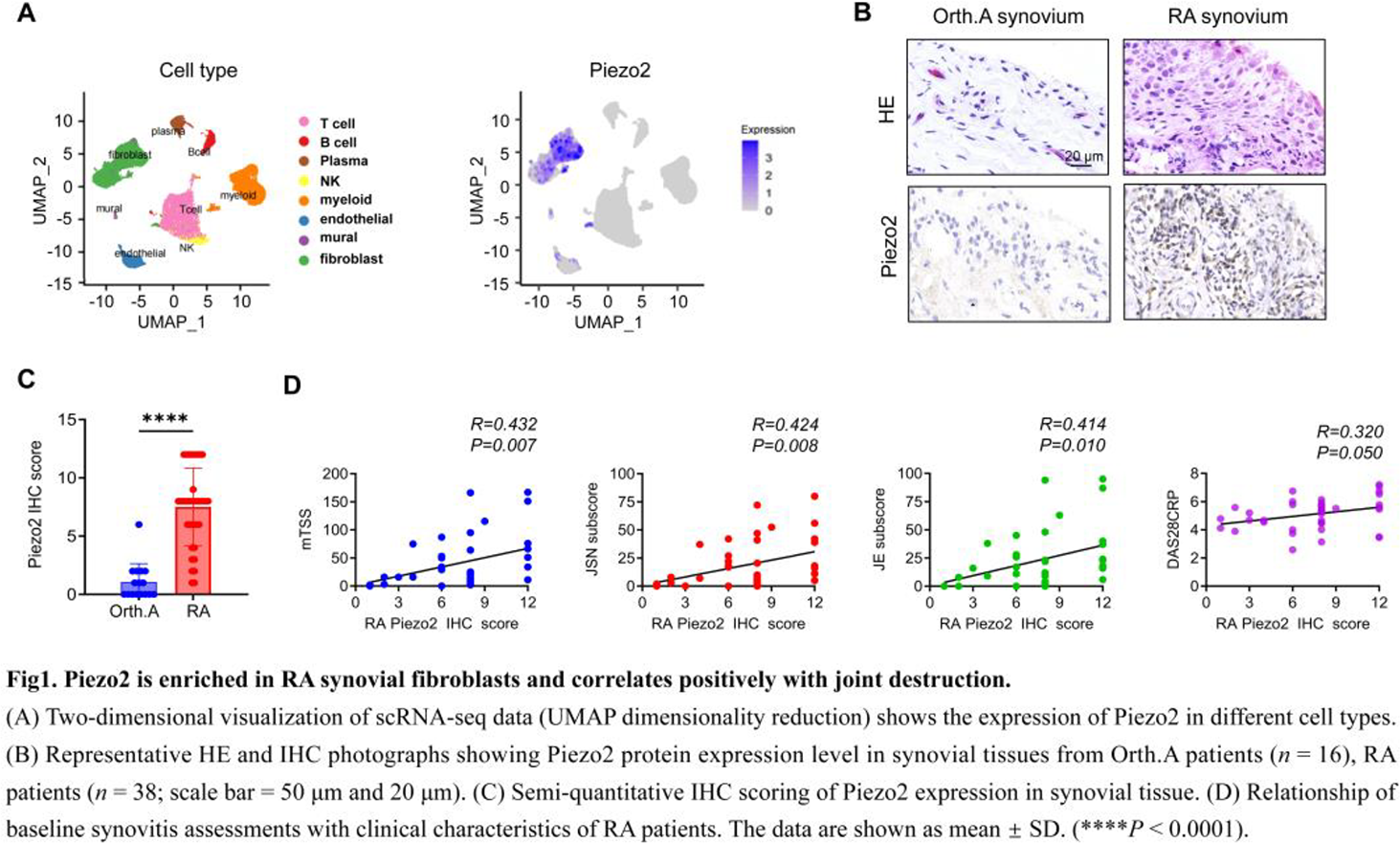
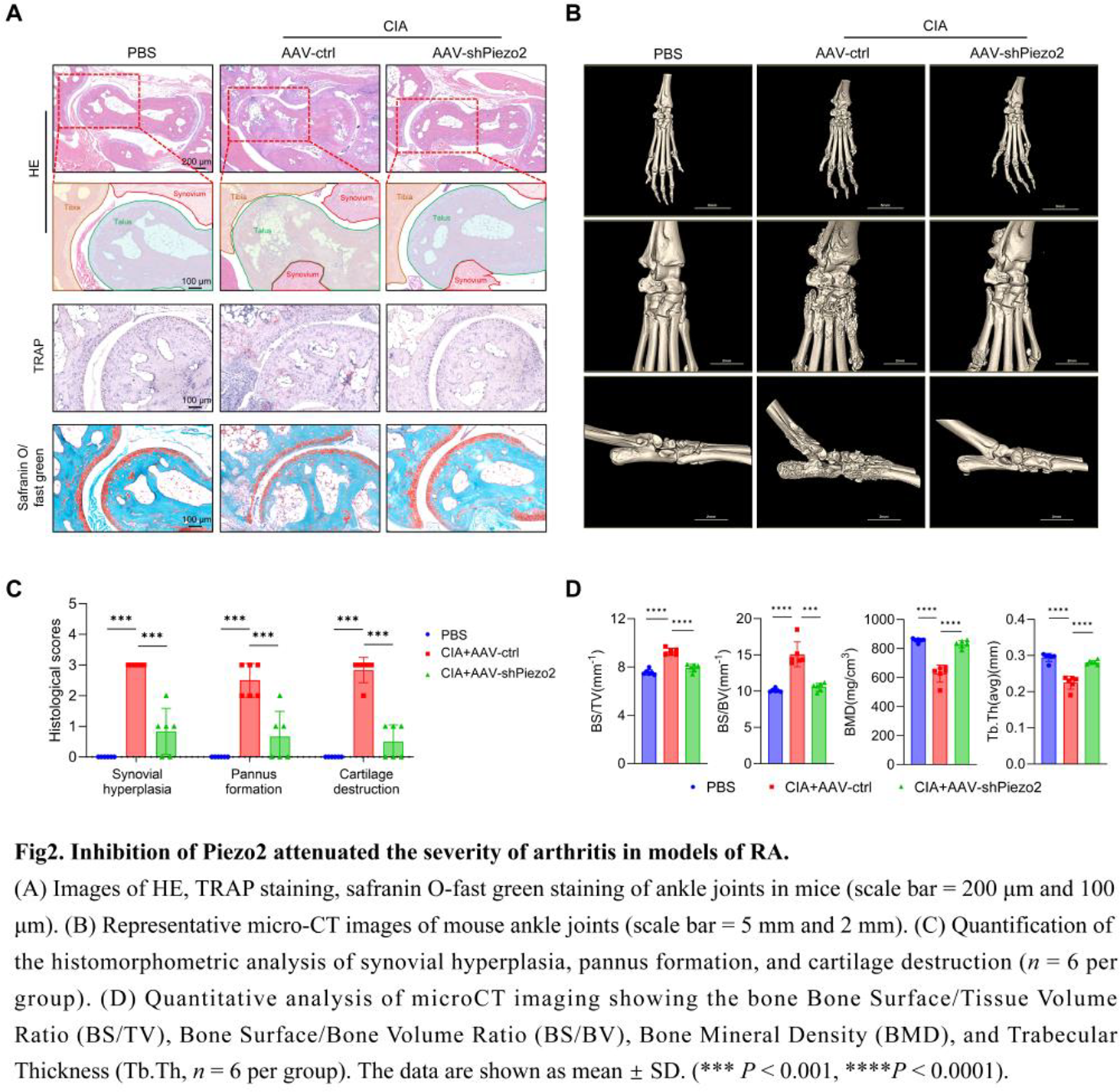
Results: We identified that Piezo2 was specifically overexpressed in RA-FLS, which was significantly higher than that in osteoarthritis (OA) and non-inflammatory orthopedic arthropathies (Orth.A)synovial tissues. Crucially, Spearman correlation analysis revealed a significant positive association between synovial Piezo2 levels and key indicators of joint destruction, including the modified total Sharp score ( r = 0.432), joint narrowing score ( r = 0.424), joint erosion score ( r = 0.414), as well as disease activity (DAS28-CRP, r = 0.320, Figure 1). Intra-articular delivery of AAV-shPiezo2 significantly ameliorated arthritis severity in CIA mice. Compared to controls, Piezo2-silenced mice exhibited reduced paw swelling, lower arthritis scores, and preserved body weight. Histological assessment (H&E, Safranin O, TRAP) confirmed that Piezo2 knockdown preserved articular architecture, attenuated inflammatory infiltration, and abrogated cartilage/bone destruction. Micro-CT analysis further demonstrated that Piezo2 silencing prevented bone loss, characterized by decreased Bone Surface/Tissue Volume Ratio(BS/TV) and Bone Surface/Bone Volume Ratio (BS/BV), as well as preserved Bone Mineral Density (BMD) and Trabecular Thickness (Tb.Th, Figure 2). To recapitulate the mechanical microenvironment of RA joints, we performed in vitro experiments by culturing FLS in 3D GelMA hydrogels mimicking pathological stiffness. The results showed that compared with the control group, Piezo2 knockdown significantly reduced the migration and invasion abilities of RA-FLS. Osteoclast-fibroblastcrosstalk assays demonstrated that Piezo2 silencing significantly decreased the secretion levels of chemokines CCL2 and CXCL12, affecting osteoclast recruitment, and inhibited osteoclast differentiation and activation by reducing the secretion of receptor activator of NF-κB ligand (RANKL). At the molecular level, we uncovered a novel regulatory mechanism: Piezo2 deficiency did not alter total RANKL protein or mRNA abundance but significantly downregulated Rab11FIP1. This downregulation disrupted Rab11 + vesicle-mediated trafficking, leading to the intracellular retention of RANKL and a marked reduction in its extracellular secretion.
Conclusions: Our findings reveal the critical role of Piezo2 in RA-FLS in promoting synovial invasion and osteoclastogensis in RA. From a mechano-immunological perspective, we elucidates a novel mechanism wherein mechanical signaling governs the secretory trafficking of RANKL. Targeting Piezo2 offers a promising therapeutic strategy to uncouple mechanical force from joint destruction, potentially providing structural protection for RA patients.
REFERENCES: NIL.
Acknowledgments: NIL.
Disclosure of Interests: None declared.