fetching data ... 
Background: HLA polymorphism is known as the major genetic risk factor in rheumatoid arthritis (RA). Nevertheless, the immunopathology underlying the contribution of HLA in disease development remains largely unclear. Analyzing T cell receptor (TCR), the direct interacting molecule with HLA, offers a promising avenue for elucidating the pathogenesis and developing novel biomarkers. However, HLA polymorphism also represents a major obstacle to identifying reliable disease-associated clonotypes because HLA is highly diverse across individuals and restricts TCR patterns, serving as a confounding factor in case-control TCR repertoire study.
Objectives: We aimed to identify RA-associated clonotypes while controlling for the impact of HLA polymorphism by population-scale TCR sequencing.
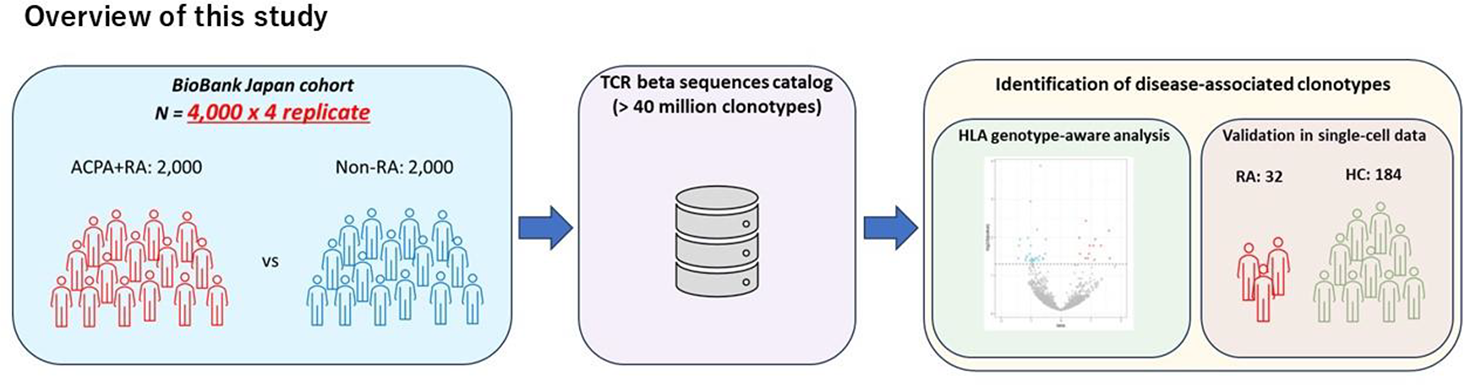
Methods: Bulk TCR-seq was performed on whole blood-derived genome DNA from 2,000 anti-citrullinated protein antibody (ACPA)-positive RA and 2,000 age- and sex-matched controls stored in BioBank Japan to build a TCR beta sequences catalog of RA (Figure 1). We prepared four technical replicates per sample (a total of 16,000 libraries). HLA genotypes were inferred by HLA imputation. We performed the sub-cohort analysis in HLA-DRB1*04:05-positive donors (N = 1,365). We generated single-cell TCR repertoire data of peripheral blood mononuclear cells from independent RA (N = 32) and healthy control (N = 184) donors. We validated the identified RA-associated clonotypes and recovered the paired alpha chain sequences using single-cell TCR repertoire data.
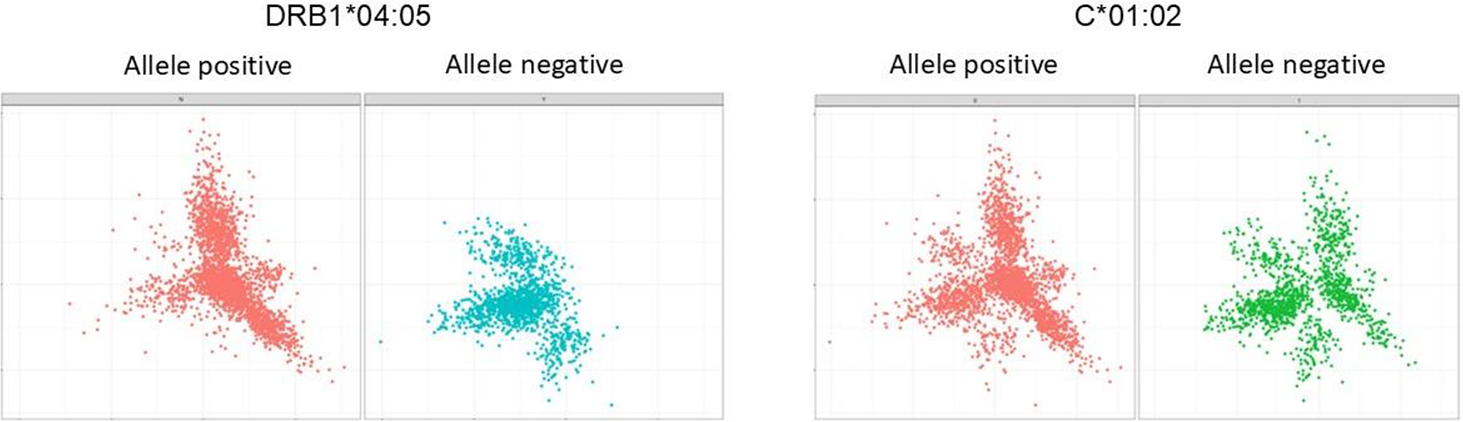
Results: We obtained over 40 million unique TCR clonotypes, the world’s largest TCR data in RA. Leveraging the strength of our large sample size, we investigated the global landscape for the effect of HLA genotype on the sharing of clonotypes among donors. HLA-DRB1*04:05 allele, the strongest RA risk factor, clearly stratified clonotype-sharing patterns among donors, whereas class I alleles did not show an obvious effect on these sharing patterns (Figure 2). Therefore, we subsequently performed a sub-cohort analysis restricted to HLA-DRB1*04:05-positive donors. We identified 13 RA-associated clonotypes (FDR < 0.05) using a Poisson model that incorporates a conservative clonal expansion index based on the number of occurrences across replicates. We finally searched for the TRBV sequences of these RA-associated clonotypes in an independent validation single-cell TCR repertoire dataset and successfully captured 3 out of 13 RA-associated clonotypes. Taking one clonotype as a specific example, it was observed in 3 out of 32 patients in RA, but only in 1 out of 184 individuals in healthy control.
Conclusions: Our large-scale TCR data enable HLA genotype-aware TCR analysis to tackle the common limitation of TCR analysis hindered by HLA polymorphism as a confounding factor. Combining HLA genotype-aware TCR analysis and subsequent validation by single-cell data provides reliable RA-associated clonotypes, which serve as candidates for further antigen-specific functional experiments. The framework of our study would be effective for elucidating antigen-specific pathology of autoimmune diseases.
Overview of this study
The landscape of clonotype-sharing patterns
REFERENCES: NIL.
Acknowledgments: NIL.
Disclosure of Interests: None declared.