fetching data ... 
Background: Behçet’s Disease (BD) is a chronic systemic vasculitis of unknown etiology, characterized by aberrant immune activation. Regulatory T cells (Tregs) play a crucial role in maintaining immune tolerance, and their reduction is considered pivotal in BD pathogenesis [1-2], although the underlying mechanisms remain unclear.
Objectives: We analyzed Treg frequencies in BD and evaluated their correlation with disease activity, inflammatory markers, disease severity, and organ involvement. We also explored the molecular mechanisms underlying impaired Treg differentiation.
Methods: Circulating Tregs (CD4 + CD25 + FOXP3 + ) in PBMCs from BD patients (N=111) and healthy controls (HC) (N=46) were analyzed by flow cytometry. Six pairs of naïve CD4 + T cells from treatment-naïve BD patients and matched HCs for transcriptomic profiling using microarrays. The key transcription factor, Nuclear Receptor Subfamily 2, Group C, Member 1 (NR2C1), was validated using qRT-PCR and flow cytometry. NR2C1 was silenced or overexpressed in naïve CD4 + T cells cultured under Treg-polarizing conditions to assess its role in Treg differentiation.
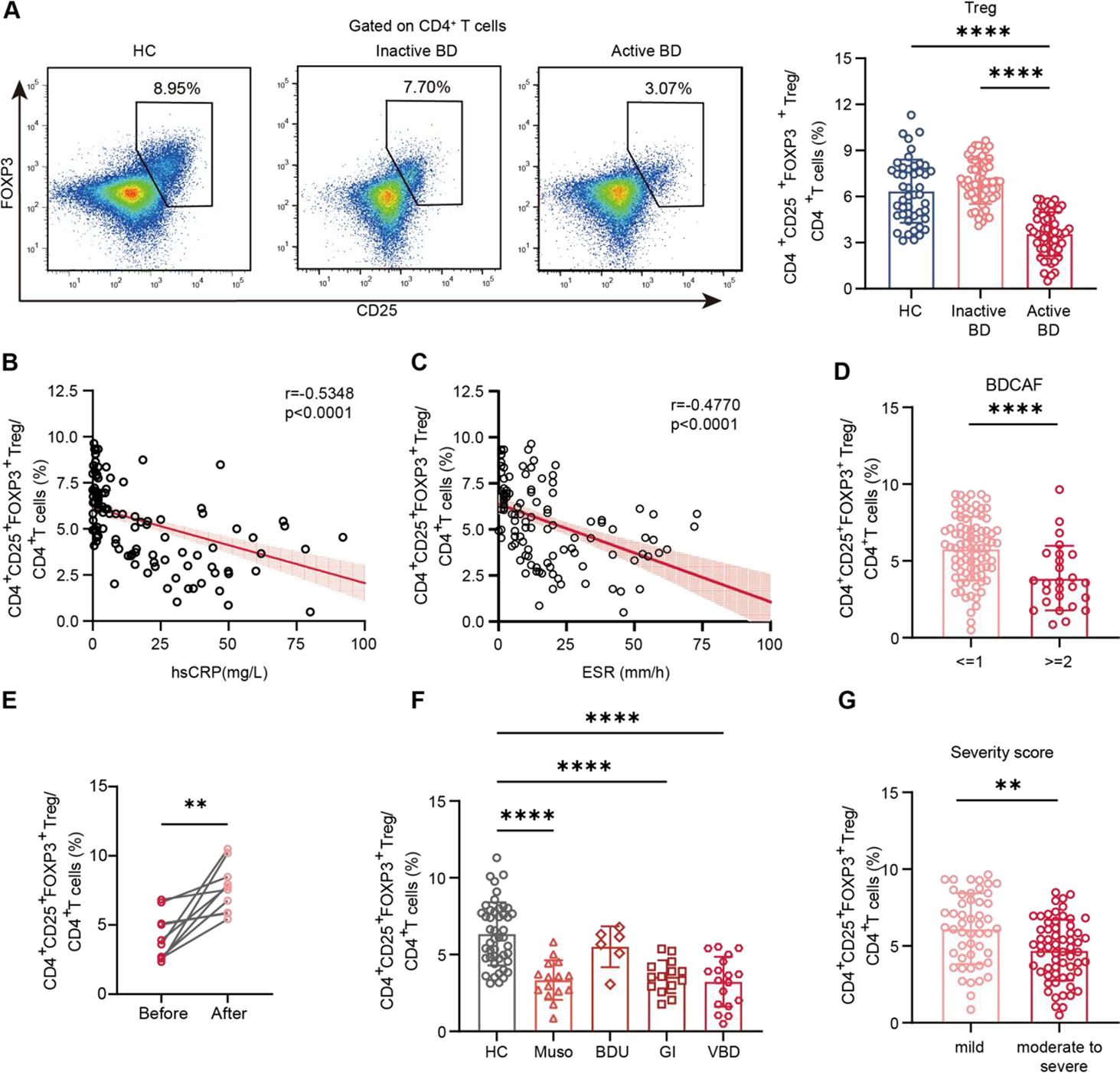
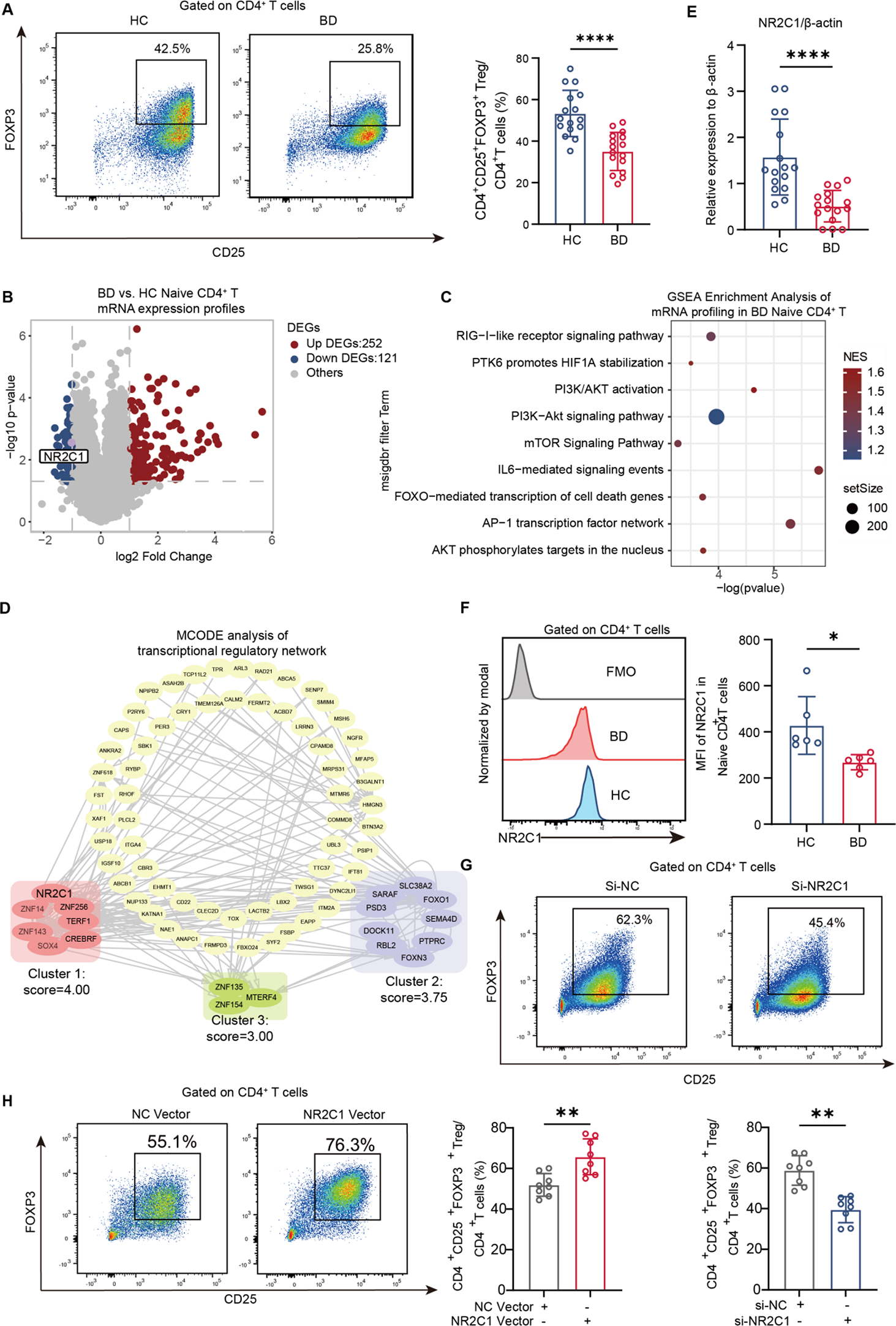
Results: Circulating Tregs were significantly reduced in active BD compared to inactive BD and HC ( p < 0.0001 vs. both inactive BD and HC), and were negatively correlated with hsCRP and ESR levels (Figure. 1B-C, p < 0.0001). Treg frequencies were markedly lower in patients with high disease activity (BDCAF≥2) than in those with low disease activity (BDCAF ≤ 1, p < 0.001, Figure. 1D), and increased dramatically after remission ( p < 0.01, Figure. 1E). Moreover, Treg frequencies were reduced in active BD patients with mucocutaneous, gastrointestinal, and vascular involvement compared with HC ( p < 0.001, Figure. 1F), as well as in moderate-to-severe BD patients, as measured by the BD Disease Severity Score [3] ( p < 0.01, Figure. 1G). To explore the mechanism underlying reduced Treg frequencies in BD, we examined Treg differentiation in BD and HC naïve CD4 + T cells, which showed an impaired Treg differentiation in BD naïve CD4 + T cells than HC cells ( p < 0.001, Figure. 2A). Transcriptomic profiling of naïve CD4 + T cells from BD patients and HCs (N = 6) using human mRNA microarrays identified 373 differentially expressed genes (DEGs), including 252 upregulated and 121 downregulated mRNAs (Figure. 2B). Gene Set Enrichment Analysis (GSEA) showed that Treg differentiation-related inhibitory pathways, such as the PI3K-AKT pathway, were activated (Figure. 2C), suggesting that BD naïve CD4 + T cells were suppressed in Treg differentiation. Notably, NR2C1 was included in the top-scoring module 1 (score = 4.000) in a transcriptional regulatory network analysis using MCODE (Figure. 2D). NR2C1 expression was confirmed to be downregulated at both the mRNA ( p < 0.0001) and protein ( p < 0.05) levels in an independent cohort (Figure. 2E-F). Furthermore, silencing and overexpressing NR2C1 significantly inhibited and enhanced Treg differentiation, respectively (Figure. 2G-H).
Conclusions: We conducted the largest cohort analysis of Tregs in BD to date and confirmed a significant decrease in circulating Tregs that negatively correlates with BD activity and severity. This is the first time to elucidate the mechanism underlying Treg reduction in BD from the perspective of naïve CD4 + T cell differentiation, and focus on the transcription factor NR2C1, demonstrating that its downregulation in naïve CD4 + T cells contributes to impaired Treg differentiation, revealing a novel mechanism in BD immunopathogenesis.
Treg reduction in active BD patients.
( A ) The frequencies of peripheral CD4 + CD25 + FOXP3 + Treg in active BD (N = 53), inactive BD (N = 58), and HC (N = 46). ( B-C ) Pearson correlation analysis of the frequencies of Treg in BD patients with hsCRP and ESR levels (N = 111). ( D ) The frequencies of Treg in BD patients stratified by Behçet’s Disease Current Activity Form(BDCAF) scores (<=1: N = 85; >=2: N = 26). ( E ) The frequencies of Treg in BD patients at baseline and in remission (N = 10). ( F ) The frequencies of Treg in active mucocutaneous BD (N = 15), BD uveitis (BDU) (N = 6), gastrointestinal BD (N = 14), vascular BD (VBD) (N = 18) and HC (N = 46). ( G ) The frequencies of Treg in mild (N = 49) and moderate-severe (N = 62) BD patients. Statistical significance was determined using One-way ANOVA, independent samples t-tests, or paired t-tests. * p < 0.05, ** p < 0.01, *** p < 0.001, **** p < 0.0001.
Dowregulated NR2C1 inhibits Treg differentiation in BD naïve CD4 + T Cells
( A )The frequencies of CD4 + CD25 + FOXP3 + Treg (N = 16) differentiated from BD and HC naïve CD4 + T cells under Treg conditions. ( B ) Volcano plot of differentially expressed genes between BD and HC naïve CD4 + T cells (N = 6). ( C ) GSEA of transcriptional profiles in BD naïve CD4 + T cells. ( D ) Regulatory network analysis of transcription factors. ( E-F ) NR2C1 expression in BD and HC naïve CD4 + T cells was assessed by qRT-PCR (N = 16, E ) and flow (N = 6, F ). ( G-H ) The frequencies of Treg in CD4 + T cells differentiated from HC naïve CD4 + T cells transfected with NR2C1 siRNA (N=8), NR2C1-expressing plasmid (N=8) or negative control under Treg conditions. Data were analyzed using independent samples t-tests or paired t-tests. * p < 0.05, *** p < 0.001, **** p < 0.0001. NR2C1, Nuclear Receptor Subfamily 2 Group C Member 1
REFERENCES: [1] Ahmadi M, Yousefi M, Abbaspour-Aghdam S, et al. Disturbed Th17/Treg balance, cytokines, and miRNAs in peripheral blood of patients with Behcet’s disease. J Cell Physiol. 2019;234(4):3985-3994.
[2] Gündüz E, Teke HU, Bilge NS, et al. Regulatory T cells in Behçet’s disease: is there a correlation with disease activity? Does regulatory T cell type matter?. Rheumatol Int. 2013;33(12):3049-3054.
[3] Krause I, Mader R, Sulkes J, et al. Behçet’s disease in Israel: the influence of ethnic origin on disease expression and severity. J Rheumatol. 2001;28(5):1033-1036.
Acknowledgments: NIL.
Disclosure of Interests: None declared.