fetching data ... 
Background: Immunoglobulin A vasculitis (IgAV) is an inflammatory small-vessel vasculitis characterised by the deposition of immune complexes containing abnormally glycosylated, galactose-deficient IgA1 [1]. Despite well-defined clinical manifestations, the molecular mechanisms driving disease onset and progression remain poorly understood. Current diagnosis often relies on invasive tissue biopsies, highlighting the need for molecular biomarkers to support non-invasive approaches. Although B cells are central to IgA biology, their role in IgAV pathogenesis—particularly in the regulation of IgA glycosylation—remains unclear [2,3]. Here, we present the first single-cell RNA sequencing analysis of peripheral B cells in IgAV.
Objectives: The aim of this work is to investigate the involvement of distinct B-cell populations in IgA vasculitis and uncover transcriptional signatures associated with aberrant IgA glycosylation at the single-cell level.
Methods: Twelve IgAV patients in the acute disease phase and twelve matched healthy controls were recruited. Peripheral CD19 + B cells were isolated from PBMCs using MACS® and analysed by single-cell RNA sequencing using the 10x Genomics platform. Data were processed with Cell Ranger and analysed in Seurat, including quality filtering, dimensionality reduction and clustering. B-cell subsets were annotated using canonical markers. Differences in subtype proportions were assessed per sample. Differential abundance analysis was performed using Milo, and differential gene expression was assessed using the Wilcoxon rank-sum test.
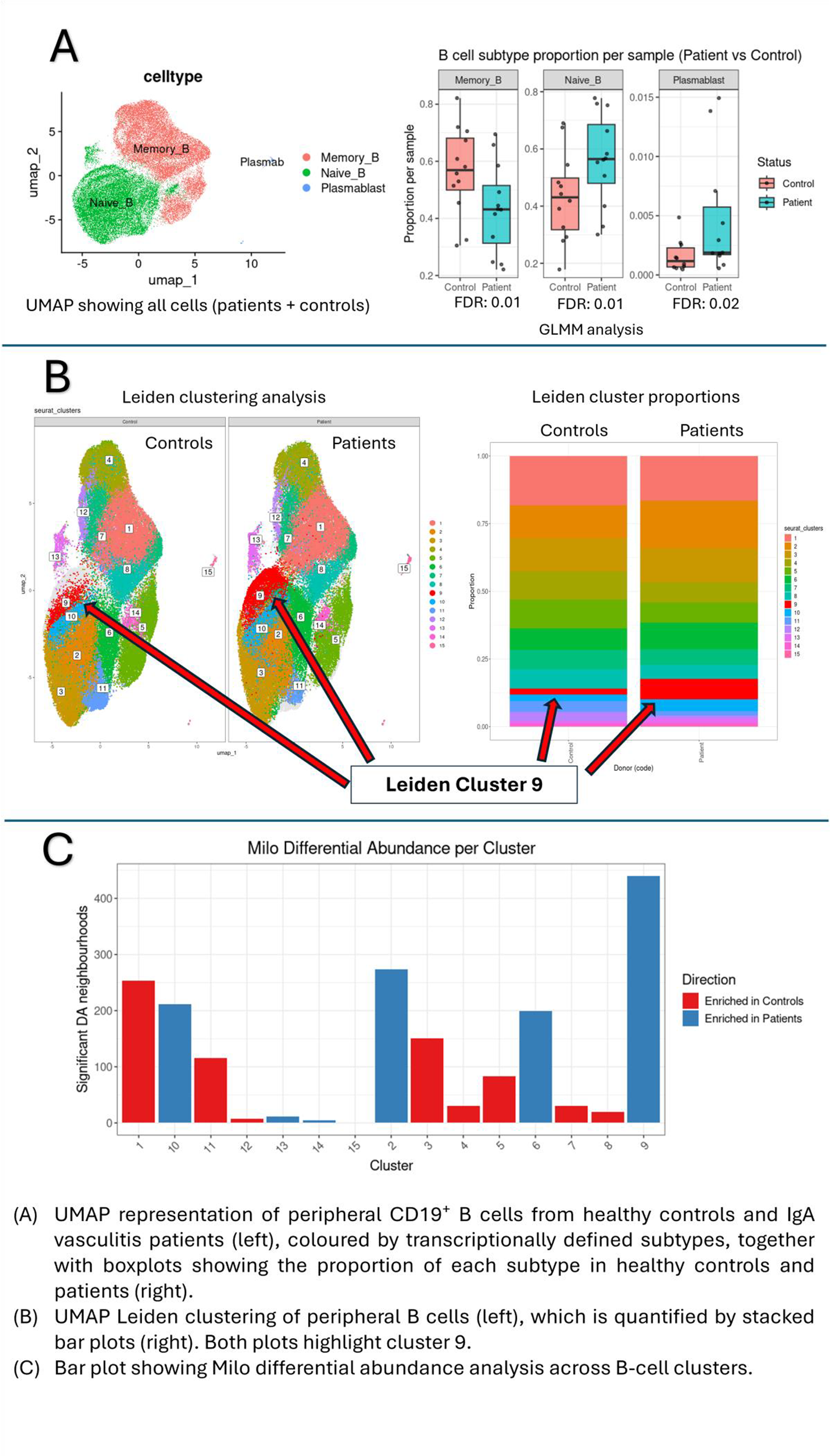
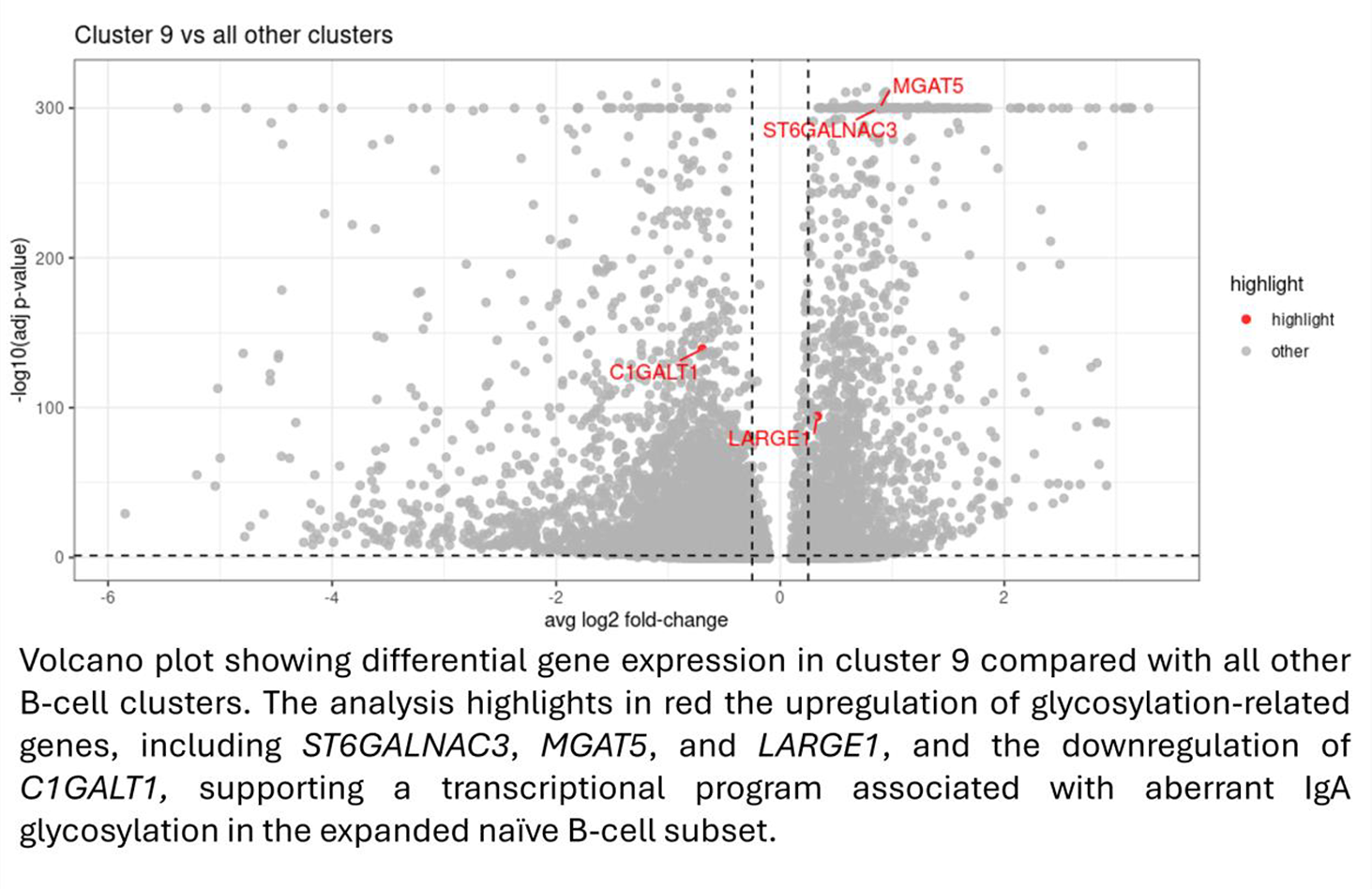
Results: IgAV patients showed a significant redistribution of B-cell subsets. These patients exhibited a higher proportion of naïve B cells than healthy controls (p < 2.2×10 −16 ) (Figure. 1A). Cluster-based single-cell analysis identified cluster 9, corresponding to a naïve B-cell subset, as the most overrepresented cluster in patients (Figure. 1B). Consistent with the preceding cluster analysis, Milo differential abundance testing confirmed a non-uniform redistribution of B-cell populations in IgA vasculitis, with cluster 9 showing the strongest enrichment in patients (Figure. 1C). Building on the selective expansion of cluster 9, differential gene expression analysis revealed the selective overexpression of genes encoding glycosyltransferases involved in O- and N-linked glycan biosynthesis (average log 2 fold change > 0.5, adjusted p < 0.001) (Figure. 2). These glycosyltransferase genes are associated with glycosylation processes directly linked to IgA glycosylation, like GCNT1 , ST6GALNAC3, MGAT5 , and LARGE1 . Notably, ST6GALNAC3 , which encodes a sialyltransferase regulating terminal O-glycan modification and previously linked to gd-IgA1, showed one of the strongest expression differences (log 2 fold change =1.9), highlighting its potential relevance to IgA-associated glycan changes observed in IgAV.
Conclusions: The enrichment of glycosyltransferase-expressing naïve B cells in IgAV suggests early molecular priming toward aberrant IgA glycosylation, providing a mechanistic link between B-cell heterogeneity and disease-specific antibody dysfunction, and supporting the potential of early B-cell alterations as biomarkers or therapeutic targets in IgAV.
Single-cell mapping, clustering, and differential abundance analysis of B cells in IgA vasculitis
Differential gene expression analysis of the overrepresented naïve B-cell cluster in IgA vasculitis. Volcano plot showing differential gene expression in cluster 9 compared with all other B-cell clusters.
Acknowledgements: NIL
Funding: This research was funded by European Union FEDER funds and “Fondo de Investigaciones Sanitarias” from “Instituto de Salud Carlos III” (ISCIII, Health Ministry, Spain), grant number PI21/00042 and PI24/00382. JCBL is a recipient of a PFIS program fellowship from the ISCIII, co-funded by the European Social Fund (`Investing in your future´), grant number FI22/00020; and a M-AES mobility grant (MV24/00004).
REFERENCES: [1] Arthritis Rheum. 2013 Jan;65(1):1–11.
[2] Front Immunol. 2022 Oct 3;13:921864.
[3] Semin Nephrol. 2024 Sep;44(5):151571.
Disclosure of Interests: Joao Carlos Batista-Liz: None declared, María Sebastián Mora-Gil: None declared, Evan Troendle: None declared, Oisin Cappa: None declared, María Teresa Leonardo Cabello: None declared, Ana Cristina Peñalba Citores: None declared, Luis Martín-Penagos: None declared, Ligia Gabrie: None declared, Rafael Gálvez-Sánchez: None declared, José Luis Callejas: None declared, Diego de Argila: None declared, Esther Vicente-Rabaneda: None declared, Santos Castañeda: None declared, David Simpson: None declared, Ricardo Blanco Abbvie, Pfizer, Roche, Bristol-Myers, Lilly, Janssen, and MSD, Abbvie, MSD, and Roche, Verónica Pulito-Cueto: None declared, Raquel López-Mejías: None declared.