fetching data ... 
Background: Patients with gout are at increased risk for accelerated kidney damage. Whether sodium-glucose cotransporter-2 inhibitors (SGLT2i) can slow kidney disease progression in patients with gout remains unknown.
Objectives: To evaluate the association between SGLT2i use and kidney impairment risk among patients with gout and type 2 diabetes.
Methods: This population-based cohort study utilized data from the IQVIA Medical Research Database (2013–2023). Patients aged 18–90 years who had diagnoses of both gout and type 2 diabetes and initiated treatment with either SGLT2i or dipeptidyl peptidase-4 inhibitors (DPP-4i) were included. Kidney impairment was defined as incident chronic kidney disease (CKD) among participants without baseline CKD, or progression to CKD stage ≥4 among those with baseline CKD stages 1–3. Baseline covariates included sociodemographic characteristics (age, sex, and index of multiple deprivation), BMI, lifestyle factors (smoking status and alcohol drinking status), laboratory measures (serum urate level, glycosylated hemoglobin A1C, and estimated glomerular filtration rate), CKD status, comorbidities, medication use, and healthcare utilization. Associations were evaluated using a Cox proportional hazards model with propensity score overlap weighting. Two sensitivity analyses were conducted to assess the robustness of findings: (1) restricting the analysis to participants aged over 40 years, and (2) evaluating the association between SGLT2i use and CKD progression among participants with mild and moderate CKD at baseline.
Results: Incidence of kidney impairment was significantly lower among 1,597 SGLT2i initiators compared with 1,852 DPP-4i initiators (6.4 versus 14.3 events per 1000 person-years) (Figure 1A), yielding a weighted rate difference (95% confidence interval [95% CI]) of -7.9 (-11.6 to -4.2) per 1,000 person-years and a weighted hazard ratio (HR) of 0.45 (0.24 to 0.86) (Table 1). Consistent findings were observed among participants ≥40 years (HR = 0.44, 0.24 to 0.84) (Table 1) and those with baseline CKD stages 1–3 (HR = 0.41, 0.20 to 0.86) (Figure 1B, Table 1).
Conclusions: SGLT2i initiation was associated with a significantly lower risk of kidney impairment compared with DPP-4i in patients with gout and type 2 diabetes, highlighting its potential renoprotective benefits in this high-risk population.
Cumulative incidence of kidney impairment among (A) participants with gout and type 2 diabetes, and (B) participants with gout, type 2 diabetes and mild or moderate CKD, after initiation of either SGLT2i or DPP-4i.
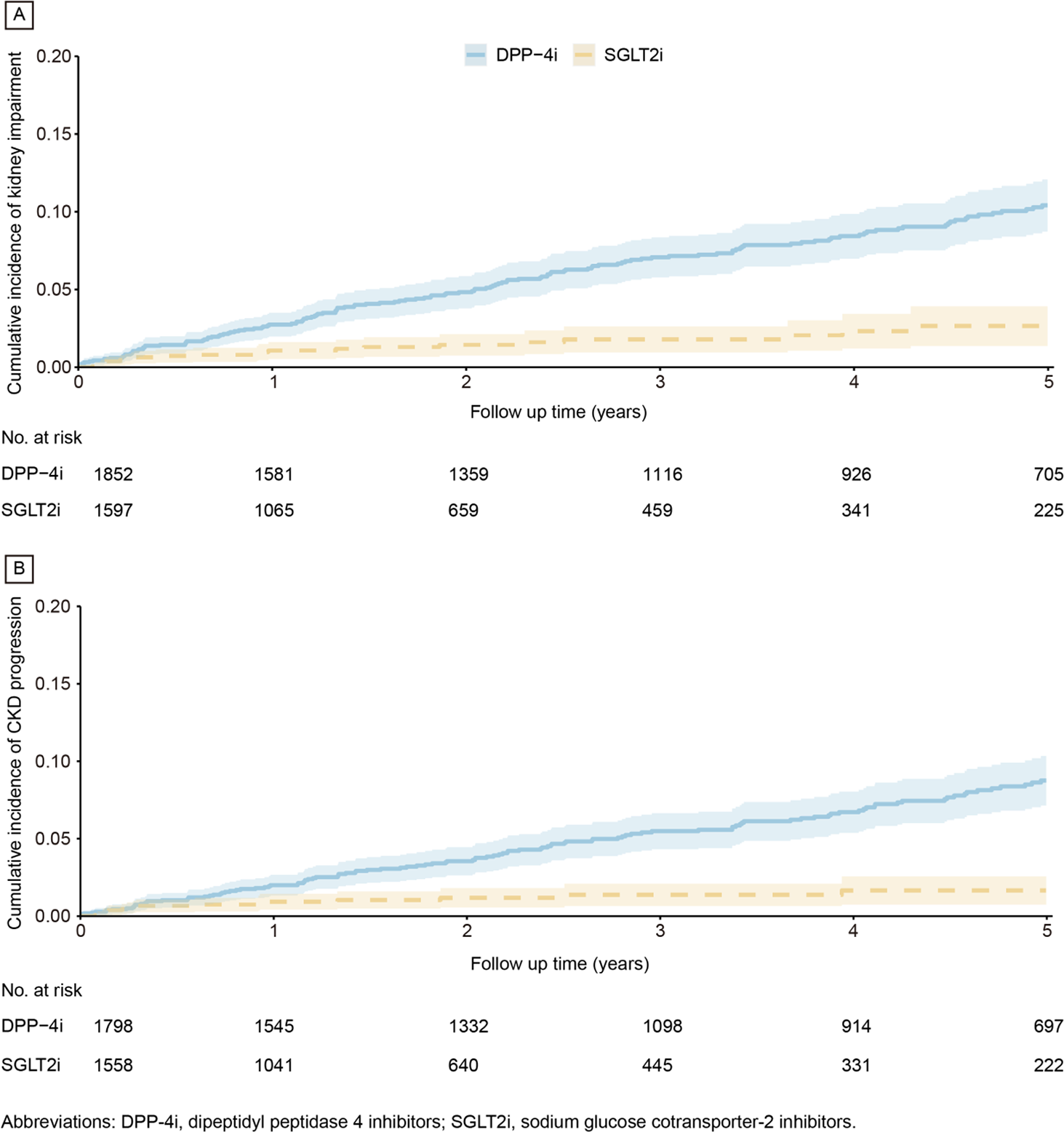
Kidney impairment among participants with gout and type 2 diabetes initiating SGLT2i compared with initiation of DPP-4i
| All participants | SGLT2i (n = 1,597) | DPP-4i (n = 1,852) |
|---|---|---|
| Events, No. | 23 | 143 |
| Weighted mean follow-up, years | 2.79 | 2.74 |
| Weighted rate of event, per 1000 person-years | 6.4 | 14.3 |
| Weighted RD (95% CI), per 1000 person-years | -7.9 (-11.6 to -4.2) | 0.0 (reference) |
| Weighted HR (95% CI) | 0.45 (0.24 to 0.86) | 1.00 (reference) |
| Aged ≥ 40 years weighted HR (95% CI) | 0.44 (0.24 to 0.84) | 1.00 (reference) |
| Participants with mild or moderate CKD at baseline | SGLT2i (n = 1,558 ) | DPP-4i (n = 1,798 ) |
| Events, No. | 17 | 113 |
| Weighted mean follow-up, years | 2.77 | 2.73 |
| Weighted rate of event, per 1000 person-years | 5.0 | 12.3 |
| Weighted RD (95% CI), per 1000 person-years | -7.3 (-10.7 to -3.9) | 0.0 (reference) |
| Weighted HR (95% CI) | 0.41 (0.20 to 0.86) | 1.00 (reference) |
| Aged ≥ 40 years weighted HR (95% CI) | 0.42 (0.20 to 0.87) | 1.00 (reference) |
Abbreviations: CKD, chronic kidney disease; DPP-4i, dipeptidyl peptidase 4 inhibitors; HR, hazard ratio; RD, rate difference; SGLT2i, sodium glucose cotransporter-2; 95% CI, 95% confidence interval.
REFERENCES: NIL.
Acknowledgments: NIL.
Disclosure of Interests: Ziying Wu: None declared, Xiaoxiao Li: None declared, Nicola Dalbeth Dr. Dalbeth has received consulting fees, speaker fees or grants from Novartis, Horizon, Selecta, Arthrosi, LG Chem, JPI, PTC Therapeutics, Protalix, Unlocked Labs, Hikma, Dexcel Pharma, Shanton Pharma, Sobi, Avalo, Biomarin, Crystalys, SK Chemicals, Medcryst, Convergence Bio outside the submitted work, As above, As above, Yuqing Zhang: None declared, Changjun Li: None declared, Kai Zhao: None declared, Chao Zeng: None declared, Guanghua Lei: None declared, Yang Cui: None declared, Jie Wei: None declared.