fetching data ... 
Background: Gouty arthritis (GA), an inflammatory disease driven by monosodium urate crystal deposition, is increasingly prevalent in younger populations, often without traditional dietary risk factors. This shift suggests a role for emerging environmental factors. The modern lifestyle, characterized by the pervasive consumption of take-out food among youth, delivers environmental factors micro- and nanoplastics (MNPs), especially polystyrene (PS) from food packaging, into the body [1,2]. Recent studies have demonstrated that PS was detected in multiple human tissues, including blood and synovial fluid, exposure to PS-MPs directly promotes the pathogenic activation of rheumatoid arthritis [3,4]. Despite these findings, the potential contribution of MNPs to inflammation-related metabolic diseases remains largely unexplored.
Objectives: This study aimed to determine whether polystyrene nanoplastics (PS-NPs) exacerbate gouty arthritis, and to explore their potential as a novel dietary risk factor, thereby providing insights for dietary recommendations for gout patients.
Methods: A total of 58,967 individuals from the NHANES database (2007–2018) were included to assess the association between urinary plastic metabolites and the prevalence of gout as well as the age of onset. Additionally, questionnaire data from gout patients at the Third Affiliated Hospital of Sun Yat-sen University, were collected to evaluate the relationship between lifestyle-related microplastic exposure and gout. A total of 30 patients diagnosed with gout, characterized by hyperuricemia (> 420 μmol/L) and acute gout flares, were included in this study. For comparison, 37 healthy non-arthritis volunteers with comparable hyperuricemia were selected as controls. To establish the causal exacerbating effect of microplastic (PS-NPs) exposure on gouty arthritis, an MSU-induced mouse model with PS-NPs (50mg/kg/d) pre-exposure was employed, wherein inflammatory cell infiltration were assessed using hematoxylin and eosin (HE) staining.
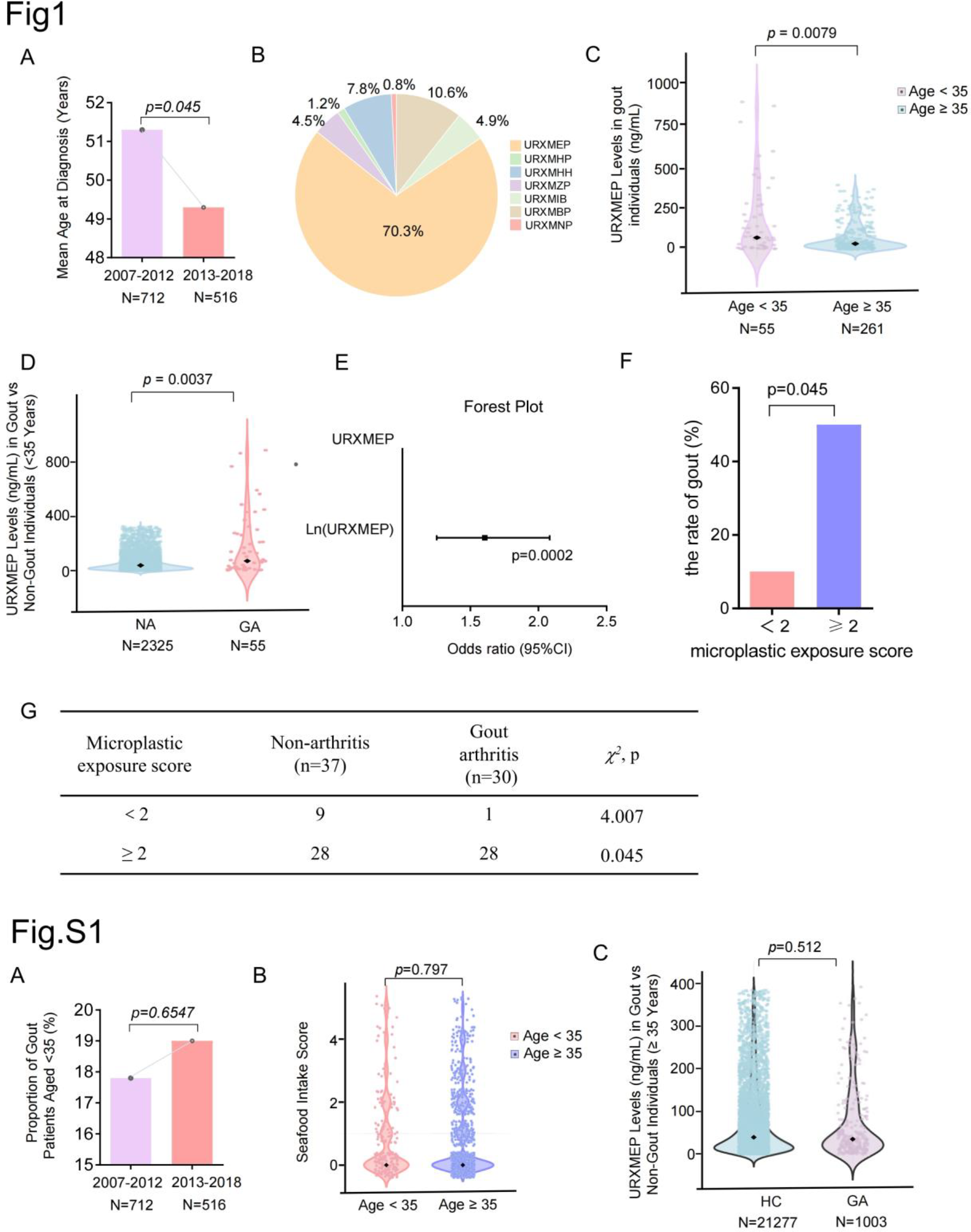
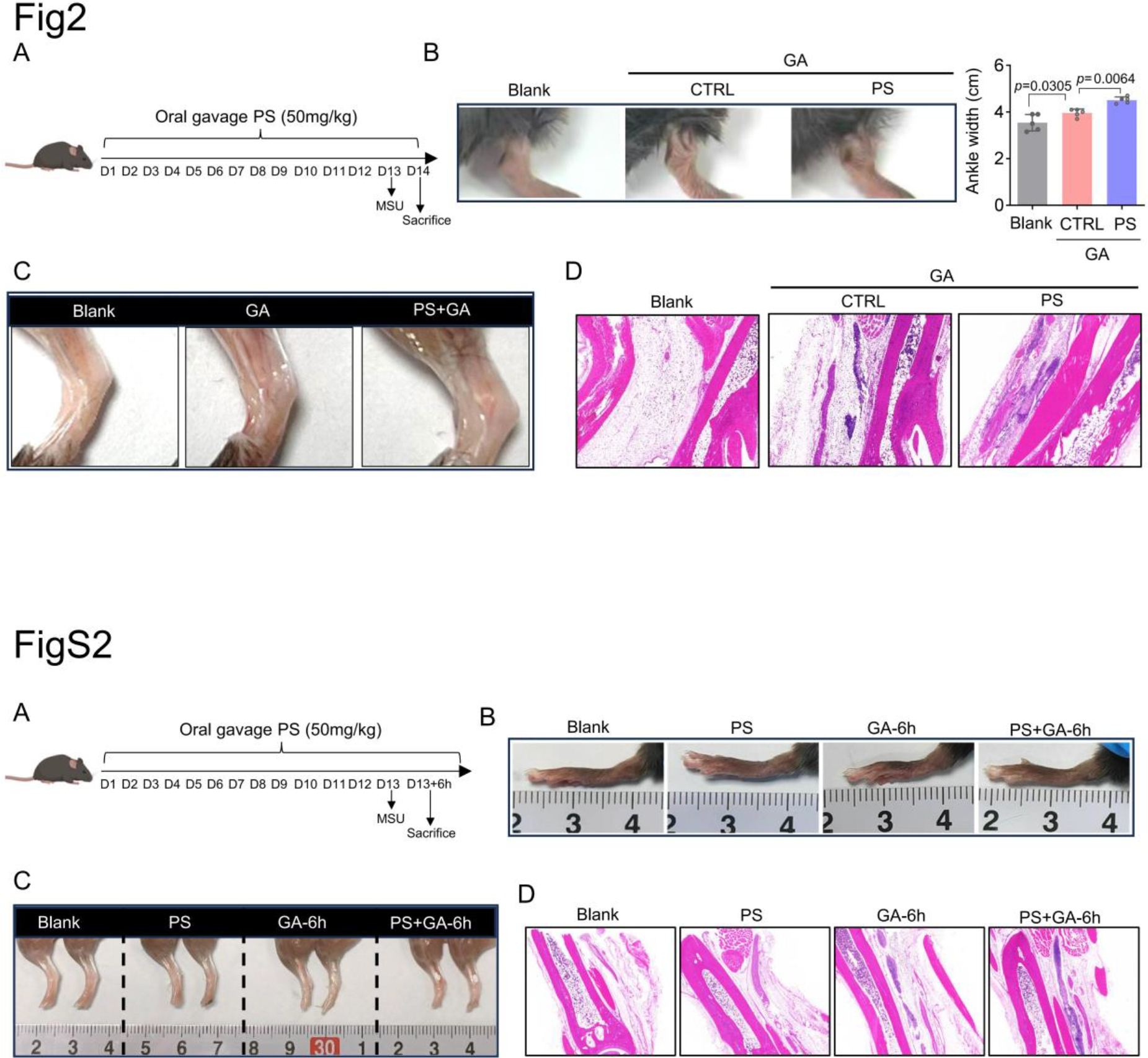
Results: Based on NHANES data analysis, gout onset is trending younger (p=0.045, Figure.1A, S1A), unrelated to seafood intake (Figure.S1B), suggesting other factors may contribute to this trend. Investigating microplastic exposure, we analyzed urinary plasticizer metabolites (focusing on URXMEP, Figure.1B). Among gout patients, those under 35 had higher URXMEP levels than older patients (Figure.1C). Furthermore, in the subgroup of participants under 35, gout patients exhibited markedly higher URXMEP concentrations than age-matched healthy controls (Figure.1D, S1C). Moreover, within the under-35 population, logistic regression analysis showed that higher URXMEP levels (OR = 1.606; 95% CI, 1.253 – 2.082) were associated with were significantly associated with gout status (Figure.1E). Our custom questionnaire linked higher microplastic exposure scores (≥2) to significantly increased gout rates (50% vs 10%, p=0.045, Figure.1F-G). We selected PS-NPs (50 nm in diameter) as a model of plastic fragments to explore their adverse effects on GA mouse model. Firstly, we constructed a PS-NPs-exposed mouse model in which were exposed to 0, or 50 mg/kg/d PS-NPs for continuous 13 days. GA mice were injected with MSU intra-articularly (i.a.) to establish the gout arthritis model on D14, Control group received only sterile PBS injection. All mice were euthanized on 6 or 24h after MSU injection (Figure.2A, S2A), which corresponded to neutrophil [5] or macrophage peak in GA zebrafish and mouse model [6]. At 6h, PS-MSU and MSU groups showed comparable ankle swelling, but ankle pathology revealed that PS-MSU induced more pronounced inflammatory cell infiltration (Figure.S2B-D). By 24h, MSU triggered significant joint swelling and immune cell infiltration, which were further exacerbated in the PS-MSU group, showing both increased edema and enhanced inflammation (Figure.2B-D). Collectively, these findings suggest that environmental plastic exposure is linked to both the earlier onset of gout in human and the exacerbation of gout attacks in mice.
Conclusions: Our multi-level investigation demonstrates that environmental microplastic exposure, particularly to polystyrene nanoplastics, is significantly associated with the earlier onset and increased severity of gouty arthritis. These findings establish microplastics as a novel and modifiable dietary risk factor, providing a mechanistic basis for dietary recommendations aimed at reducing plastic exposure in gout prevention and management.
REFERENCES: [1] Du F, Cai H, Zhang Q, Chen Q, Shi H. Microplastics in take-out food containers. Journal of hazardous materials 2020;399:122969.
[2] Huang YQ, Zeng Y, Mai JL, Huang ZS, Guan YF, Chen SJ. Disposable Plastic Waste and Associated Antioxidants and Plasticizers Generated by Online Food Delivery Services in China: National Mass Inventories and Environmental Release. Environmental science & technology 2024.
[3] Lee S-H, Jeong GH, Nam M-K, et al. Polystyrene microplastics activate NF-κB/MAPK signaling in synovial fibroblasts, promoting inflammation and joint destruction in rheumatoid arthritis. Journal of hazardous materials 2025;499:140194.
[4] Lihua C, Zhiyin T. Microplastics aggravates rheumatoid arthritis by affecting the proliferation/migration/inflammation of fibroblast-like synovial cells by regulating mitochondrial homeostasis. Int Immunopharmacol 2023;120:110268.
[5] Hall CJ, Sanderson LE, Lawrence LM, et al. Blocking fatty acid-fueled mROS production within macrophages alleviates acute gouty inflammation. J Clin Invest 2018;128:1752-71.
[6] Zhao L, Ye W, Zhu Y, et al. Distinct macrophage polarization in acute and chronic gout. Lab Invest 2022;102:1054-63.
Acknowledgments: NIL.
Disclosure of Interests: None declared.