fetching data ... 
Background: Effective treatment is available for gout with long-term urate-lowering therapy (ULT). However, ULT continues to be under-prescribed and is often not continued long-term. Although biological causes of gout, such as genetic variants, renal impairment, age and diuretic use are well described, most members of the public view lifestyle choices such as diet and alcohol intake as the main causal factors [1]. Many patients receive information about gout from internet and television and may seek treatment advice from family members rather than clinicians. Causal beliefs about illness affect treatment decisions and disease outcomes [2]. Opinions about the causes of gout held by members of the community could be a target for interventions aiming to improve use of ULT.
Objectives: This study aimed to investigate how causal beliefs about gout influence views about gout management in the general population.
Methods: Members of the public recruited through public advertisements and a job search website were randomised 1:1 to view one of two 2-minute videos about gout, then completed a questionnaire about gout and its management. The videos were identical, except for a 45-second section that described the causes of gout using either a biological or lifestyle explanation. The biological explanation discussed genetics, kidney disease, age, sex and diuretic therapy. The lifestyle explanation discussed certain foods, alcohol, sugary drinks, and being overweight. Both videos contained an identical explanation of gout management, including both medication and lifestyle strategies. The primary outcome was response to the question “How likely is it that long-term medications would help gout?”, rated on an 11-point Likert scale. Participants rated 9 potential causes of gout on a 5-point Likert scale and were also asked to provide the three most important causes of gout in rank-order, recorded as free-text. Seven potential management strategies were rated on an 11-point Likert scale. Illness perceptions were assessed with the Brief Illness Perceptions Questionnaire (BIPQ). To ensure the participants had viewed the video, they were asked to state which disease the video was about prior to the interview.
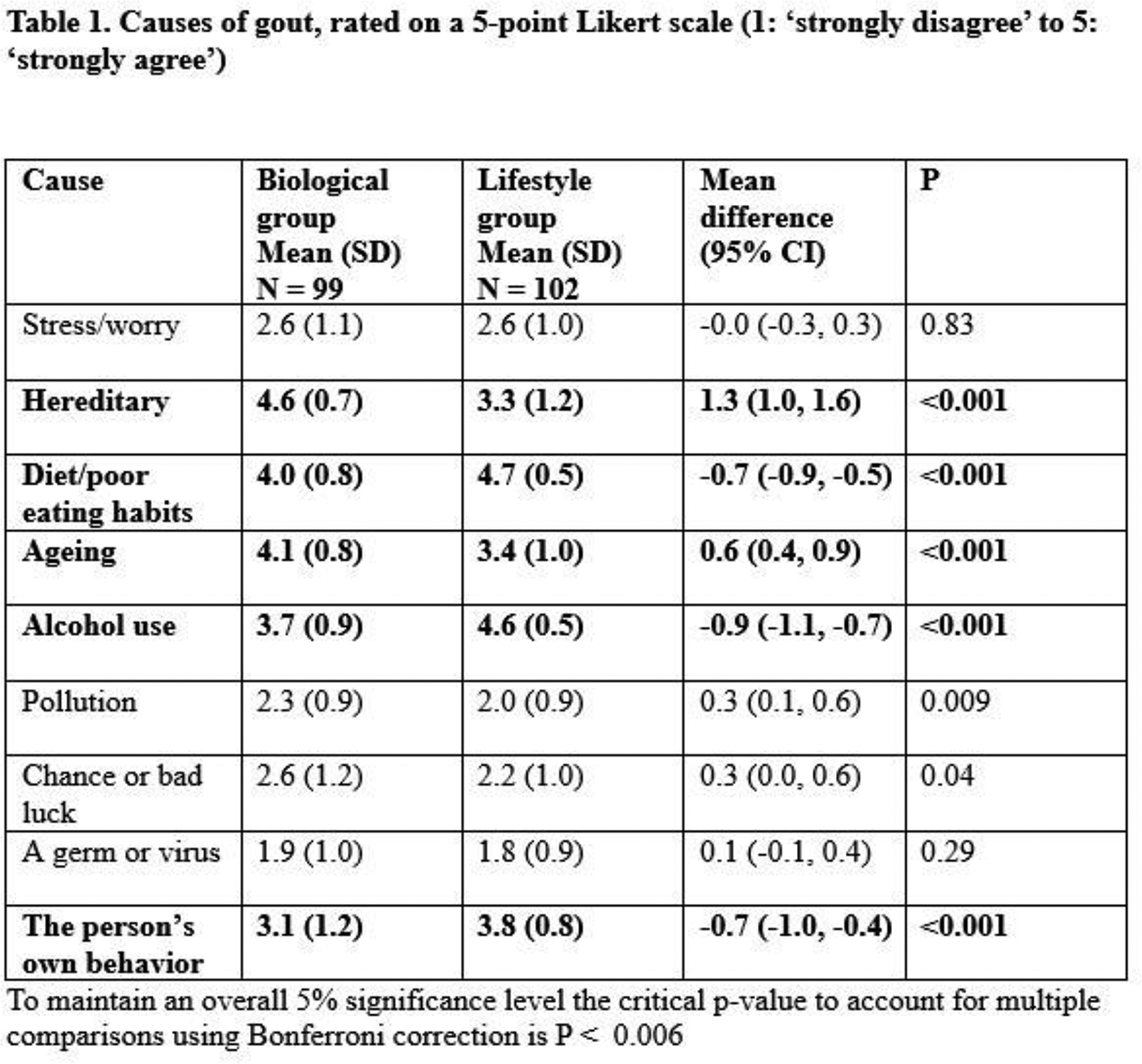
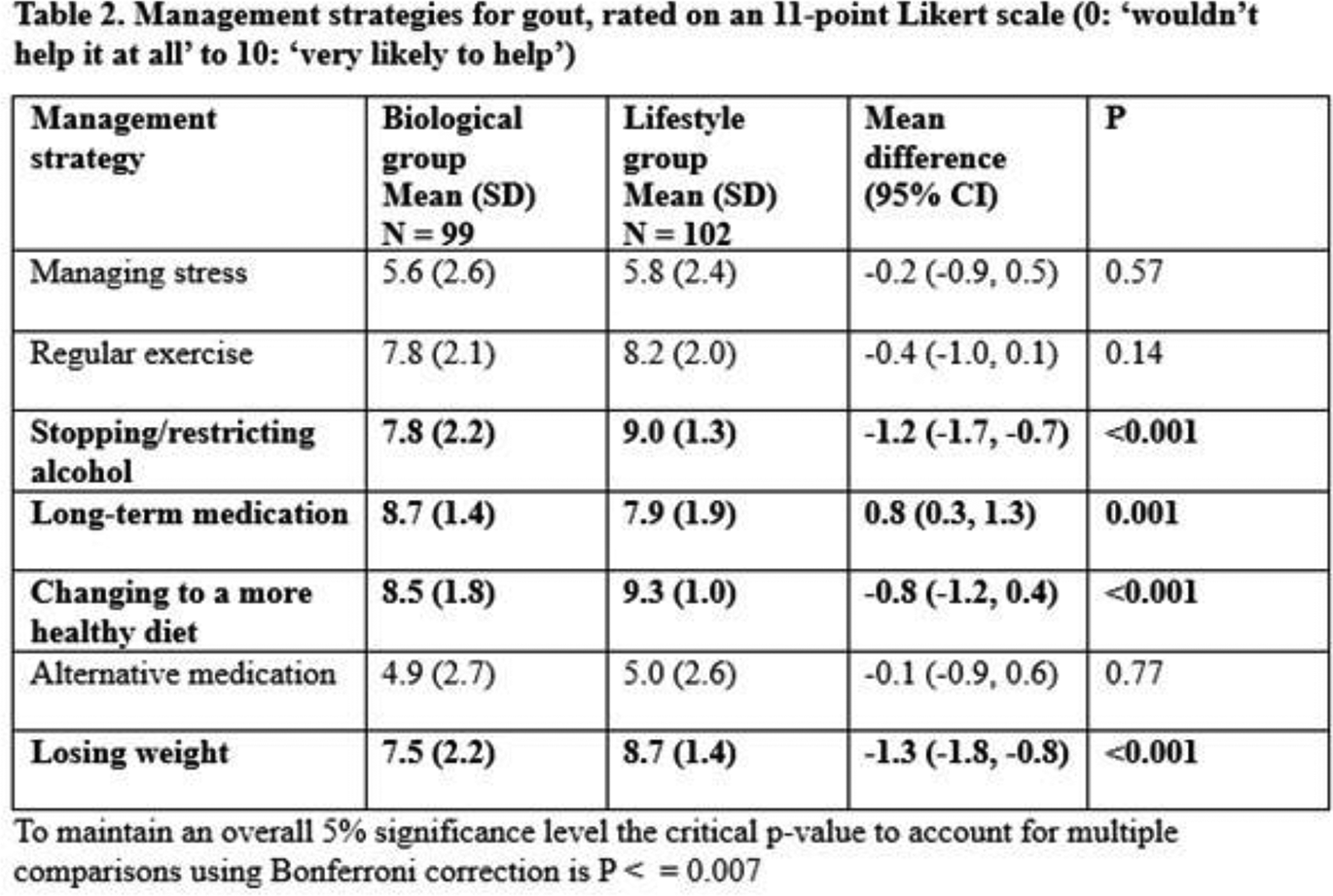
Results: Between June 2023 and April 2024, 201 participants were interviewed. Of the 201 participants, 152 (75.6%) were female, and the average age was mean (SD) 40.3 (18.8) years. Three participants (1.5%) had gout, and 86/201 (42.8%) had a family member or close friend with gout. Participants in the biological group rated hereditary factors as a more important cause than those in the lifestyle group, with a mean rating on a 5-point Likert scale of (mean (SD)) 4.6 (0.7) compared with 3.3 (1.2) (p < 0.001) (Table 1). They also rated ageing more highly as a cause. Participants in the biological group rated poor diet, alcohol use and the person’s own behaviour less highly as causes than those in the lifestyle group (p < 0.001 for all). When providing the three most important causes of gout in rank-order, 13/99 (13.1%) in the biological group and 62/102 (60.8%) in the lifestyle group gave diet in general or a specific dietary factor as the most important cause (p < 0.001). In the biological group, 74/99 (74.7%) gave genetics as the most important cause compared with 9/102 (8.8%) in the lifestyle group (p < 0.001). Ratings for the primary outcome measure, how likely it is that long-term medication would help gout, were (mean (SD)) 8.7 (1.4) in the biological group and 7.9 (1.9) in the lifestyle group on an 11-point Likert scale, p = 0.001 (Table 2). Those watching the biological video rated stopping/restricting alcohol, changing to a healthier diet and losing weight less highly as management strategies than those watching the lifestyle video (p < 0.001 for all). There was no difference between groups in illness perceptions assessed using the BIPQ.
Conclusions: Explaining gout as a disease caused by biological in contrast to lifestyle factors affects beliefs about the benefits of long-term medication held by the general population. Accurate communication about causes of gout could affect the public’s beliefs about treatment strategies. Taking a public health approach through campaigns targeting the public’s knowledge of the causes of gout is a feasible strategy for improving awareness and uptake of ULT.
REFERENCES: [1] Petrie KJ, MacKrill K, Derksen C, Dalbeth N. An illness by any other name: The effect of renaming gout on illness and treatment perceptions. Health Psychol. 2018;37(1):37-41.
[2] Sensky T. Causal attributions in physical illness. J Psychosom Res. 1997;43(6):565-73.
Acknowledgments: NIL.
Disclosure of Interests: Rachel Murdoch: None declared, Borislav Mihov: None declared, Anne Horne: None declared, Keith Petrie: None declared, Greg Gamble: None declared, Lachlan Fleck: None declared, Nicola Dalbeth Arthrosi, SK Chemicals, Arthrosi, PTC Therapeutics, Protalix, Unlocked Labs, LG Chem, Dexoligo Therapeutics, Shanton Pharma, Avalo, Sobi, Biomarin, Convergence, Implicit, GondolaBio, Novotech, Medcryst.