fetching data ... 
Background: CAR T-cell therapy targeting CD19 has shown potential in autoimmune diseases such as SSc, yet molecular profiling in these patients remains unexplored. In a phase 1 open-label trial (NCT06414135), we assessed relmacabtagene autoleucel(relma-cel) in progressive diffuse cutaneous SSc. Relma-cel demonstrated a favorable safety profile across six patients. All patients achieved deep B-cell depletion, significant improvement in skin thickness scores, stabilization or improvement of interstitial lung disease, and marked reduction in autoantibody levels, indicating preliminary efficacy.
Objectives: We applied a multi-omic analysis to discern the underling mechanism associated with clinical improvement.
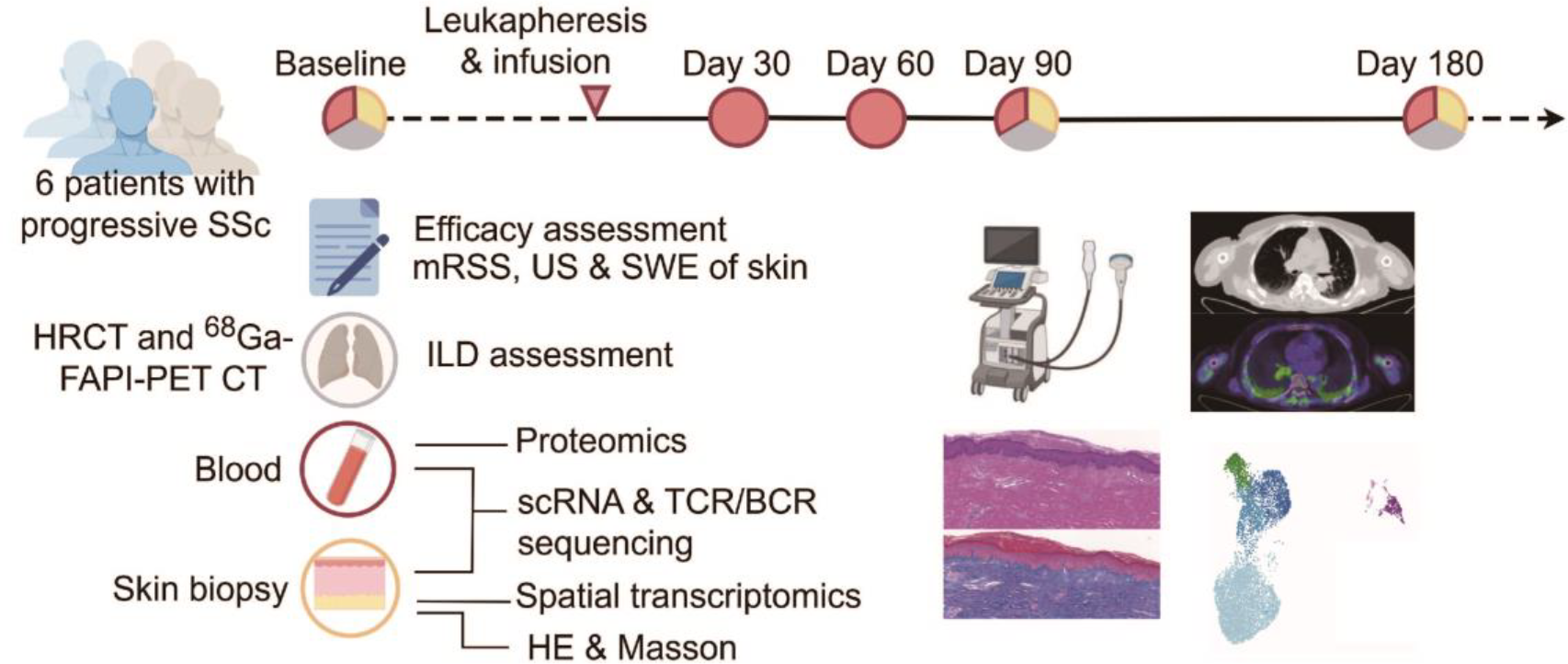
Methods: We performed integrated single-cell RNA sequencing, T-and B-cell receptor repertoire analysis, plasma proteomics, and spatial transcriptomics at multiple time points to characterize molecular changes following CD19 CAR-T-mediated B-cell depletion in SSc patients.
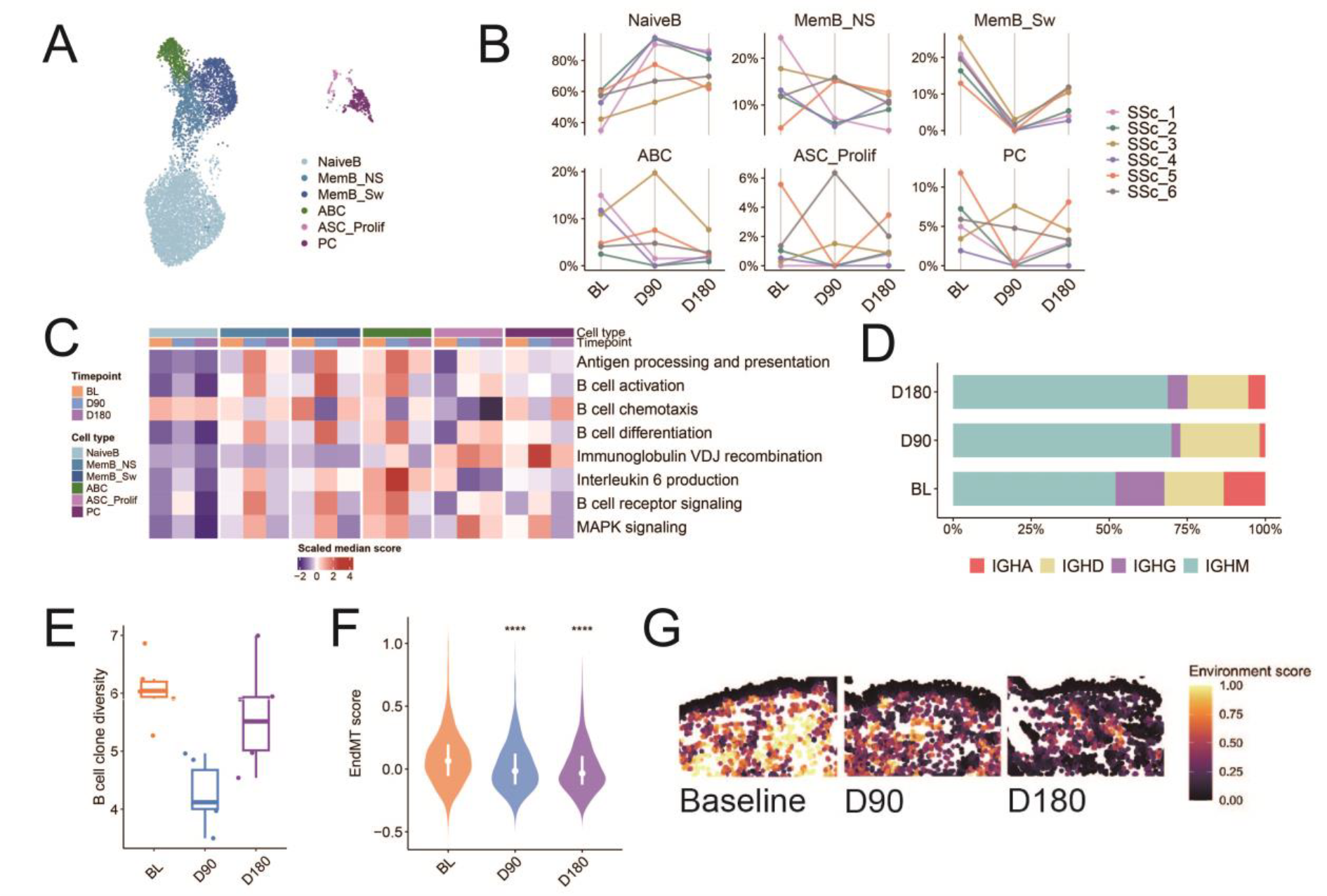
Results: Single-cell RNA analysis of peripheral blood mononuclear cells identified 7,486 B cells, subclustered into naïve B cells, memory B cells (switched and non-switched), age-associated B cells, and antibody-secreting cells. Naïve B cell proportion increased by day 90 (D90), while plasma cell proportion was markedly reduced. Memory B cells (switched) decreased at D90 and partially recovered by D180, reflecting post-treatment immune remodeling. Single sample gene set enrichment analysis (ssGSEA) revealed downregulation of B-cell activation, differentiation, and BCR signaling pathways by D180. IGHG and IGHA isotypes were largely eliminated post-treatment and did not return to baseline by D180. Clonal expansion and diversity among B-cell subtypes were reduced. Naïve T-cell proportions decreased at D90 and recovered by D180, whereas effector memory T cells showed the opposite trend. T-cell subtypes showed reduced signatures of type I interferon post-treatment. T cell activation, differentiation and TCR signaling pathways were also downregulated by D180. Clone diversity of T cell decreased at D90. For skin single-cell RNA analysis, we identified a CTHRC1-high dermal fibroblast subcluster, which carried the strongest myofibroblast signature and resembled pathogenic fibroblasts found in various fibrotic diseases. Over time, it exhibited a broad downregulation of key pro-fibrotic pathways-encompassing cytokine signaling, matrix production, and differentiation pathways-which aligned with clinical improvement. Besides skin endothelial cells exhibited reduced endothelial-mesenchymal transition signatures. Spatial transcriptomics identified a fibrosis-associated gene module-including collagens(COL1A1, COL1A2, COL3A1, COL6A1-3), ECM components(DCN, LUM, FN1, SPARC, BGN, CCN2), and activated fibroblast markers(SFRP2, COMP, POSTN)-whose expression was significantly reduced at D90 and further decreased at D180. Longitudinal proteomics analysis showed decreased levels of molecules linked to skin fibrosis (e.g. CD93, GDF15), ILD (IL18, MMP19), and vascular injury and inflammation (e.g. CCN1, IFI16).
Conclusions: Our multi-omic analysis demonstrates that CD19 CAR-T cell therapy induces profound B-cell depletion and remodeling of the immune landscape in patients with progressive SSc. The observed reduction in pathogenic B-cell subsets, autoantibody production, and fibrotic gene module expression correlates with clinical improvements in skin and lung involvement. These findings suggest that CAR-T therapy may mitigate disease progression through coordinated modulation of adaptive immunity and fibroblast activation.
Schematic of the study design.
Multi-omic analysis
(A) UMAP showing B cell by subtype. (B) Proportion change of B cell subtypes by timepoint. (C) ssGSEA score of B cell subtypes by timepoint. (D) Immunoglobulin isotype composition at BL, D90, and D180. (E) B cell clone diversity across timepoints. (F) Violin plot displaying EndMT score of endothelial cells across timepoints. (G) Environment score of fibrosis-associated gene module shown on spatial data.
REFERENCES: NIL.
Acknowledgments: NIL.
Disclosure of Interests: None declared.