fetching data ... 
Background: Osteoarthritis (OA) is a debilitating degenerative joint disease, and while joint damage is its hallmark, chronic pain remains the primary clinical challenge. Similar to neuropathic pain, sex serves as a key factor influencing analgesic efficacy in OA, with females often exhibiting higher pain sensitivity. The ventrolateral periaqueductal gray (vlPAG) is a crucial node in the descending pain inhibitory system. Previous research indicates that the inhibitory circuitry in the vlPAG regulates neuronal activity in a sex-specific manner to modulate cannabinoid analgesia. The vlPAG receives dense projections from the medial prefrontal cortex (mPFC), establishing the mPFC-vlPAG circuit as a key player in descending pain control. Cannabinoid receptor 1 (CB1R) regulates synaptic plasticity and concurrently inhibits ascending nociception while potentiating descending inhibition.However, it remains unknown whether OA pathology alters this upstream circuit or whether CB1R expression on mPFC neurons projecting to the vlPAG contributes to the sexual dimorphism observed in OA pain management.
Objectives: This study aimed to elucidate the central circuit mechanisms underlying sex differences in OA-induced pain. We hypothesized that CB1R expressed on CaMKIIα excitatory neurons in the mPFC projecting to the vlPAG mediates sex-dependent antinociceptive effects. The specific goals were to map the sex-specific distribution of CB1R in this circuit, determine how OA pathology affects receptor expression, and evaluate whether circuit-specific modulation can rescue OA-induced allodynia.
Methods: Male and female C57BL/6J wild-type mice, CB1R-floxed mice, and GAD2-Cre-tdTomato mice were used. To mimic OA pain, we utilized the monosodium iodoacetate (MIA) model, a chemically induced procedure that triggers rapid cartilage degeneration and robust mechanical allodynia. Mechanical thresholds were assessed using von Frey filaments. To map the circuit, we employed viral tracing with rAAV2/R-hSyn-FLP-EGFP and rAAV-hSyn-fDIO-mCherry injected into the vlPAG and mPFC, respectively. RNAscope in situ hybridization was used to quantify CB1R mRNA levels. To investigate functional significance, we utilized a Cre-loxP system to specifically knockout CB1R in mPFC CaMKIIα neurons. Furthermore, we employed an opto-CB1R strategy (pAAV-CaMKIIα-optoCB1R-EGFP) to specifically activate these receptors via blue light stimulation (473 nm). Whole-cell patch-clamp recordings in vlPAG slices were performed to measure optogenetically evoked excitatory postsynaptic currents (oEPSCs) and spontaneous inhibitory postsynaptic currents (sIPSCs).
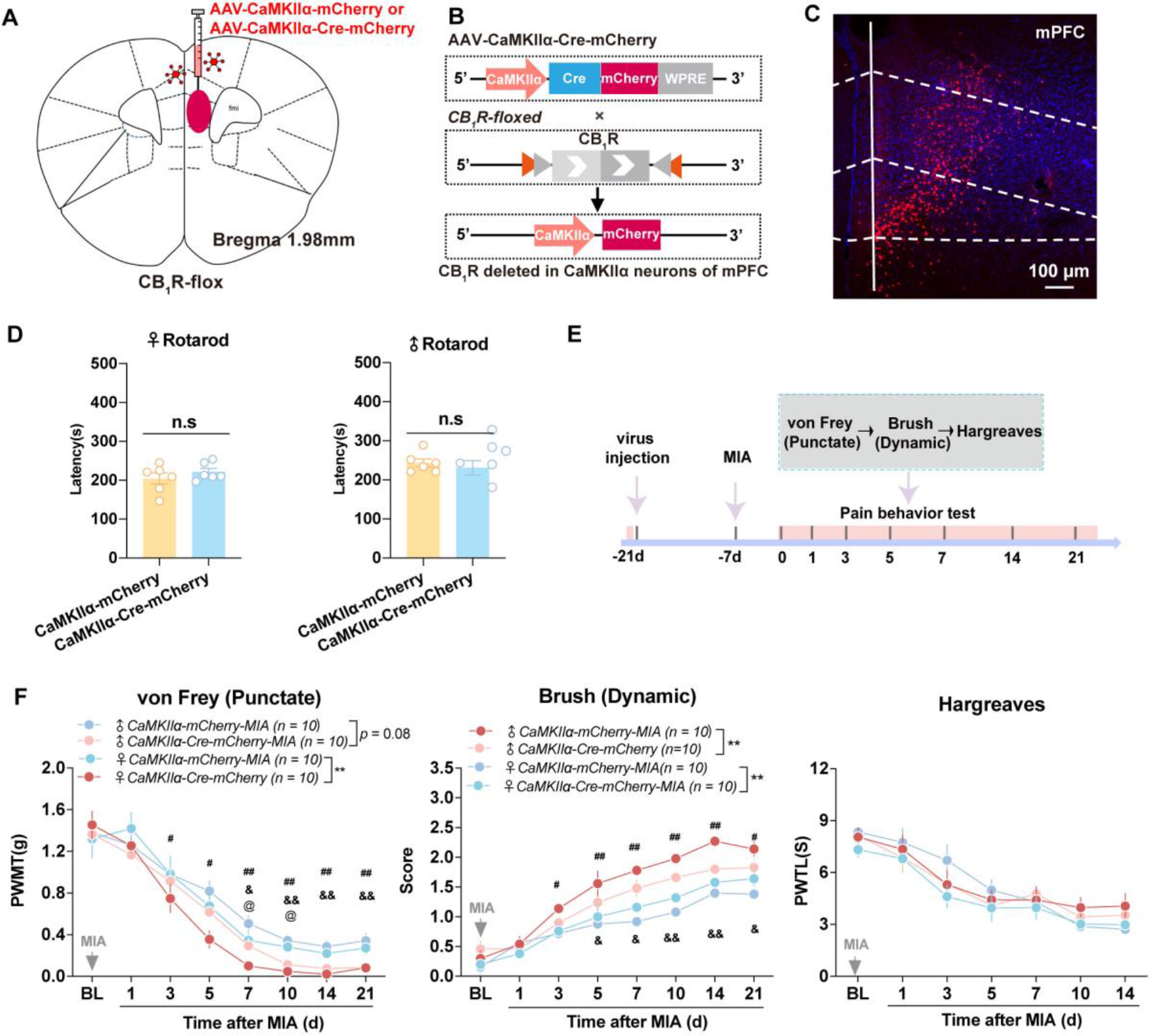
Results: Viral tracing confirmed that mPFC neurons projecting to the vlPAG are predominantly CaMKIIα-positive excitatory neurons (>80%), with no projection density differences between sexes. However, RNAscope analysis revealed a significant sexual dimorphism: under naive conditions, these projection neurons expressed significantly higher levels of CB1R mRNA in females compared to males. Following MIA-induced OA, CB1R expression was downregulated in both sexes, but the reduction was significantly more pronounced in female mice.Behaviorally, specific knockout of CB1R in mPFC CaMKIIα neurons exacerbated OA-induced mechanical allodynia, with female mice exhibiting a more severe pain phenotype than males. Conversely, specific activation of CB1R on mPFC terminals using optogenetics or the agonist ACEA produced robust analgesia that was significantly stronger in females. Electrophysiological recordings revealed that activation of presynaptic CB1R on mPFC terminals reduced glutamatergic drive (oEPSC amplitude) onto vlPAG neurons. In females, this suppression of excitatory input to local GABAergic interneurons resulted in a disinhibition of the descending pathway, as evidenced by reduced sIPSC frequency in output neurons. This synaptic modulation was significantly blunted in males.
Conclusions: This study demonstrates that the mPFC-CaMKIIα-vlPAG-GABA circuit is a critical substrate for sex differences in OA pain. The retrograde projection from the vlPAG to the mPFC is predominantly excitatory, and the high basal expression of CB1R in females serves as a key regulator of descending inhibition. The drastic downregulation of these receptors during OA pathology renders females more susceptible to pain, yet paradoxically, their activation provides superior analgesia via circuit disinhibition. These findings suggest that sex-tailored interventions targeting mPFC CB1R signaling could offer more potent relief for chronic osteoarthritis pain.
Knockout of CB1R on CaMKIIa neurons in the mPFC exacerbates pain in a sex-dependent manner.
REFERENCES: [1] Blanton H, Barnes R, McHann M, Bilbrey J, Wilkerson J, Guindon J. Sex differences and the endocannabinoid system in pain. Pharmacol Biochem Behav 2021;202:173107.
[2] Jiang Z, Wang Q, Zhao J, Wang J, Li Y, Dai W, Zhang X, Fang Z, Hou W,Xiong L. Sex-specific cannabinoid 1 receptors on GABAergic neurons in the ventrolateral periaqueductal gray mediate analgesia in mice. J Comp Neurol 2022;530:2315–34.
[3] Liu X, Huang H, Zhang Y, Wang L, Wang F. Sexual dimorphism of inputs to the lateral habenula in mice. Neurosci Bull 2022;38:1439–56.
[4] Salis F, Sardo S, Finco G, Gessa GL, Franconi F, Agabio R. Sex-gender differences are completely neglected in treatments for neuropathic pain.Pharmaceuticals (Basel) 2024;17.838.
Acknowledgments: NIL.
Disclosure of Interests: None declared.