fetching data ... 
Background: Nociplastic pain is common in patients with neuropathic conditions, yet mechanistic understanding of this overlap is lacking.
Objectives: To identify plasma protein signatures causally shared between neuropathic versus nociplastic pain relevant phenotypes and validate mechanistic relevance in a nerve-injury model.
Methods: We analysed UK Biobank participants with plasma proteomics (Olink Explore; n=53,029). Neuropathic pain phenotypes were defined from hospital ICD-10 codes (e.g., neuralgia, nerve/nerve root/plexus disorders and radiculopathy/sciatica), and the nociplastic pain phenotype was defined as fibromyalgia. Protein-phenotype associations were tested using multivariable regression adjusting for demographic factors, lifestyle, socioeconomic status, and BMI. Causal support was assessed using cis-pQTL Mendelian randomisation and colocalisation. For mechanistic validation, we utilized the sciatic nerve chronic constriction injury (CCI) model and quantified CA14 expression in dopaminergic neurons of the ventral tegmental area (VTA) and substantia nigra pars compacta (SNc); causal effects on excitability were tested via targeted CA14 manipulation (lentivirus overexpression/knockdown) with whole-cell electrophysiology and network activity analyses. Drug-target annotation mapped prioritised proteins to clinically available compounds using curated drug databases (Drug bank) and literature review. For mechanistic validation, we used a rodent neuropathic pain model (chronic constriction injury via sciatic nerve ligation) and quantified CA14 expression across brain regions and neuronal subtypes. Lentivirus transfection for primary dopaminergic neurons was used to assess the alteration of neuronal excitability and synchronized network activity.
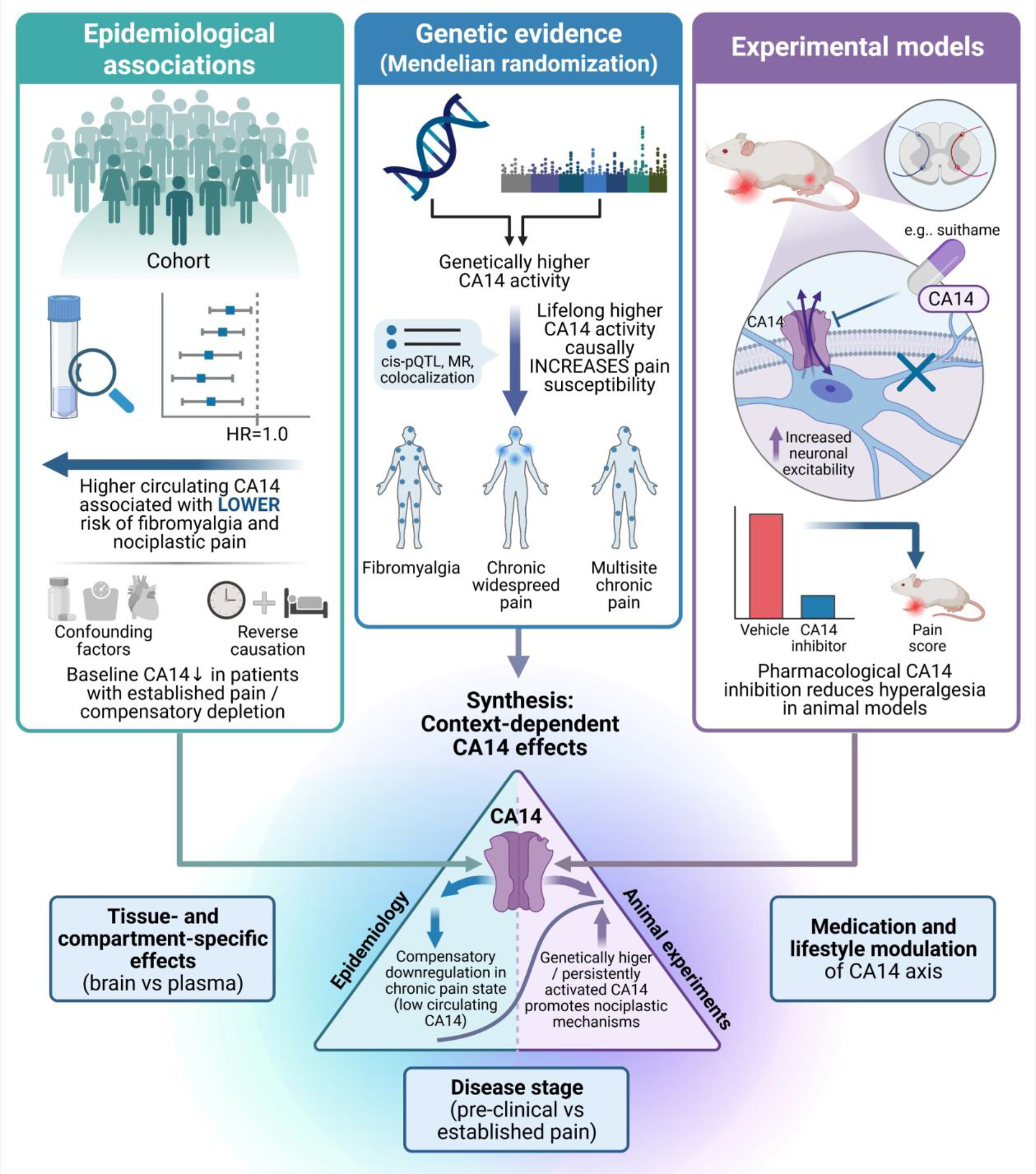
Results: CA14 was consistently associated with both neuropathic pain and nociplastic (observational: HR=0.82 [95%CI 0.77-0.87], p<0.0001 for FM). Genetic triangulation supported an effect of genetically predicted higher CA14 on both phenotypes (MR: OR=1.05-1.12 across phenotypes, p<0.05; colocalisation PP4=0.59 for multisite chronic pain). Experimentally, CA14 was upregulated in VTA/SNc dopaminergic neurons following nerve injury, and CA14 overexpression increased neuronal excitability and promoted synchronous network bursting. Drug-target annotation linked CA14 as an target of exisiting drug: sulthiame/sultiame (an antiepileptic used for self-limited epilepsy with centrotemporal spikes); In addition, sulthiame has recently shown dose-dependent improvements in obstructive sleep apnoea in a phase 2 trial, further supporting human target pharmacology in a central physiology-relevant setting.
Conclusions: Across population proteomics, genetic causal inference, and circuit-level validation, CA14 emerges as a shared transdiagnostic protein linked to neuropathic-pain–consistent phenotypes and fibromyalgia. These findings support carbonic anhydrase biology as a candidate mechanistic axis for pain centralisation and motivate evaluation of carbonic anhydrase inhibition (particularly sulthiame) as a hypothesis-generating repurposing strategy for central sensitisation-prone pain treament.
REFERENCES: NIL.
Acknowledgments: NIL.
Disclosure of Interests: None declared.