fetching data ... 
Background: Total hip arthroplasty is effective in reducing self-reported pain and increasing health related quality of life and physical function. Despite these improvement, objective measured physical activity (PA) may not be changed and may continue to be markedly lower compared to healthy peers. Qualitative research indicates that barriers to PA after total hip arthroplasty include fear of implant failure, multijoint pain, and comorbidities, which may be reinforced by insufficient and inconsistent information provided to patients. The well-documented positive associations between PA and respectively physical function, general health, and chronic disease prevention and management underscore the potential benefits of increasing PA post-surgery on recovery and patient outcomes. Short-term effectiveness of pedometer-driven behaviour change interventions (BCI) to increase daily step counts have been shown in people with rheumatic or musculoskeletal diseases. Likewise promising short-term results have been shown in people who have undergone total knee arthroplasty for knee osteoarthritis. Preliminary interviews with patients have suggested that three months after total hip arthroplasty could be a window of opportunity to change patients’ attitudes and regular physical activity behaviours.
Objectives: The primary objective of the study was to investigate the short-term (6 months post-surgery) and secondary the long-term (12 months post-surgery) effectiveness of a multicomponent, pedometer-driven BCI initiated three months after total hip arthroplasty due to hip osteoarthritis on daily step counts.
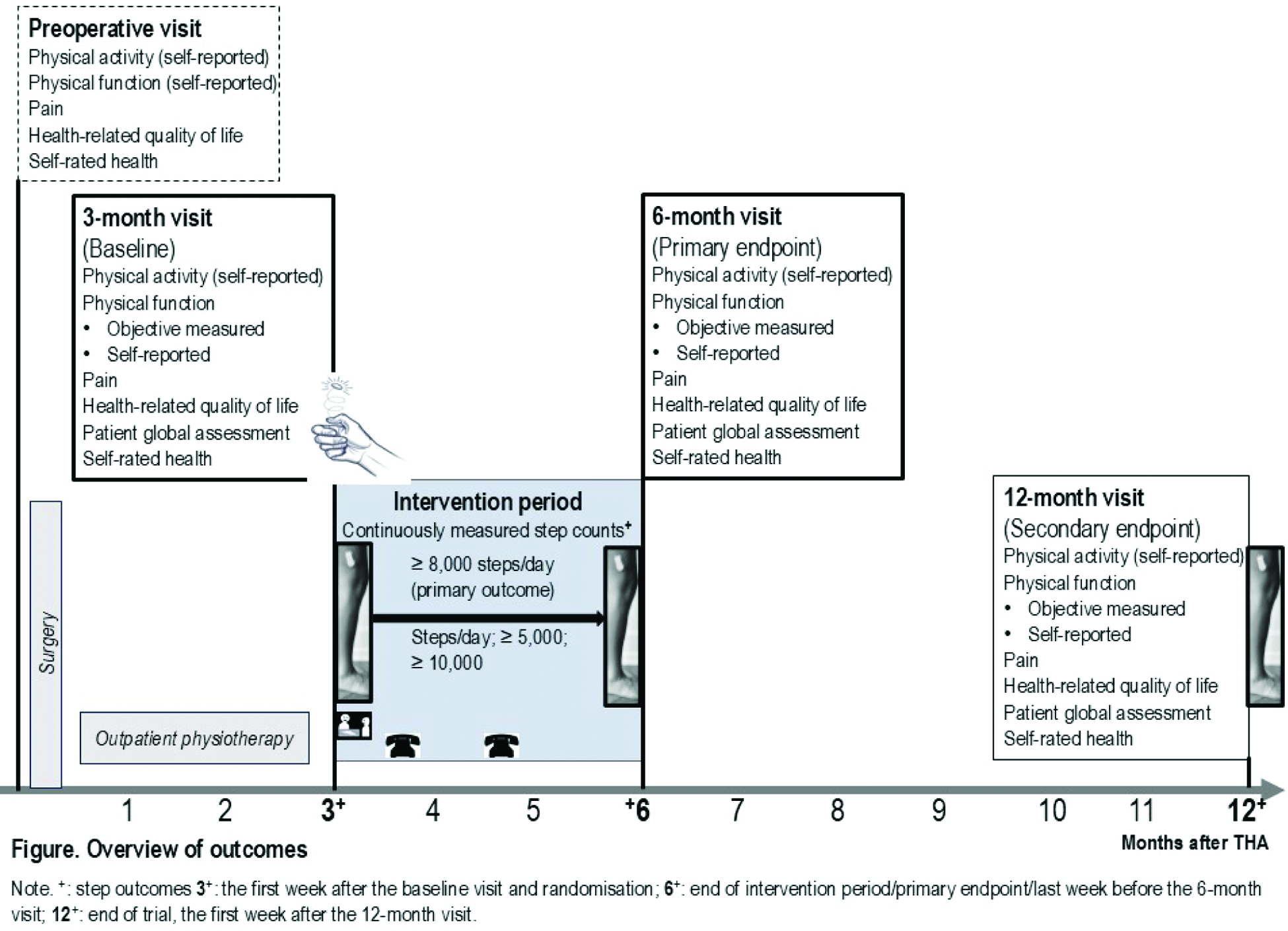
Methods: We conducted a randomised controlled, superiority, trial with a parallel group design (ClinicalTrials.gov identifier: NCT04471532) including home-dwelling, independent, and self-reliant adults who underwent primary total hip arthroplasty due to hip osteoarthritis. The participants were recruited pre-surgery and finally included, baseline tested and randomized 1:1 three months post-surgery to either the BCI (BCI-group) or control. The BCI was a 3-month, multicomponent, pedometer-driven program delivered through one 45-minute in-person and two 20-minute telephone counselling sessions with a physical therapist. Patients were involved in the development of the BCI. The components included: 1) a brief motivational interviewing, 2) patient educational material (video and leaflet) regarding PA after total hip arthroplasty, 3) handling out a pedometer and a step-counting journal together with 4) a practice-oriented leaflet regarding how to use the pedometer, the step-counting journal, and goal setting and 5) strategies to incorporate PA into daily life. The control group received no intervention but follow-up visits and attention regarding their thigh-worn accelerometer, without visual feedback, comparable to the BCI-group. The primary outcome was between-group difference in the proportion completing ≥8,000 steps/day at 6-month post-surgery measured with a thigh-worn accelerometer; secondary outcomes included the proportion completing ≥5,000 steps/day respectively ≥10,000 steps/day, change in physical function measured with the 6-minute walk test, the 30-s chair-stand test, a timed stair climb test, and the function in daily living subscale of the Hip disability and Osteoarthritis Outcome Score (HOOS), change in pain measured with the subscale pain of HOOS, and general health and health-related quality of life measured with the EuroQol 5-Dimension Questionnaire (EQ-5D-3L) (Figure 1). Follow-up was at 6-month post-surgery for the primary endpoint and 12-month post-surgery for the secondary (Figure 1). Analysis followed the intention-to-treat principle.
Results: The mean age of the participants (n=192) was 67 SD:10 years, 64% were women, the mean number of self-reported comorbidities was 1.3 SD: 1.1 and joint pain comorbidity was frequent: 59% reported knee pain and 58% reported back pain. Participant characteristics of the BCI-group (n=95) and the control group (n=97) were similar. At 6-month, no significant between-group difference was observed in the primary outcome of the proportion achieving ≥8,000 steps/day (26% in the BCI-group versus 20% in the control group; odds Ratio (OR) = 1.37, 95% CI: 0.68-2.77). Regarding secondary outcomes, at 6-month a significantly greater proportion of participants in the BCI-group achieved ≥5,000 steps/day compared with the control group (52% versus 36%; OR = 1.93, 95% CI: 1.03–3.61). However, there was no significant between-group difference at 12-month (62% versus 49%; OR = 1.70, 95% CI: (0.89-3.23)). Between 3- and 6-month post-surgery, the BCI-group demonstrated a significantly greater improvement in 6-minute walk distance than the control group (38m in the BCI-group versus 24m in the control group; mean between-group difference: 14.1m 95% CI: 2.3–25.9 m). No other statistically significant between-group differences were observed.
Conclusions: The multicomponent, pedometer-driven behaviour change intervention initiated three months after total hip arthroplasty delivered through one in-person and two telephone counselling sessions did not increase the proportion of participants achieving ≥8,000 steps/day but improved attainment of ≥5,000 steps/day and capacity to walk over longer distances at 6-month post-surgery. These gains were not sustained at 12-month post-surgery.
REFERENCES: NIL.
Acknowledgments: NIL.
Disclosure of Interests: None declared.