fetching data ... 
Background: Systemic lupus erythematosus (SLE) is an autoimmune disease characterized by aberrant B cell activation. B cell depletion is effective in SLE and data from CD19 CAR-T cell therapy suggest that deep B cell depletion can leads to drug-free remission. We have reported on the reconstituted B cell compartment of patients having received CD19 CAR-T cell therapy being mainly naïve. Herein, we describe the cellular and molecular features of the first case of an SLE patient with disease relapse after initial treatment response to CD19 CAR-T cell therapy.
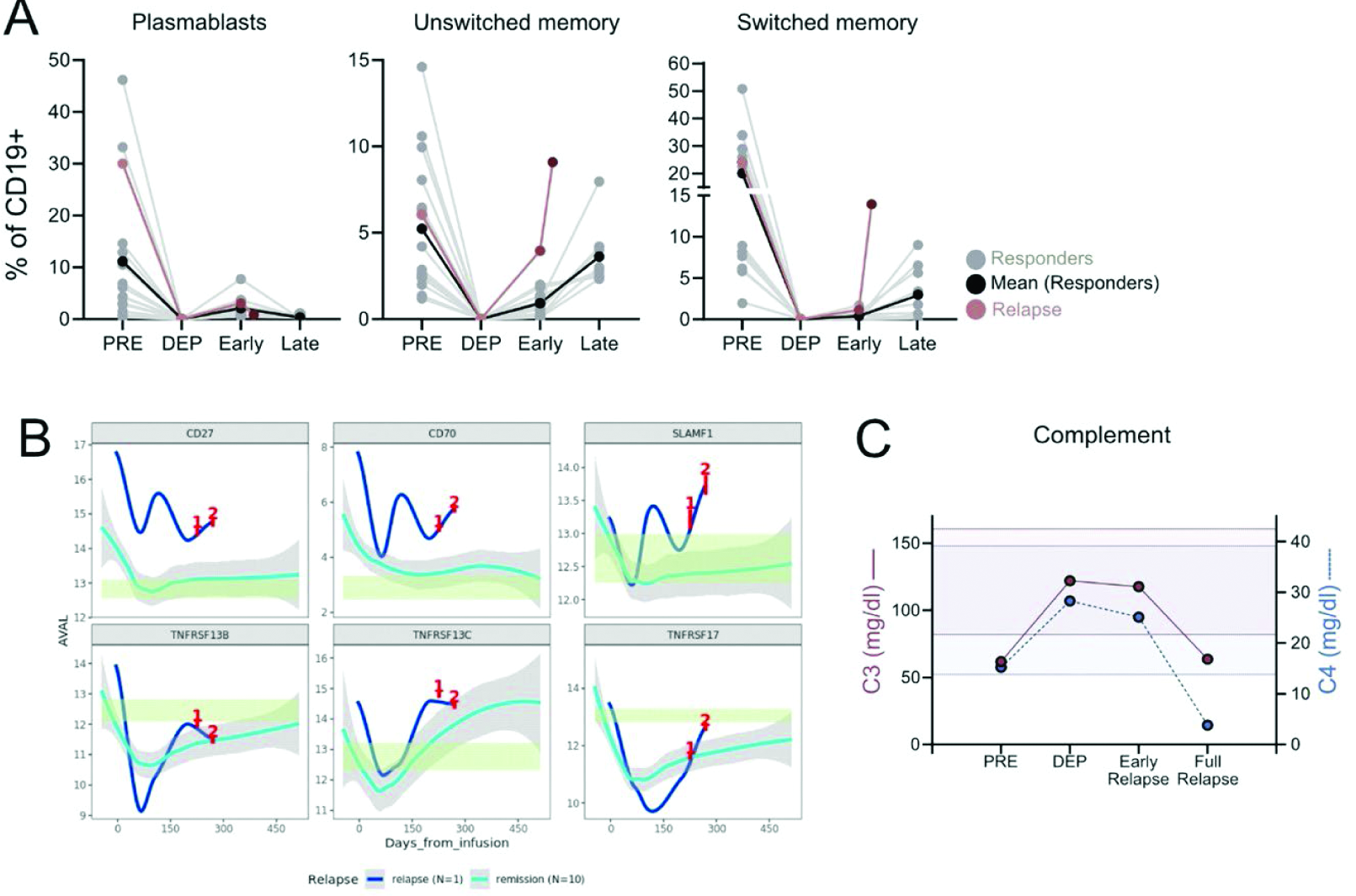
Case Presentation: A 24-year-old female patient was treated with CD19 CAR-T cells for refractory SLE with severe renal involvement and serositis at our institution. The patient showed complete peripheral B cell depletion and achieved LLDAS. Longitudinal clinical and laboratory follow-up was performed, including sequential flow-cytometric B cell phenotyping and proteomic profiling from serum. B cells reconstituted at d203 after treatment, showing an initially naïve phenotype. Shortly after, the patient experienced return of disease activity at d226 (SLEDAI-2K: 6) and a full relapse with development of SLE-associated transverse myelitis at d270 (SLEDAI-2K: 20). Compared to SLE patients in sustained remission after CAR-T cell treatment (n=10), the SLE relapse was associated with an early return of memory B cells (14 vs. 1% of CD19+ cells) and atypical B cells (8 vs. 2 % of CD19+ cells) shortly after B cells reconstituted (Figure 1A). Multiplex serum protein analysis showed a decrease in B cell- and plasmablast-related proteins following CAR-T cell therapy in 10 patients who reached sustained remission, including CD27, TACI, BAFF-R and SLAMF1. In the relapsed individual, however, an early rise of B cell maturation and memory markers CD27, SLAMF1 and CD70 was seen at B cell reconstitution, thereby preceding the clinical onset of disease activity (Figure 1B). In contrast, conventional laboratory markers of SLE - including dsDNA-antibody titers and complement levels - were in normal range and hence did not predict relapse (Figure 1C).
Learning points for clinical practice: We here provide the first analysis of reconstituting B cells in a patient with relapse of SLE after CD19 CAR-T cell therapy. The B cell compartment of this patient stands in contrast to the largely naïve B cell compartment seen in all 10 patients in long-lasting remission. Proteomic profiling shows early return (or possibly persistence) of B cell markers, suggesting retained B cell memory. Thorough immune phenotyping of relapsed individuals will guide our future understanding of remission and relapse prediction in the context of CD19 CAR-T cell therapy.
( A ) Serum frequencies of B cell subsets from flowcytometry. ( B ) Modelled serum protein levels of patients in remission vs. relapse (green: healthy, 1: early relapse, 2: full relapse). ( C ) Serum complement levels (C3, C4).
PRE: Baseline, DEP: Depletion, Early: B cell reconstitution, Late: ≥12m after B cell reconstitution.
REFERENCES: NIL.
Acknowledgments: NIL.
Disclosure of interest: Danae-Mona Nöthling: None declared, Kirill Anoshkin: None declared, Patrick G. Gavin AstraZeneca, Panagiotis Garantziotis: None declared, Futoshi Iwata: None declared, Laura Bucci: None declared, Nicola Ferrari AstraZeneca, Sarah Clarke AstraZeneca, Carlo Tur: None declared, Melanie Hagen: None declared, Andreas Wirsching: None declared, Tobias Rothe: None declared, Sascha Kretschmann: None declared, Simon Völkl: None declared, Michael Aigner: None declared, Fabian Müller: None declared, Andreas Mackensen: None declared, Aline Bozec: None declared, Georg Schett BMS, Cabaletta, Janssen, Kyverna, Miltenyi, Novartis, Ricardo Grieshaber-Bouyer AbbVie, Alfasigma, AstraZeneca, Bristol-Myers Squibb, Candid Therapeutics, Cullinan Therapeutics, Epana Bio, Gilead, Kite, Johnson &Johnson, Kyverna Therapeutics, Lilly, Novartis, Pfizer, Sanofi, UCB.