fetching data ... 
Background: Immune checkpoint inhibitors (ICIs) have transformed cancer therapy but carry a significant risk of immune-related adverse events (irAEs), which may be sustained and life-altering. Among these, inflammatory arthritis develops in ≥6% of ICI-treated patients, representing one of the more common irAEs. Understanding the mechanisms driving irAEs is essential to optimise irAE management without compromising the anti-tumour response. Moreover, given probable shared disease pathways, understanding their mechanisms may provide vital insights into the development of “spontaneous” immune-mediated inflammatory diseases (IMIDs), including inflammatory arthritis.
Objectives: To examine the pathobiology underlying irAE development through cytometric, proteomic and network analysis.
Methods: Fifty-seven adults with a cancer diagnosis receiving ICIs as part of routine care and enrolled into the MEDALLION cohort were included. Participants were followed longitudinally, with serial blood samples collected during ICI infusions from baseline until ~10 months’ follow-up or the visit immediately preceding an irAE (pre-irAE). 250 unique serum proteins were profiled using the NULISAseq Inflammation Panel. Protein expression values were normalised using the standard NULISAseq workflow, including internal-control and inter-plate control normalisation, log 2 transformation, and final intensity scaling to produce plate-harmonised values. In parallel, serially obtained peripheral blood mononuclear cells were analysed using multi-parameter flow cytometry (38 parameters across two complementary panels) with a focus on T-cell subsets and their activation status. To explore protein–protein relationships, a baseline network was inferred using the ARACNE algorithm (bootstrapping B=300, Data Processing Inequality pruning ε=0.10), retaining only stable edges (stability ≥0.60). ARACNE computes pairwise mutual information between all proteins, capturing any statistical dependency in expression, linear or non-linear. Differential protein expression was overlaid to identify subnetworks of coordinated alteration in participants with irAEs. Longitudinal changes in protein relationships were further examined using Differential Gene Correlation Analysis (DGCA). Pairwise correlations between proteins were compared between baseline and pre-irAE visits, and correlations of per-patient changes (Δ = [pre-irAE/matched timepoint for non-irAE participants] - baseline) were assessed to identify proteins exhibiting coordinated co-change over time. Statistical analysis was performed in R (v2025.09.2 + 418); network visualisation in Cytoscape (v3.10.3).
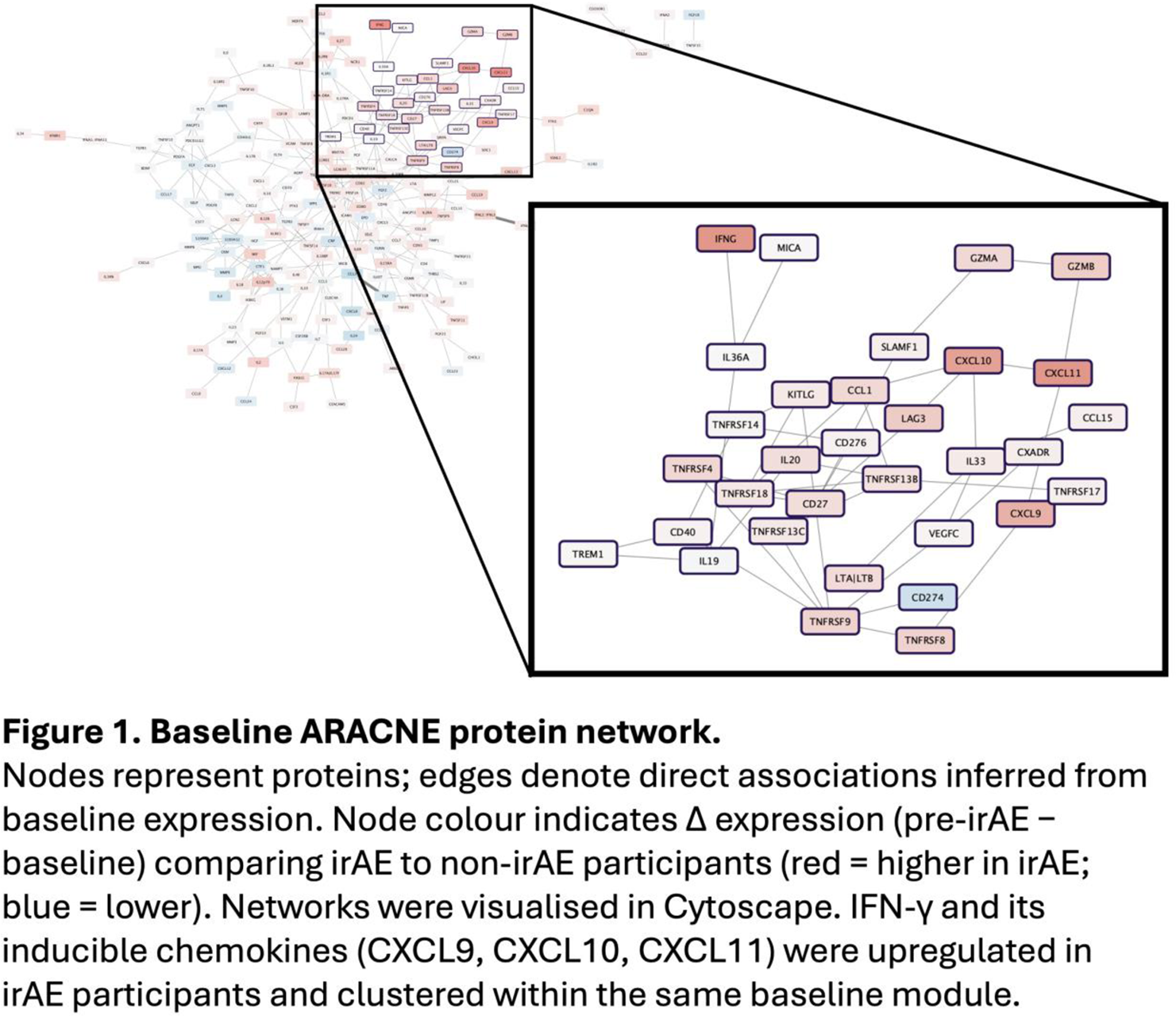
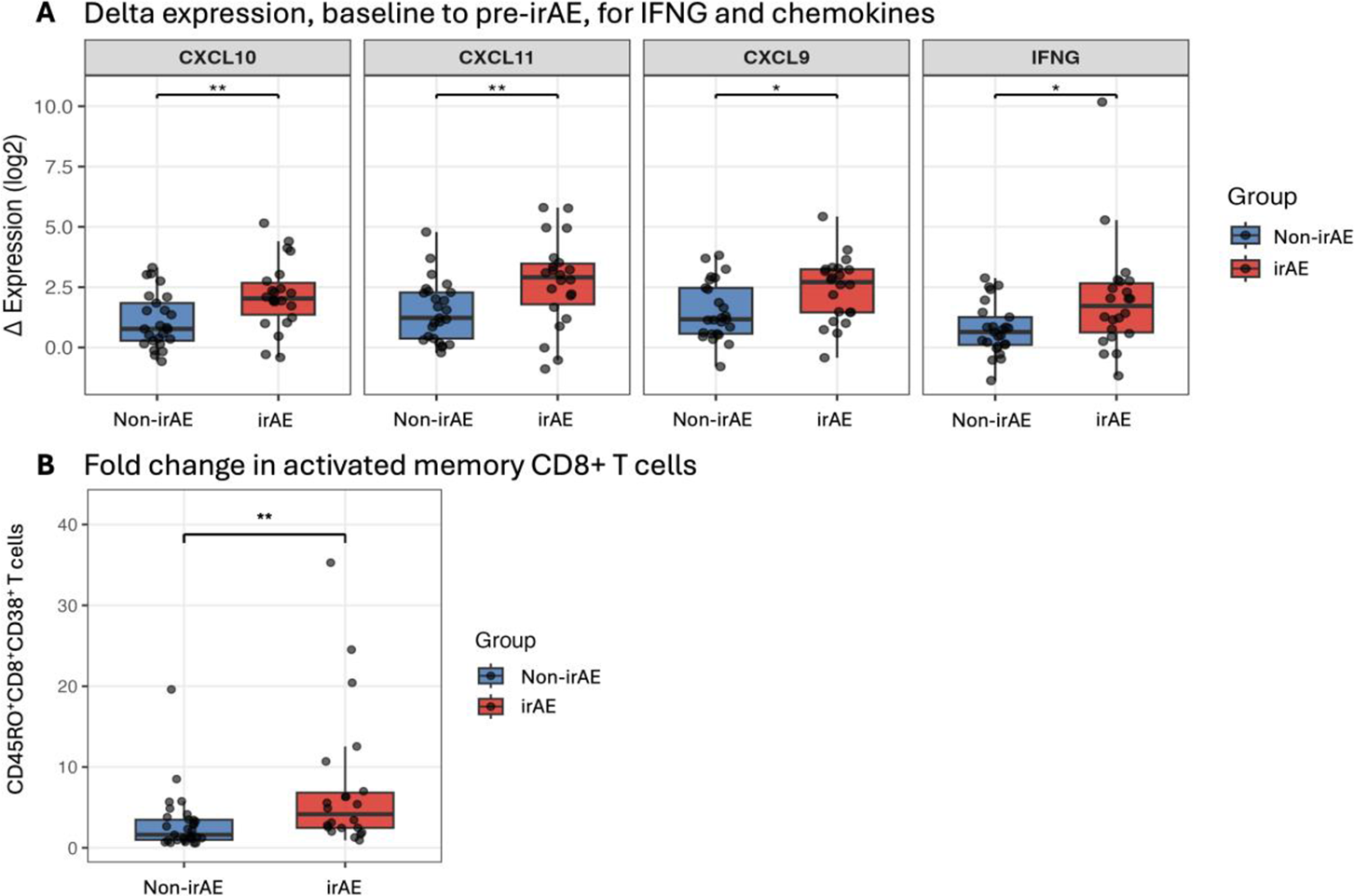
Results: The cohort comprised forty-nine (86%) participants with malignant melanoma, 3 (5%) with lung adenocarcinoma and 5 (9%) with mesothelioma. Thirty-one participants (54%) received combination therapy including anti-CTLA4 at initiation, alongside anti-PD-1 or anti-PD-L1 agents. Combination therapy recipients were significantly more likely than those on monotherapy to develop ≥1 irAE, and a higher proportion of participants with irAEs were classified as ICI “responders” (complete, partial, or stable disease) by the end of follow-up. Baseline demographics and clinical characteristics did not otherwise differ significantly between groups. The exploratory ARACNE network using baseline expression data highlighted a subnetwork of highly interconnected proteins, enriched for IFN-γ-related proteins and including IFN-γ, chemokines CXCL9, -10, -11, Granzyme A and B, and LAG3 (Figure 1). Proteomic analysis revealed increased expression of the proteins within this subnetwork, particularly IFN-γ and related chemokines, in patients who developed irAEs. Subsequent DGCA analysis confirmed the persistence of the baseline protein correlations and revealed multiple protein pairs with correlated longitudinal changes, suggesting a coordinated upregulation of the subnetwork prior to clinical irAE manifestation (Figure 2). Alongside our proteomic analysis, cytometric analysis showed a less activated baseline CD8 + memory T-cell phenotype in participants who developed irAEs; followed by markedly greater post-ICI induction (evidenced by change in CD38 expression on CD45RO + CD8 + T cells).
Conclusions: Our longitudinal proteomic analysis demonstrates coordinated upregulation of peripheral IFN-γ and IFN-γ–induced chemokines, prior to irAEs. In parallel, participants developing irAEs showed a more robust activation of memory CD8+ T cells. Our data suggest potential biomarkers preceding irAEs and support a model whereby checkpoint inhibition amplifies IFN-γ–driven CXCL9/10/11–CXCR3 signalling, promoting recruitment of activated T-cells and establishing a positive feedback loop that supports peripheral tissue inflammation.
REFERENCES: NIL.
Acknowledgments: NIL.
Disclosure of Interests: None declared.