fetching data ... 
Background: Entheseal pain is a major determinant of disability in Spondyloarthritis (SpA) and frequently persists despite adequate control of inflammatory disease activity and may have peripheral and central sensitization components. Notably, Janus kinase inhibitors (JAKi) have shown rapid clinically meaningful pain relief in SpA, often exceeding their effects on objective inflammatory measures, suggesting additional mechanisms beyond inflammation control. Increasing evidence points to neuroimmune interactions at the enthesis—the primary inflammatory site in SpA [1]—as a potential driver of pain persistence. However, the molecular mediators linking local immune activation to nociceptor sensitization remain poorly defined. CXCL10 is a pleiotropic chemokine with well-established roles in nociceptive and neuropathic pain [2-4].
Objectives: Given the central role of the enthesis in SpA, we aimed to investigate immune-derived mediators potentially involved in pain-related pathways within the entheseal microenvironment. Moreover, we sought to evaluate the differential effects of by TNF inhibition versus JAK1 and TYK2 blockade on these pathways, seeking to elucidate how distinct immunomodulatory mechanisms may differentially influence neuroimmune signalling and pain modulation with a particular focus on chemokine pathways known to be involved in pain.
Methods: We used an in-vitro human enthesitis model from donors during spinal surgery, following the stimulations of peri-entheseal bone (PEB) with lipopolysaccharide (LPS) to mimic inflammatory activation. Following LPS entheseal activation selected immunomodulatory agents, namely Upadacitinib (UPA), Deucravacitinib (DEU), and Adalimumab (ADA), were used. Transcriptomic profiling across all conditions was performed by bulk-RNA-sequencing, followed by comparative analyses of the effects of UPA, DEU and ADA. Based on transcriptomic results, protein secretion of selected mediators was subsequently assessed in culture supernatants using multiplex immunoassays.
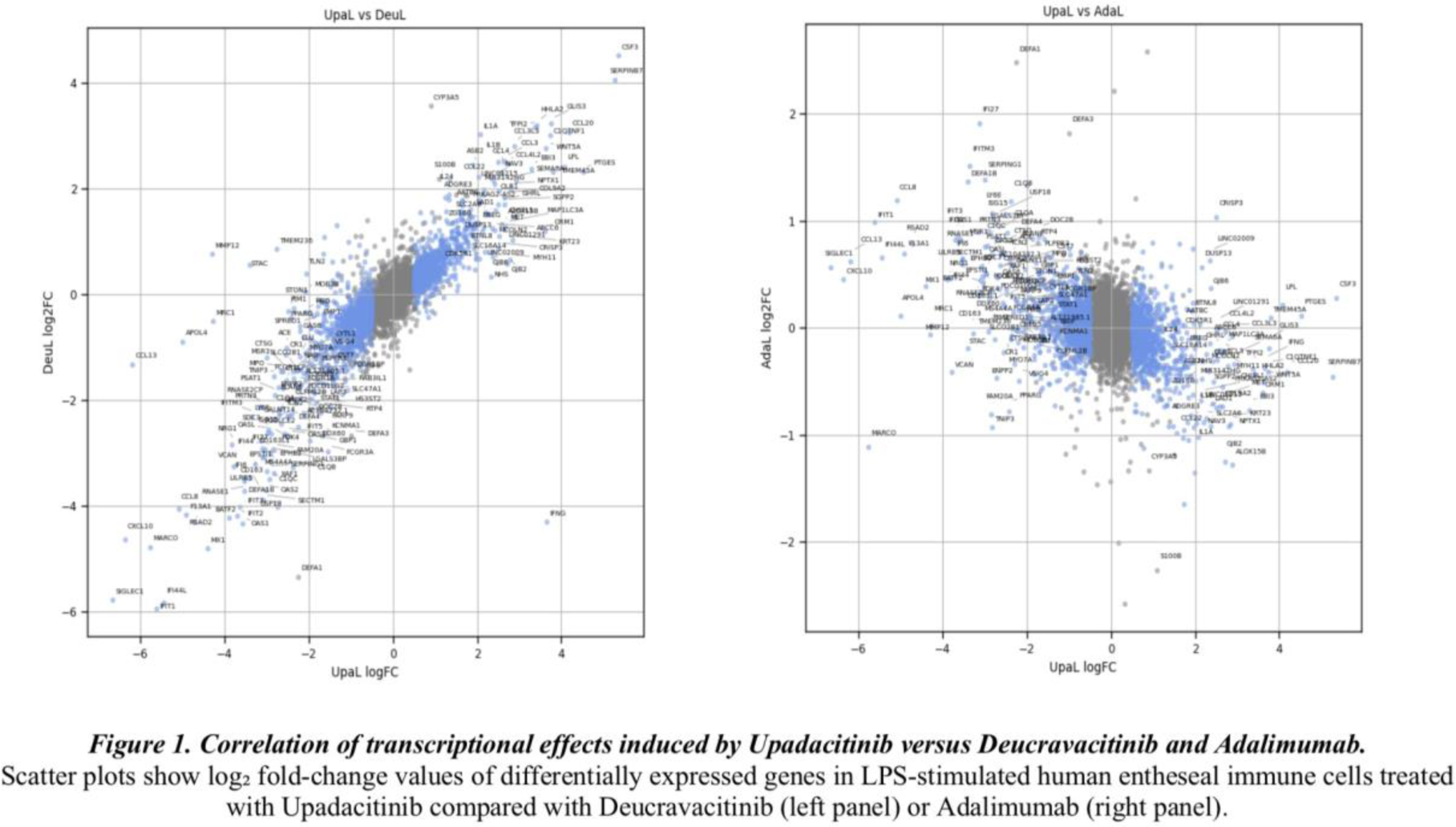
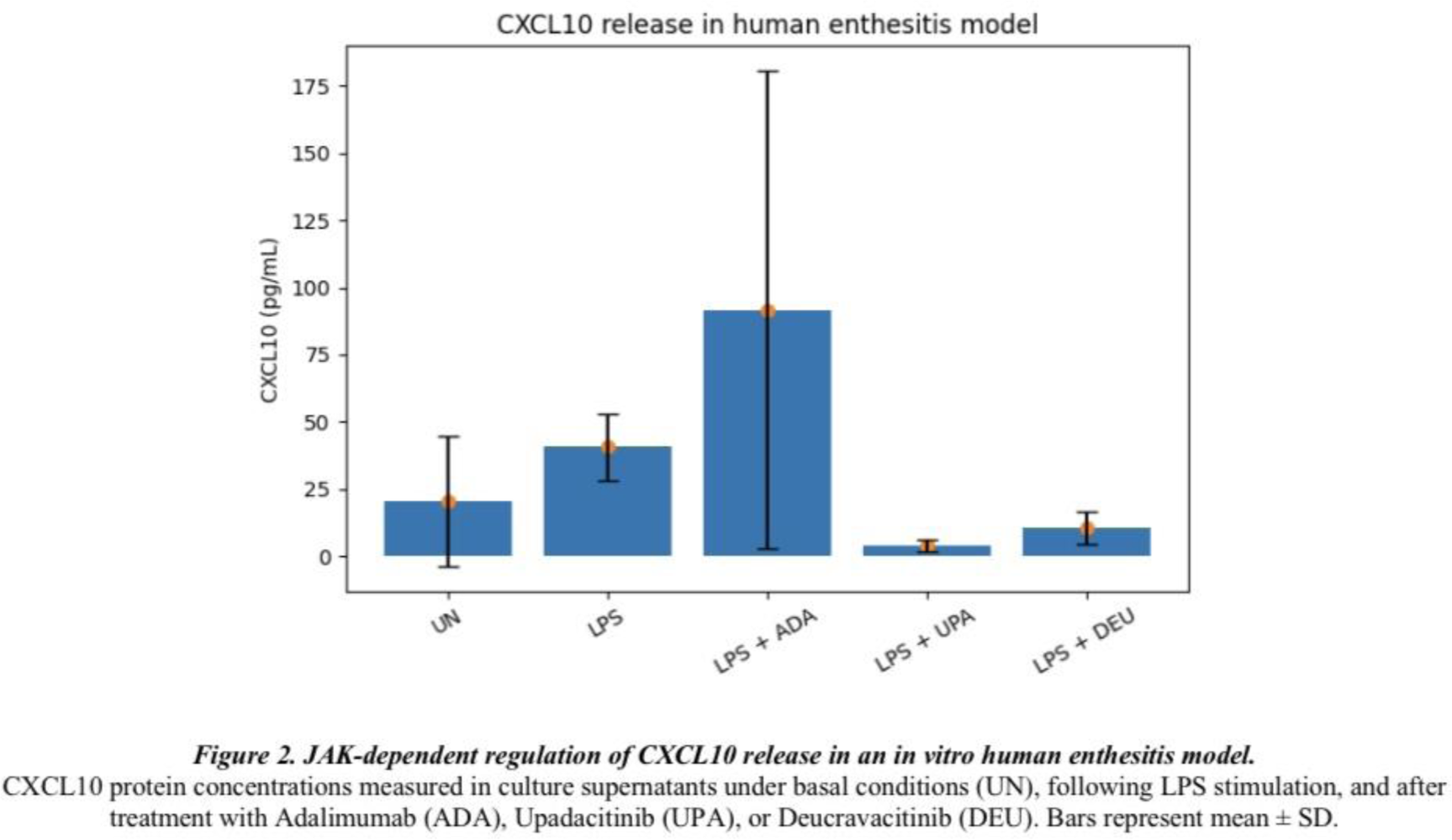
Results: Bulk-RNA-sequencing demonstrated a clear transcriptional segregation between JAK-i and TNF-blockade. A strong positive correlation was observed between UPA and DEU, indicating overlapping modulation of interferon- and neuroinflammation-related pathways, whereas a weaker correlation with ADA reflected distinct transcriptional effects. In fact, numerous genes strongly downregulated by UPA exhibited minimal or no change following ADA treatment (Figure 1). CXCL10 emerged among the most selectively modulated genes by JAKi, with a recognized role in CXCL10–CXCR3–mediated nociceptor sensitization and neuroinflammation through both peripheral and central mechanisms[2-3]. At the protein level, CXCL10 concentrations were low under basal conditions (20.6 ± 24.4 pg/mL) and increased modestly following LPS stimulation (40.5 ± 12.1 pg/mL). Among LPS-stimulated samples, UPA significantly reduced CXCL10 release (3.7 ± 2.1 pg/mL; p = 0.0169), whereas DEU showed a non-significant decrease (10.4 ± 5.9 pg/mL; p = 0.14). In contrast, ADA did not reduce CXCL10 secretion (91.6 ± 89.1 pg/mL; p > 0.99) (Figure 2).
Conclusions: CXCL10 emerges as a potential JAKi modified pain related pathway at the enthesis, linking myeloid activation, interferon signalling, and pain pathways in SpA. Preferential suppression of CXCL10 by JAK1/TYK2 inhibition provides a novel mechanistic angle for the superior analgesic efficacy of JAKi for enthesitis via chemokine related pain pathways.
REFERENCES: [1] Benjamin M, McGonagle D. The enthesis organ concept and its relevance to the spondyloarthropathies. Adv Exp Med Biol . 2009;649:57–70.
[2] Bufi AA, et al. The central role of CXCL10–CXCR3 signaling in neuroinflammation and neuropathology. Cytokine Growth Factor Rev . 2025;84:20–34.
[3] Chen Y, et al. Chemokine CXCL10/CXCR3 signaling contributes to neuropathic pain in spinal cord and dorsal root ganglia after chronic constriction injury in rats. Neurosci Lett . 2019;694:20–28.
[4] Piotrowska A, et al. Pharmacological blockade of CXCR3 reduces neuropathic pain and enhances opioid effectiveness. BBA Mol Basis Dis . 2018;1864:3418–3437.
Acknowledgments: NIL.
Disclosure of Interests: None declared.