fetching data ... 
Background: Reactive arthritis (ReA) exhibits variable outcomes, with approximately half of patients achieving resolution of inflammation within three months, while others develop chronic disease. To identify predictive biomarkers for these different trajectories, we performed a baseline transcriptomic analysis of whole blood and synovial fluid in ReA and undifferentiated peripheral spondyloarthritis (pSpA) and followed patients up for 3 months each.
Objectives: To determine whether baseline whole blood and synovial fluid transcriptomic profiles can differentiate patients with resolving reactive arthritis from those who develop chronic disease.
Methods: 54 patients meeting Braun criteria for ReA, or ASAS criteria for peripheral spondyloarthritis [pSpA] (excluding IBD-related SpA or psoriatic arthritis) were recruited. Baseline blood and synovial fluid (SF) samples from inflamed joints were collected. Resolution was defined as complete drug-free remission (DFR) at three months after the initial attack. Transcriptomics was carried out on the whole blood of 14 patients and paired SF of available 10 patients. RNAseq was performed using Illumina NovaSeq X Plus. DRAGEN was used for demultiplexing and alignment, DESeq2 and clusterProfiler (in the R Environment) for differential gene expression and KEGG(Kyoto Encyclopaedia of Genes and Genomes) for pathway enrichment analyses.
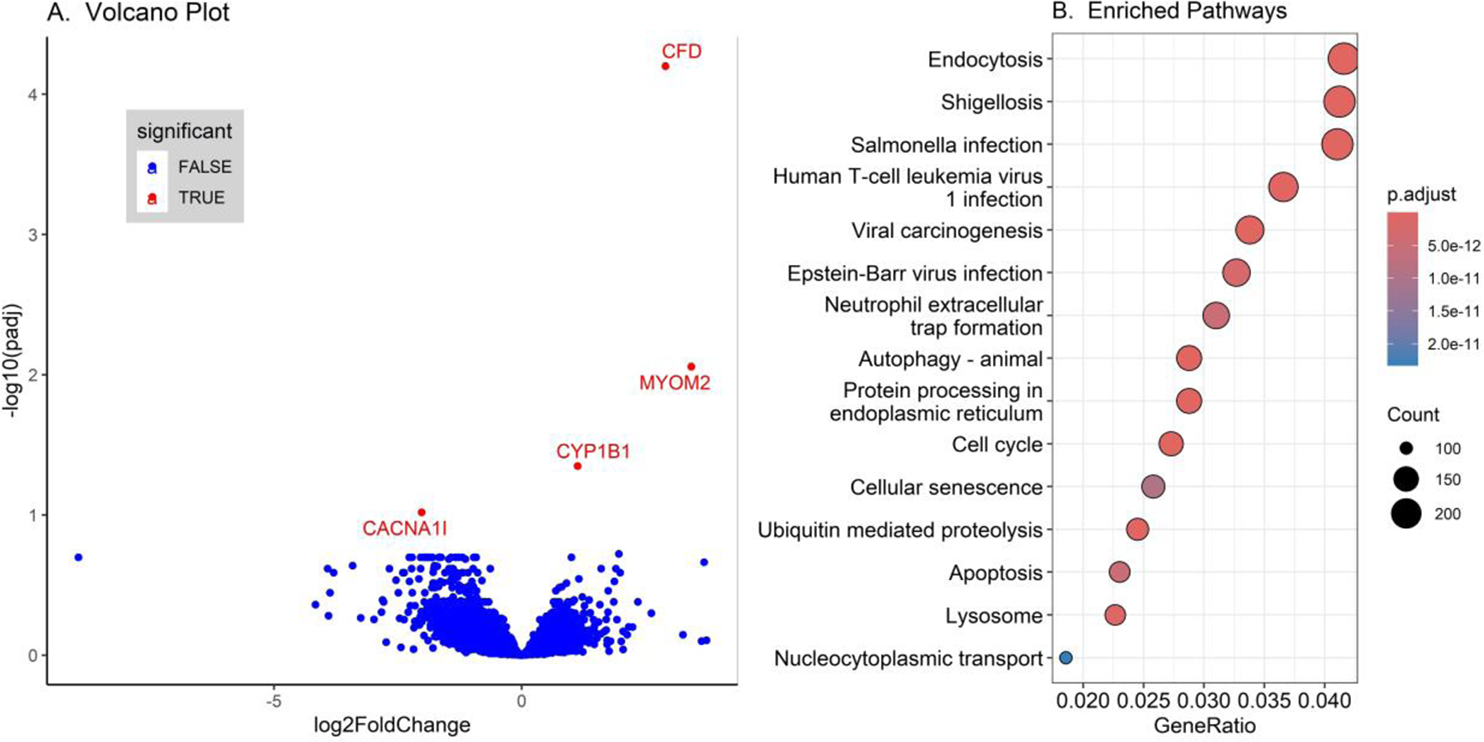
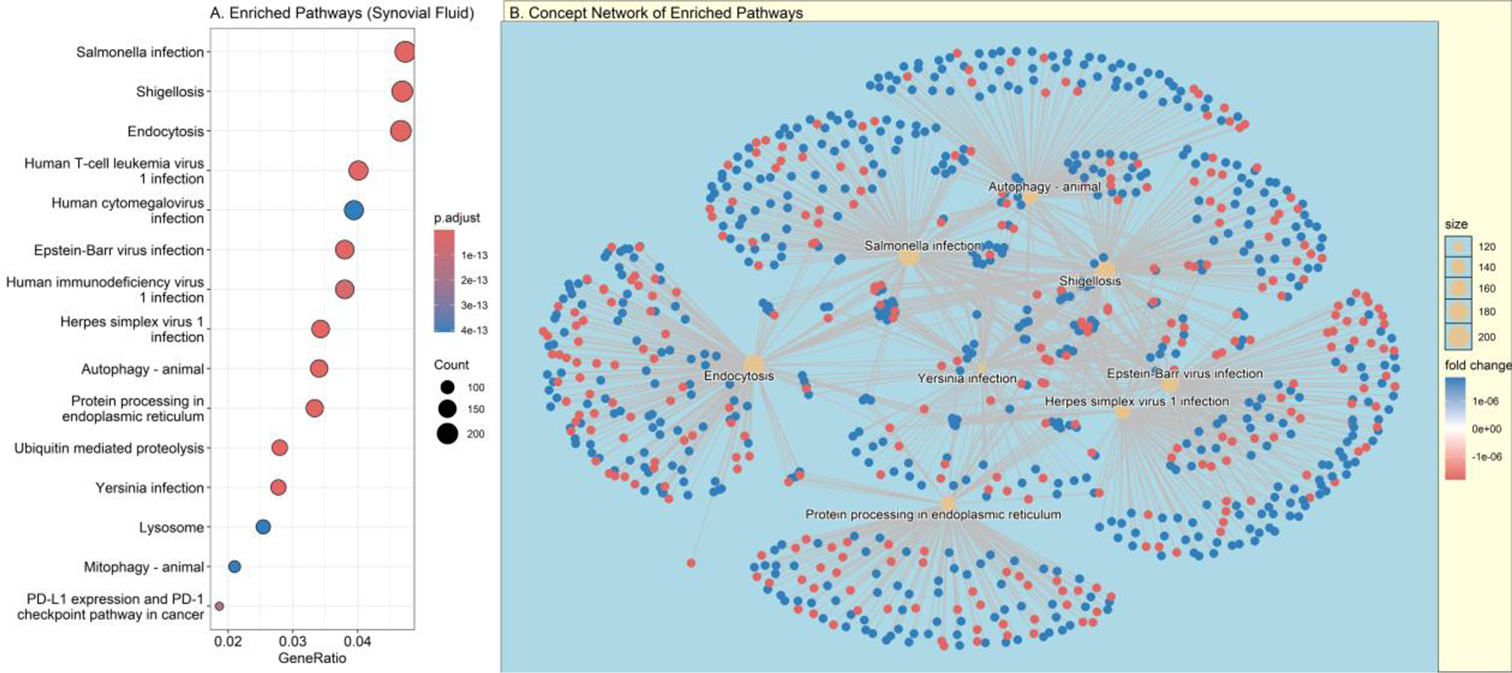
Results: Out of total 54 patients [72% males; median age 32.5(21-46) years], 34 were ReA and 20 were undifferentiated pSpA. Fifty-two percent (n=28) of patients achieved DFR, while 26 patients developed chronic disease. We selected baseline whole blood (n=14) and paired synovial fluid (SF, n=10) samples based on RNA quality for RNAseq. Of these, 6 patients had attained DFR and 8 patients showed a chronic course. Whole blood transcriptomics identified four differentially expressed genes associated with DFR (Upregulated: CFD, MYOM2, CYP1B1. Downregulated: CACNA1l) [Figure 1A]. KEGG enrichment analysis revealed pathways related to endocytosis, Shigellosis, Salmonellosis and certain viral-related pathways that were enriched in patients who attained DFR [Figure 1B]. Differentially expressed genes in the synovial fluid were not statistically significant (not shown). However, the KEGG analysis also showed the enrichment of pathways associated with Salmonella or Shigella infection as well as endocytosis and different viruses [Figure 2A]. Figure 2B shows the concept maps of the top 8 upregulated pathways in the KEGG analysis.
Conclusions: Baseline whole blood gene expression profiles differentiate resolving from chronic ReA. Intriguingly, bacterial and viral pathways are enriched in resolving as compared to chronic disease courses, suggesting that the presence of bacterial triggers, such as Salmonella and Shigella , is a favourable rather than deleterious prognostic factor.
Comparison between whole blood transcriptome profiles of patients with chronic reactive arthritis and those with drug-free remission. (A) Volcano plot showing differentially expressed genes and (B) showing the top 15 enriched pathways (KEGG)
Comparison between synovial fluid transcriptome profiles of patients with chronic reactive arthritis and those with drug-free remission. (A) Dot plot of the top 15 enriched pathways (KEGG) and (B) showing a Concept network map between the top 8 enriched pathways.
REFERENCES: NIL.
Acknowledgments: NIL.
Disclosure of Interests: Avarna Agarwal: None declared, Phanidhar Dhanekula: None declared, Sarthak Verma: None declared, Subham Ravi Nayak: None declared, Prakashini Mruthyunjaya: None declared, Prasanta Padhan: None declared, A Raj Kumar Patro: None declared, Ramnath Misra: None declared, Sakir Ahmed SA has received honorarium as speaker from Alkem, Cipla, Pfizer, DrReddy, SunPharma, Torrent, Ipca and was on the advisory board of Jansen.