fetching data ... 
Background: Biologic disease-modifying antirheumatic drugs (bDMARDs) have enabled sustained remission in a substantial proportion of patients with rheumatoid arthritis (RA). Although drug tapering in these patients would be desirable to reduce treatment burden and healthcare costs, its implementation remains limited due to insufficient evidence regarding the safety and efficacy of tapering strategies, as well as the lack of reliable biomarkers to predict disease flare.
Objectives: This study aimed to identify circulating protein biomarkers predictive of disease flare in RA patients undergoing bDMARD tapering, with the aim of supporting biomarker-guided treatment optimization strategies.
Methods: A proteomic discovery phase using mass spectrometry (MS) was performed on baseline serum samples from a nested case-control subset (n=44) of the OPTIBIO trial (EudraCT 2012-004482-40). This multicenter randomized trial, conducted in five Spanish hospitals, evaluated whether reduced-dose biologic therapy could sustain remission in RA patients. Adult patients who had been in remission for at least six months defined by DAS28 <2.6, SDAI <5, or ACR/EULAR 2011 criteria, were randomized to either a dose-tapering group or a standard-treatment group, and followed for 1–3 years with regular assessments. Disease flares were defined as DAS28 >2.6, SDAI >5, or failure to meet remission criteria. Biomarker candidates were subsequently validated in the full OPTIBIO cohort (n=194) using enzyme-linked immunosorbent assays (ELISA). In addition, 15 circulating anti-cytokine autoantibodies were quantified using multiplex immunoassays. Functional pathway analysis was conducted to explore biological processes associated with candidate biomarkers. Associations between biomarkers and flare risk were assessed using non-parametric tests, logistic and Cox regression models, and receiver operating characteristic (ROC) curve analyses, both alone and in combination with clinical variables (DAS28-CRP).
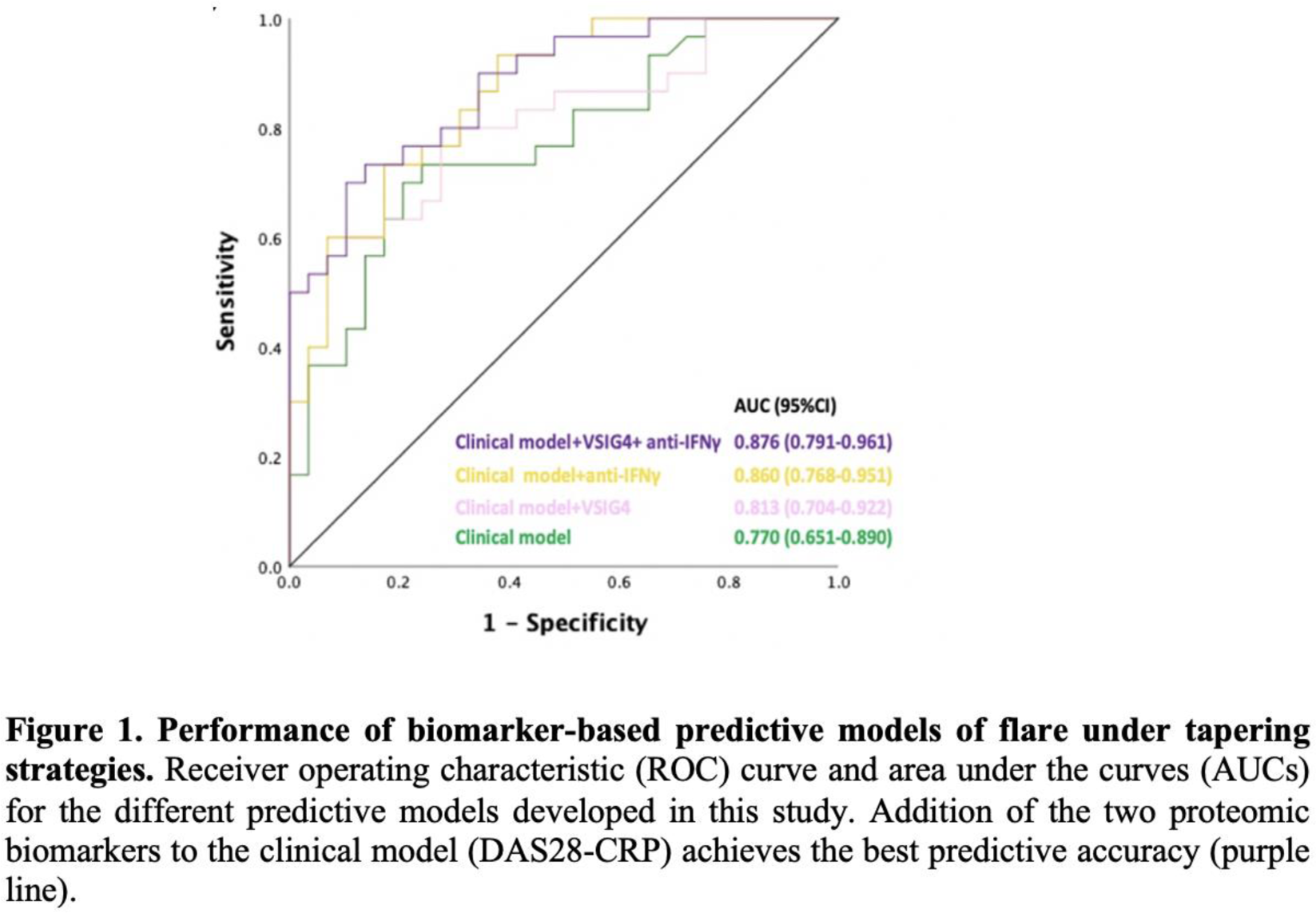
Results: The MS analysis identified 806 circulating proteins, of which 87 were differentially expressed at baseline between patients who flared and those who maintained remission during follow-up in the tapering group. Validation analyses confirmed that higher baseline serum levels of V-set immunoglobulin domain-containing protein 4 (VSIG4) were independently associated with an increased flare risk [OR=1.236 (95% CI: 1.215–1.258), p=0.015]. In addition, elevated baseline anti-interferon gamma (anti-IFNγ) autoantibody levels were also predictive of flare [OR=4.419 (95% CI: 4.414–4.425), p=0.018]. As shown in Figure 1, a combined model including VSIG4, anti-IFNγ, and DAS28-CRP demonstrated the highest predictive performance [AUC=0.876 (95% CI: 0.791–0.961), p<0.001], with improved specificity (0.897) and accuracy (0.797) compared with the clinical model alone.
Conclusions: VSIG4 and anti-IFNγ are novel circulating biomarkers predictive of disease flare during bDMARD tapering in RA patients. Their combination with standard clinical measures significantly improves flare prediction and supports the development of biomarker-guided, personalized strategies to optimize biologic treatment in patients in remission.
REFERENCES: NIL.
Acknowledgments: NIL.
Disclosure of Interests: None declared.