fetching data ... 
Background: Polymyalgia rheumatica (PMR) and giant cell arteritis (GCA) are chronic inflammatory disorders that predominantly affect older adults. 18 F-FDG-PET/CT has become valuable for evaluating disease activity in PMR and GCA. PET imaging with FAP inhibitors (FAPI) has shown potential for producing high-contrast images in various oncological and inflammatory diseases. However, the role of PET-FAPI in assessment of PMR and GCA is unknown.
Objectives: To perform a head-to-head comparison of the novel FAPI-PET/CT with the established FDG-PET/CT for evaluating disease activity and localization in patients with PMR and GCA.
Methods: In this prospective study, 78 patients (27 FAPI-PET, 51 FDG-PET) with PMR and/or GCA according to international criteria were enrolled. All patients underwent clinical evaluation, laboratory testing, and PET/CT imaging. The FAPI-PET Visual Index was calculated by summing visual scores (0-3) across involved sites. Imaging findings, their correlation with the Polymyalgia Rheumatica Activity Score (PMR-AS), and clinical outcomes were analyzed.
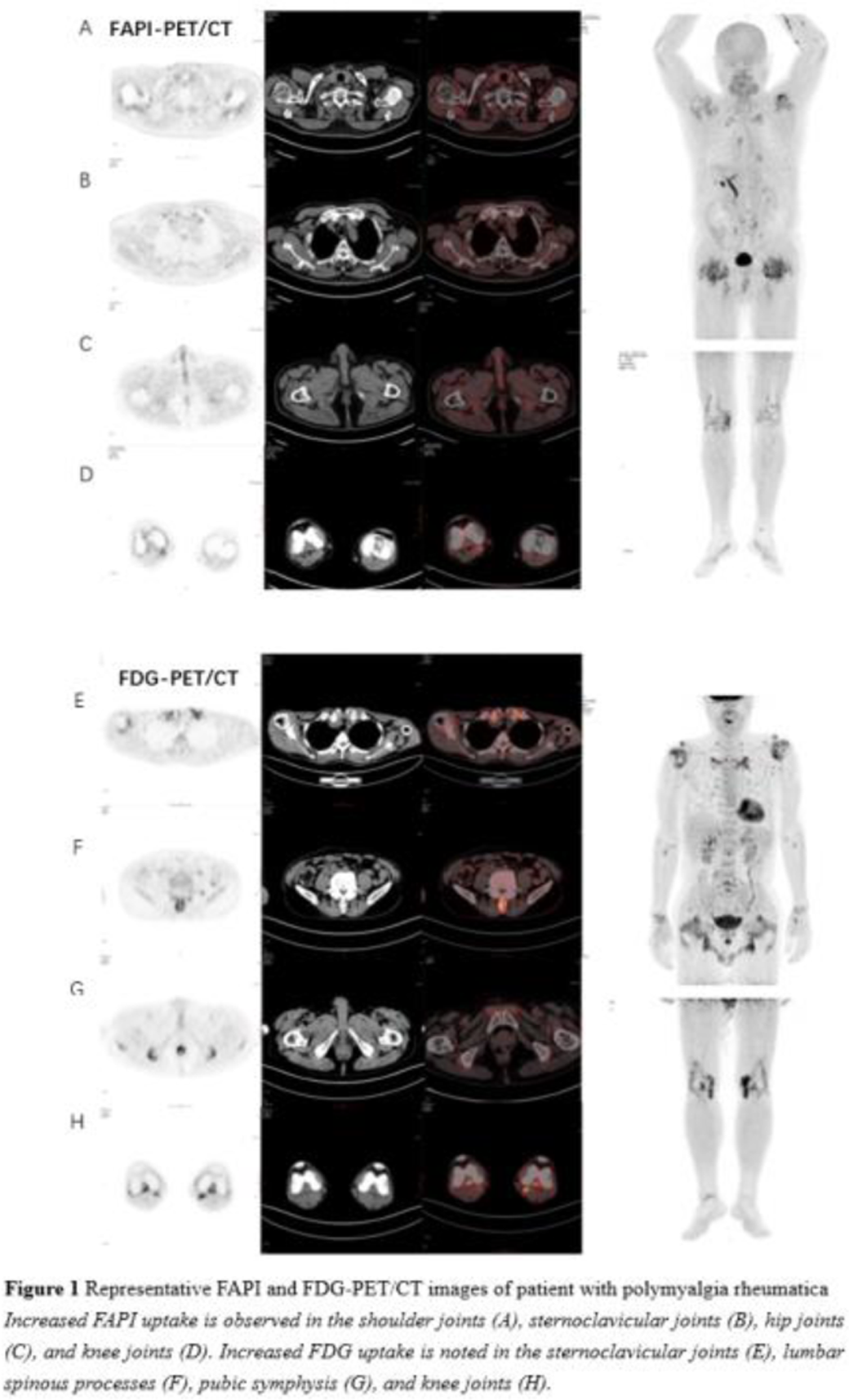
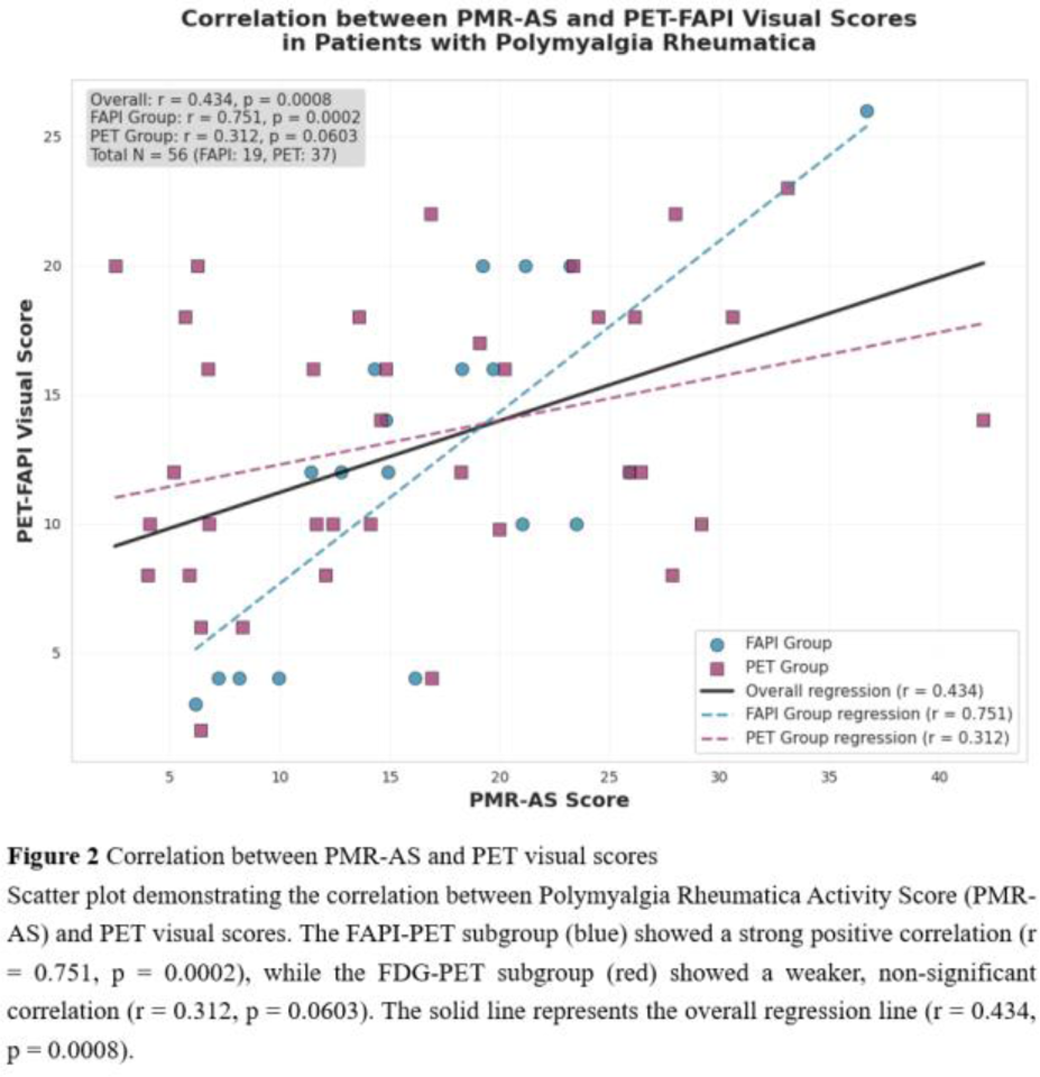
Results: The cohort consisted predominantly of patients with PMR (83.3%). In these patients, FAPI-PET demonstrated a distinct imaging profile, characterized by superior sensitivity in the shoulder girdle (91.3% vs 66.7%, P =0.023) and significantly higher uptake intensity (SUVmax 9.5 vs 5.6, P <0.01) compared to FDG-PET. FDG-PET showed higher detection rates at other sites including the ischial tuberosities. Most notably, we found a strong positive correlation between the FAPI-PET Visual Index and clinical disease activity (PMR-AS: R=0.751, P =0.0002), which was significantly stronger than the non-significant correlation observed with FDG-PET (R=0.312, P =0.0603). In the smaller GCA subgroup, trends were observed, with FDG-PET showing more frequent vascular involvement.
Conclusions: FAPI-PET demonstrates superior performance for the assessment of PMR, closely reflecting clinical disease activity and outperforming FDG-PET in evaluating characteristic girdle involvement. FAPI-PET emerges as a highly specific imaging biomarker for PMR, holding significant promise for improving diagnosis, phenotypic stratification, and objective monitoring of treatment response.
REFERENCES: [1] Dejaco, C., et al., 2015 Recommendations for the management of polymyalgia rheumatica: a European League Against Rheumatism/American College of Rheumatology collaborative initiative. Ann Rheum Dis, 2015. 74 (10): p. 1799-807.10.1136/annrheumdis-2015-207492.
[2] Hellmich, B., et al., 2018 Update of the EULAR recommendations for the management of large vessel vasculitis. Ann Rheum Dis, 2020. 79 (1): p. 19-30.10.1136/annrheumdis-2019-215672.
[3] Dasgupta, B., et al., 2012 provisional classification criteria for polymyalgia rheumatica: a European League Against Rheumatism/American College of Rheumatology collaborative initiative. Ann Rheum Dis, 2012. 71 (4): p. 484-92.10.1136/annrheumdis-2011-200329.
[4] Ponte, C., et al., 2022 American College of Rheumatology/EULAR classification criteria for giant cell arteritis. Ann Rheum Dis, 2022. 81 (12): p. 1647-1653.10.1136/ard-2022-223480.
[5] van der Geest, K.S.M., et al., Diagnostic value of [18F]FDG-PET/CT in polymyalgia rheumatica: a systematic review and meta-analysis. Eur J Nucl Med Mol Imaging, 2021. 48 (6): p. 1876-1889.10.1007/s00259-020-05162-6.
[6] Billet, A.C., et al., Prognostic value of 18 FDG-PET at diagnosis and follow-up in giant cell arteritis: An observational restrospective study. Eur J Intern Med, 2024. 126 : p. 69-76.10.1016/j.ejim.2024.03.037.
[7] Slart, R., FDG-PET/CT(A) imaging in large vessel vasculitis and polymyalgia rheumatica: joint procedural recommendation of the EANM, SNMMI, and the PET Interest Group (PIG), and endorsed by the ASNC. Eur J Nucl Med Mol Imaging, 2018. 45 (7): p. 1250-1269.10.1007/s00259-018-3973-8.
[8] Lindner, T., et al., Development of Quinoline-Based Theranostic Ligands for the Targeting of Fibroblast Activation Protein. J Nucl Med, 2018. 59 (9): p. 1415-1422.10.2967/jnumed.118.210443.
[9] Kratochwil, C., et al., (68)Ga-FAPI PET/CT: Tracer Uptake in 28 Different Kinds of Cancer. J Nucl Med, 2019. 60 (6): p. 801-805.10.2967/jnumed.119.227967.
[10] Bentestuen, M., N. Al-Obaydi, and H.D. Zacho, FAPI-avid nonmalignant PET/CT findings: An expedited systematic review. Semin Nucl Med, 2023. 53 (5): p. 694-705.10.1053/j.semnuclmed.2023.02.001.
[11] Leeb, B.F. and H.A. Bird, A disease activity score for polymyalgia rheumatica. Ann Rheum Dis, 2004. 63 (10): p. 1279-83.10.1136/ard.2003.011379.
[12] Kang, F., et al., Performance of the PET vascular activity score (PETVAS) for qualitative and quantitative assessment of inflammatory activity in Takayasu’s arteritis patients. Eur J Nucl Med Mol Imaging, 2020. 47 (13): p. 3107-3117.10.1007/s00259-020-04871-2.
[13] El-Haddad, G., et al., Evolving role of positron emission tomography in the management of patients with inflammatory and other benign disorders. Semin Nucl Med, 2004. 34 (4): p. 313-29.10.1053/j.semnuclmed.2004.06.006.
[14] Weyand, C.M. and J.J. Goronzy, Clinical practice. Giant-cell arteritis and polymyalgia rheumatica. N Engl J Med, 2014. 371 (1): p. 50-7.10.1056/NEJMcp1214825.
[15] Tateishi, U., J. Tsuchiya, and K. Yokoyama, Large vessel vasculitis: imaging standards of (18)F-FDG PET/CT. Jpn J Radiol, 2021. 39 (3): p. 225-232.10.1007/s11604-020-01059-4.
[16] Giesel, F.L., et al., (68)Ga-FAPI PET/CT: Biodistribution and Preliminary Dosimetry Estimate of 2 DOTA-Containing FAP-Targeting Agents in Patients with Various Cancers. J Nucl Med, 2019. 60 (3): p. 386-392.10.2967/jnumed.118.215913.
[17] Grayson, P.C., et al., (18) F-Fluorodeoxyglucose-Positron Emission Tomography As an Imaging Biomarker in a Prospective, Longitudinal Cohort of Patients With Large Vessel Vasculitis. Arthritis Rheumatol, 2018. 70 (3): p. 439-449.10.1002/art.40379.
[18] Quinn, K.A., et al., Association of (18) F-Fluorodeoxyglucose-Positron Emission Tomography Activity With Angiographic Progression of Disease in Large Vessel Vasculitis. Arthritis Rheumatol, 2023. 75 (1): p. 98-107.10.1002/art.42290.
Acknowledgments: NIL.
Disclosure of Interests: None declared.