fetching data ... 
Background: The application of immune checkpoint inhibitors (ICIs) is associated with immune-related adverse events (irAEs), which can lead to treatment discontinuation and compromise patient safety. The underlying mechanisms remain unclear, and effective biomarkers for early risk prediction are currently lacking. This highlights the need to identify dynamic biomarkers to improve early detection and mechanistic insight.
Objectives: This study aims to identify novel serum biomarkers of irAEs via dynamic proteomic profiling and to elucidate their potential role in irAE pathogenesis.
Methods: Dynamic proteomic profiling was performed on serum samples collected from lung cancer patients before and after ICI therapy, using Olink assays. CD6 expression on CD4 + T cells was analysed by flow cytometry. In vitro, CD4 + T cells were stimulated with anti-PD-1 antibody, after which CD6 secretion along with JAK/STAT pathway activity were evaluated.
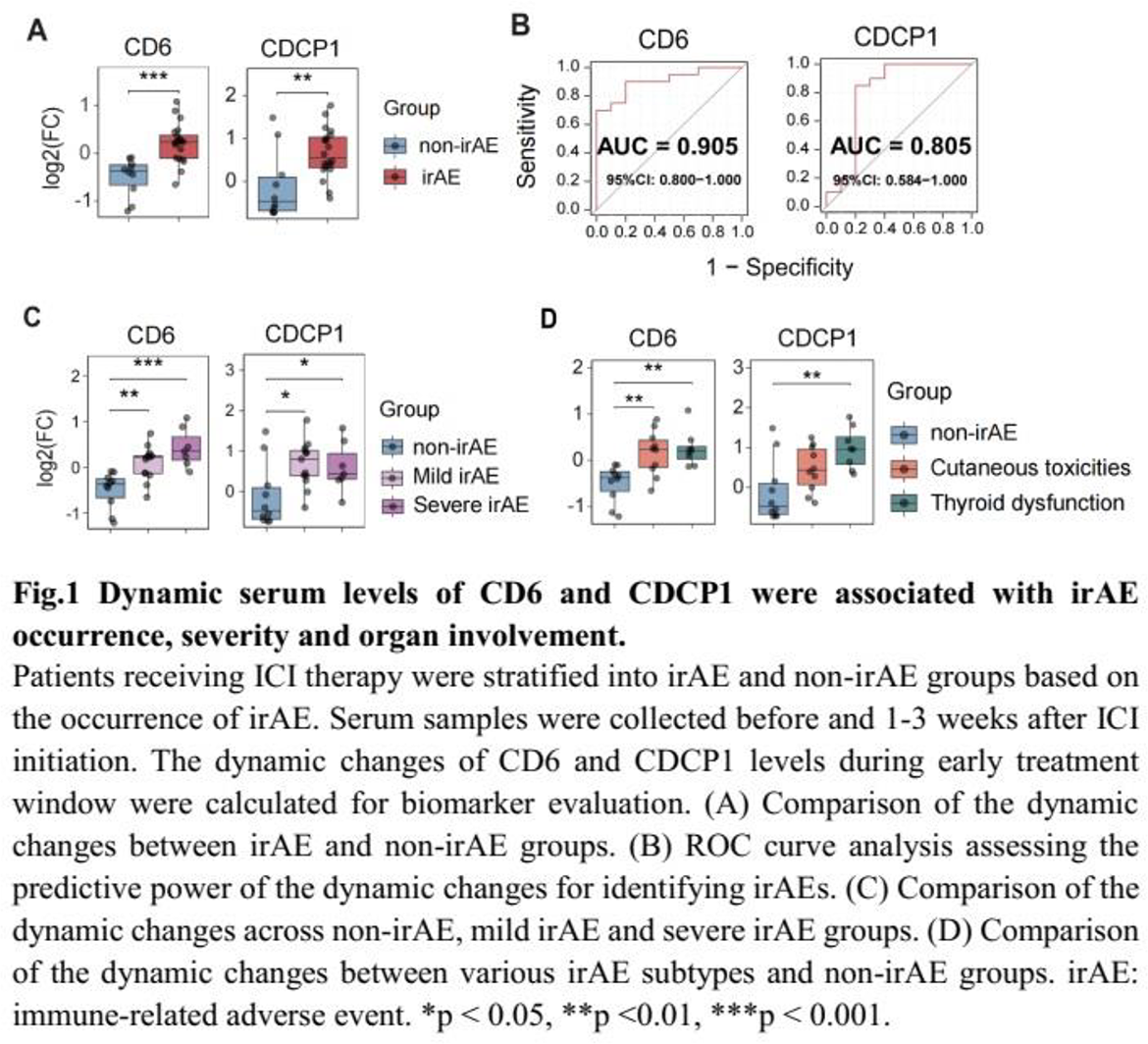
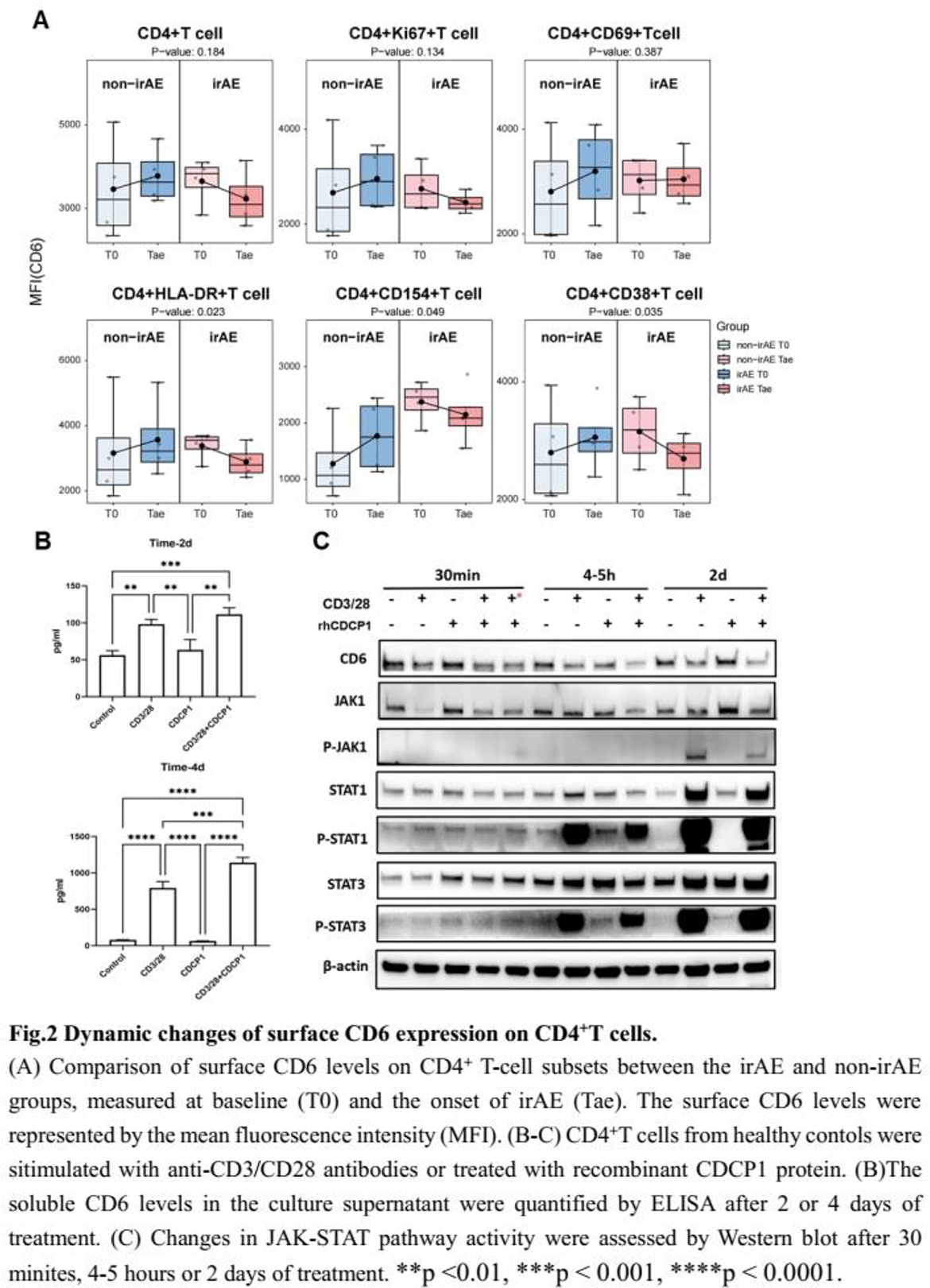
Results: The post-/pre-ICI change of serum CD6 was significantly higher in irAE group compared to the non-irAE group (p<0.001). And its ligand, CDCP1, showed a consistant dynamic change (Figure 1A). The dynamic change of both CD6 and CDCP1 demonstrated high predictive accuracy (AUC>0.8) and correlated with clinical severity and organ involvement of irAE, supporting their potential as biomarkers (Figure 1B-D). Flow cytometry revealed decreased surface CD6 on CD4 + T cells, especially on activated subsets, in irAE patients, whereas it increased in non-irAE patients (Figure 2A). Furthermore, in vitro activation via anti-CD3/CD28 or anti-PD-1 treatment promoted CD6 shedding from CD4 + T cells and enhanced the T cell activation through a JAK/STAT-dependent mechanism (Figure 2B-C).
Conclusions: Our study identifies CD6 as a dynamic serum biomarker associated with irAE occurrence, severity and organ involvement. Mechanistically, ICI therapy may induce CD6 shedding from CD4 + T cells, thereby attenuating CDCP1-mediated inhibition of the JAK/STAT pathway and leading to hyperactivation and proliferation of CD4 + T cells, ultimately driving irAE pathogenesis. These findings provide a promising biomarker for early irAE detection and a mechanistic basis for targeted interventions.
REFERENCES: NIL.
Acknowledgments: NIL.
Disclosure of Interests: None declared.