fetching data ... 
Background: The global impact of knee OA continues to grow due to aging populations and rising obesity rates. As the immune system ages and regenerative functions decline, joint tissue damage accumulates with low-grade inflammation, driving progressive knee pain and functional disability. Allocetra is a novel allogeneic immune-modulating cell therapy that induces reprogramming of activated macrophages, by harnessing the naturally-occurring activity of apoptotic cells to induce an immuno-modulated pro-homeostatic state. The 3-month analysis of an ongoing Phase IIa RCT (NCT06233474) assessing safety and efficacy of Allocetra in knee OA, identified a primary age-related responder population, demonstrating a clinically meaningful and statistically significant response trending with increasing age.
Objectives: The aim of this report is to present 6-month data from ENX-CL-05-001, a multicenter, randomized, double-blind, placebo-controlled Phase IIa trial evaluating the safety and efficacy of intra-articular (IA) administration of Allocetra compared to placebo in patients with symptomatic moderate-severe knee OA. Primary objectives are safety and tolerability. Key secondary endpoints evaluate responses to treatment using WOMAC and pain (NRS 0-10) questionnaires, as well as functional performance tests. Exploratory objective was to identify a high responder sub-population based on predefined criteria.
Methods: Included participants had chronic, painful knee OA with radiographic KL grade 2-3. Participants received IA injections on Days 0/14/28 and are followed to Month 12. An innovative data-driven machine-learning (ML) approach explored heterogeneity in treatment responses and high-responder populations.
Results: 134 patients were randomized and treated. Baseline characteristics were well balanced (mean age 61, 55% female, mean BMI 29). No treatment-related SAEs occurred. AEs were more frequent with Allocetra (89.6% [60/67] vs 74.6% [50/67]), driven by transient local reactions comprising increased knee pain and/or swelling (typically resolving ~6 days).
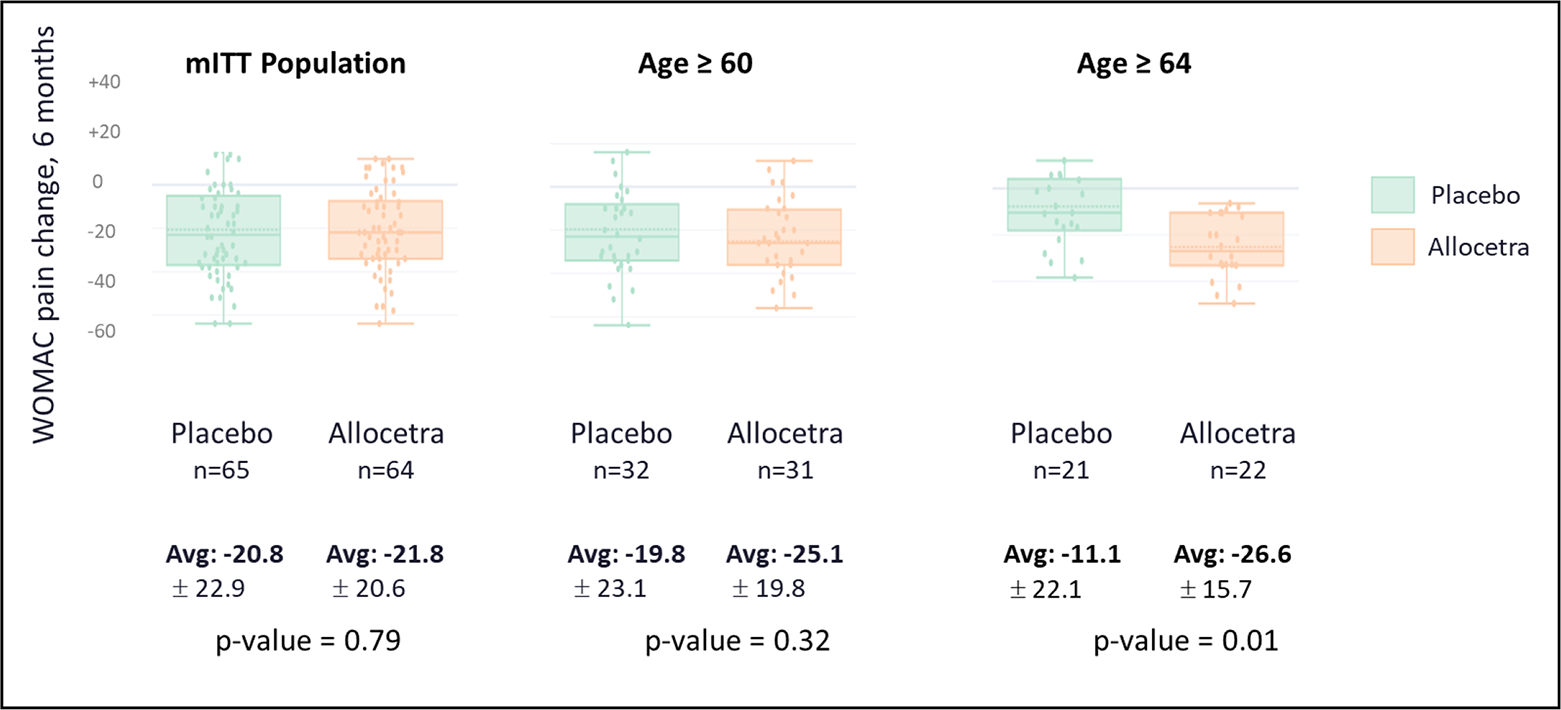
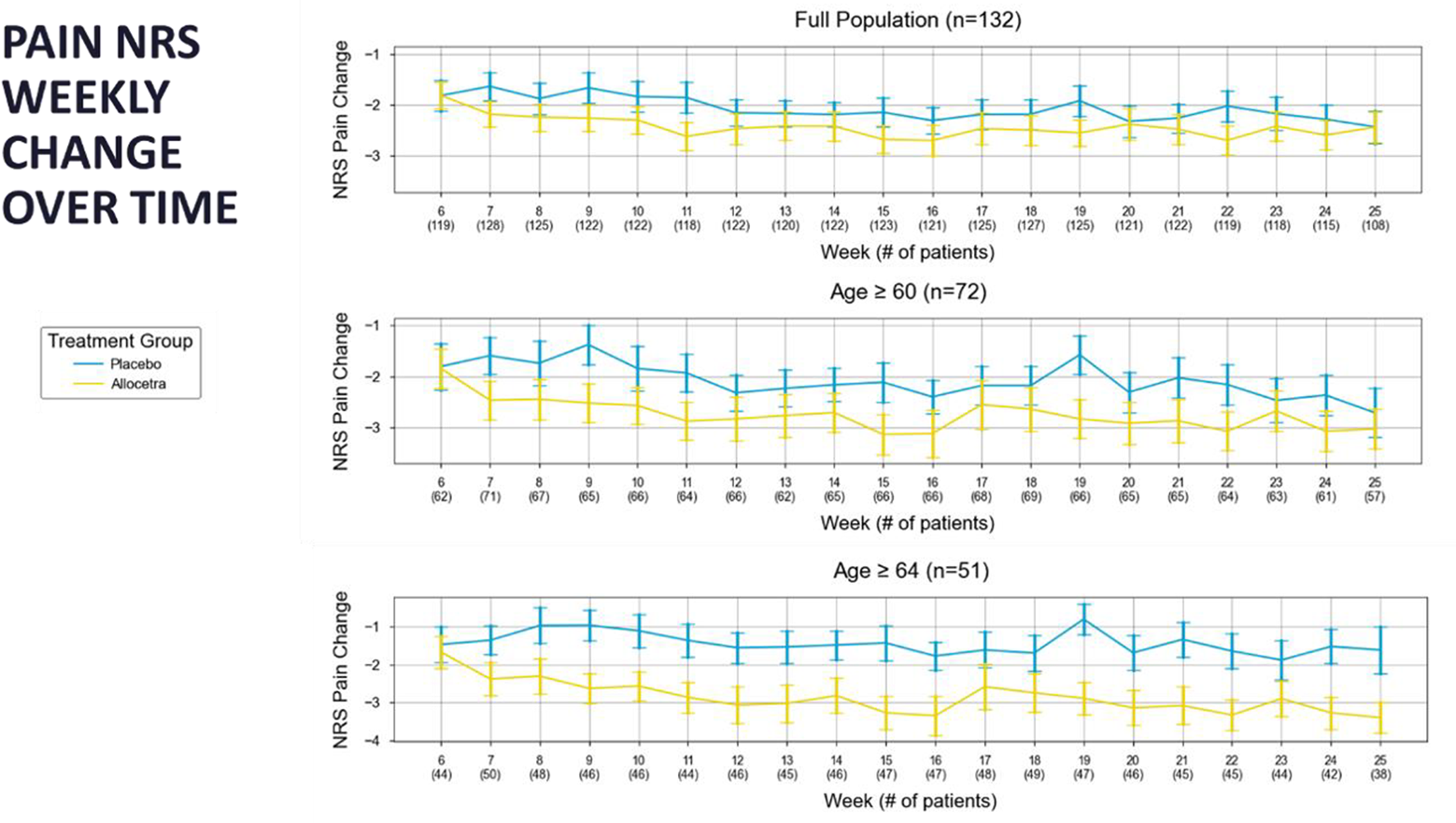
In the mITT population, pain improvement was up to 24% higher with Allocetra vs placebo and WOMAC pain and function improvements were also numerically evident without achieving statistical significance. The agnostic ML responder analysis identified an age-related responder population, with consistent statistical benefit for older age, starting from age 60 years (54% of the population), and when using older age cut points. Results at 6 months supported the age-related responder population (Figure 2), and demonstrated durable outcomes for Allocetra, with a sustained treatment effect across ages. For example, at 6 months WOMAC pain was −26.55 (SD 15.71) change from baseline in Allocetra-treated patients aged 64 years and above and placebo was −11.14 (SD 22.13), demonstrating an improvement over controls (p=0.012; standardized effect size (SES) 0.8), and WOMAC Function −26.47 (SD 13.34) for Allocetra vs −6.95 (SD 21.27; p=0.0008; SES 1.1). Pain NRS group difference (-1.86 at 6 months; scale 0-10; p=0.010) was consistent with weekly pain reporting (Figure 1). Results were further supported by performance-based tests demonstrating mean increases of 3.5 repetitions in the age 64+ population in the 30-sec Chair Stand Test at 6 months (p=0.039, respectively). Furthermore, age and outcomes further demonstrated correlations to imaging markers of disease severity and synovial inflammation, potentiating the clinical relevance of the findings.
Conclusions: Intra-articular Allocetra was well tolerated without treatment-related SAEs. Results at 6 months were consistent with 3 months and demonstrated clinically meaningful and statistically significant improvements in pain and function in participants ≥60 years, with effects increasing at older ages. This target population is consistent with an age-linked, macrophage-mediated OA phenotype. Findings support advanced trials targeting an older population with primary, age-related knee OA, demonstrating at least 6 months clinical efficacy and potentially paving the way to a novel therapeutic approach at the intersection of aging, inflammation and tissue damage in knee OA patients.
Distribution of change from baseline in WOMAC pain score at 3 months by treatment group in the overall population and age-stratified subgroups. Box plots show the median and interquartile range. Sample sizes and mean ± SD are shown below each group. Negative values indicate improvement in pain.
Mean weekly change from baseline in Pain Numeric Rating Scale (NRS) scores over time in the full population and stratified by age group (≥60 years and ≥64 years). Points represent mean change from baseline at each week with 95% confidence intervals. Numbers below the x-axis indicate the number of patients contributing data at each time point.
REFERENCES: NIL.
Acknowledgments: NIL.
Disclosure of Interests: Philip G. Conaghan AbbVie, Alfasigma, Eli Lilly, Enlivex, FormatoinBio, Genascence, Grunenthal, Kolon TissueGene, Levicept, Moebius, Novartis, Orion, Pacira, Stryker, Takeda, Bernt Husøy: None declared, Cecilie Rovsing: None declared, Sidsel Lyngaard Boll: None declared, Liliana Groppa: None declared, Ali Mobasheri Enlivex, Tobias Winkler BMFTR Germany, Enlivex, European Commission, Heraeus Medical, Innovation Fund Denmark, Liposphere, Ossium, Pluri, Relieve, Ariel Vishne: None declared, Adir Shaham: None declared, Elad Berkman: None declared, Lital Weinfeld-Bergman Enlivex, Lior Binder Enlivex, Asger R. Bihlet: None declared, Oren Hershkovitz Enlivex, Einat Galamidi Enlivex, Dror Mevorach Enlivex, Amir Oron: None declared.