fetching data ... 
Background: Following regulatory safety warnings based on the ORAL Surveillance trial [1], uncertainty remains regarding the generalisability of the reported malignancy risk associated with JAK inhibitors (JAKi) to routine clinical practice. Although ORAL Surveillance evaluated several cancer subtypes, it assessed only a single JAKi and did not include biologic DMARDs with other modes of action (OMA). Real-world observational studies addressing this question have reported inconsistent results.
Objectives: To evaluate the incidence of cancer subtypes in RA patients treated with JAKi compared to TNF inhibitors (TNFi) and bDMARDs-OMA, from a large, international, real-world population.
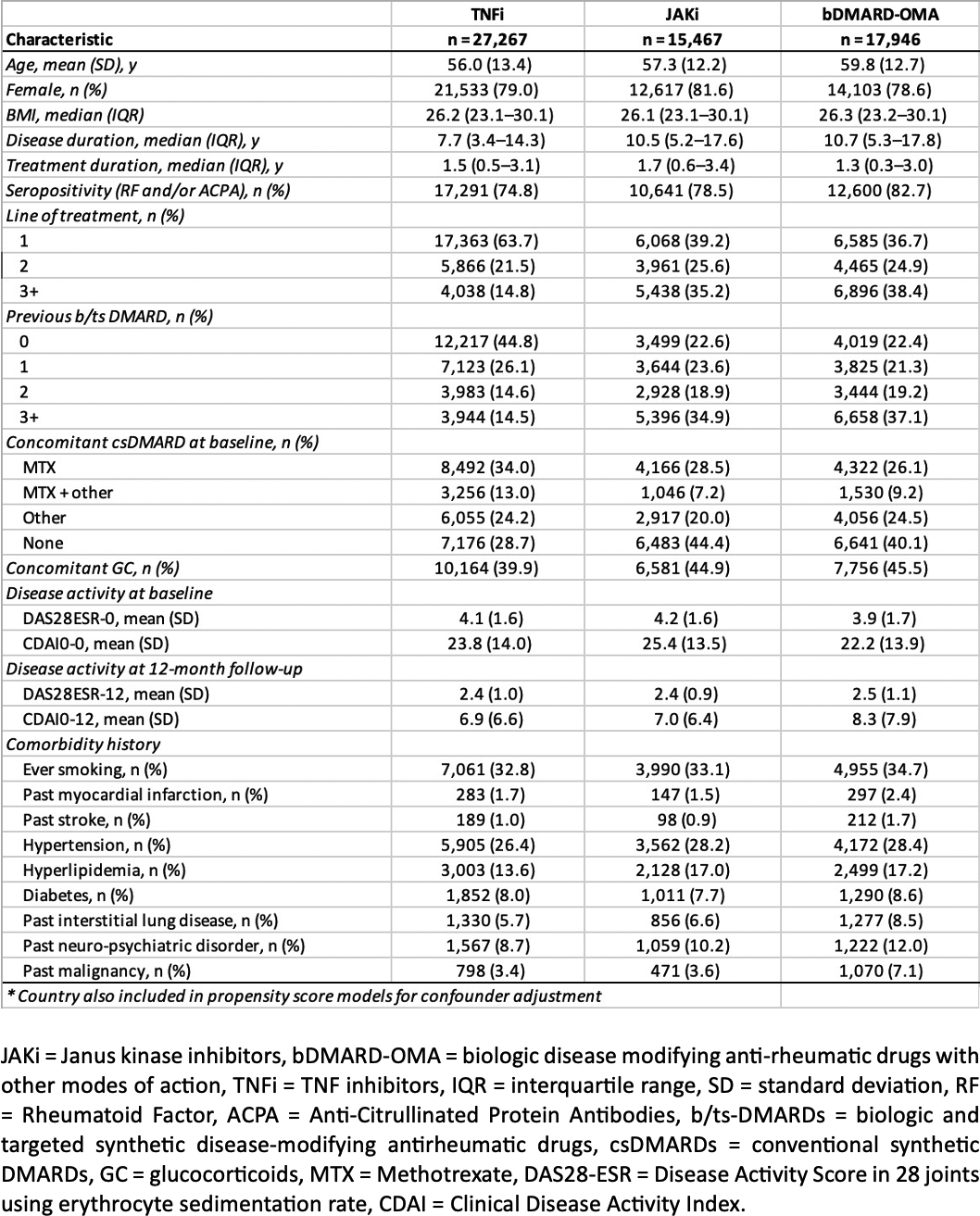
Methods: Data from 14 European and Québec RA registries of patients treated with JAKi (tofacitinib, baricitinib, upadacitinib, filgotinib), TNFi, or OMA (IL-6 inhibitors, CTLA4-Ig, rituximab) were analysed through October 2025. Cancer outcomes were assessed within an exposure window extending from treatment initiation until 5 years after treatment discontinuation, or until the occurrence of an adverse event (AE), loss to follow-up, or study end, whichever came first. The outcomes considered were stratified into overall cancers excluding non-melanoma skin cancer (NMSC), NMSC, haematologic malignancies, and specific solid tumors (breast, colorectal, genital, lung, and prostate cancers). The category “overall cancer excluding NMSC” comprised all solid and haematologic malignancies, including solid tumors other than those analysed separately. Incidence rates (IR) per 1000 patient years (PY) and incidence rate ratios (IRR) between treatments were calculated using Poisson generalized estimating equations (GEE). Adjusted IRRs (aIRR) and confidence intervals (CIs) were calculated with propensity score weighting based on the covariates from Table 1 and in addition for country.
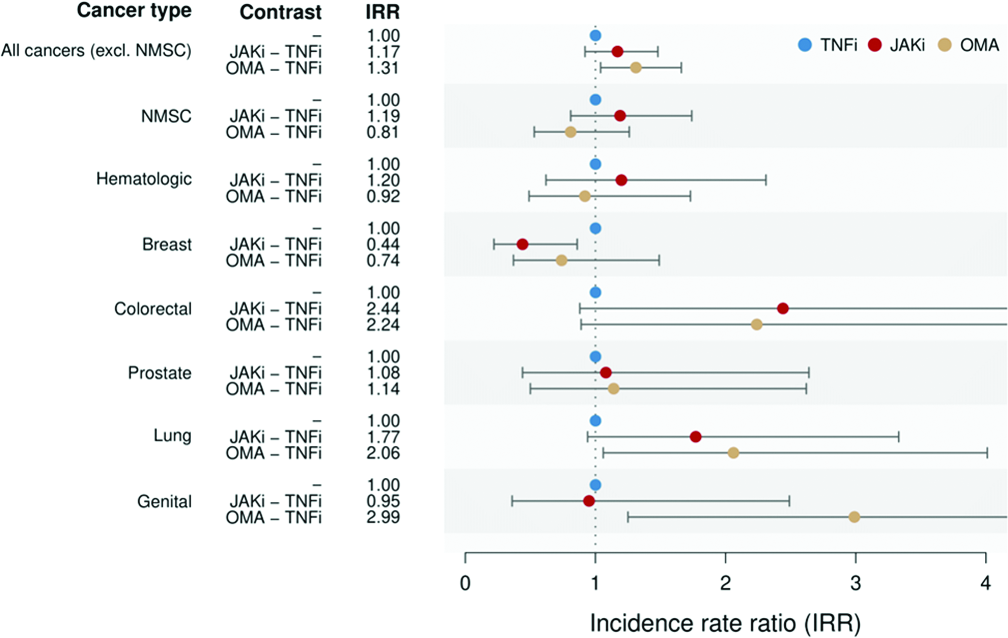
Results: Among 37’559 patients with 60’977 treatment courses, 792 cancers, including 217 NMSC, were recorded. Mean follow-up was 2.98 (standard deviation 2.2) years for TNFi, 2.85 (2.0) for JAKi and 3.00 (2.2) for OMA. Crude incidence of overall cancer excluding NMSC was lower for TNFi (2.7/1000 PY) than for JAKi (3.4/1000 PY) and OMA (3.9/1000 PY). After adjustment, there was no statistically significant higher risk with JAKi compared to TNFi for overall cancer excluding NMSC (aIRR = 1.17; 95% CI 0.92–1.48), NMSC (1.19; 0.81–1.74), haematologic malignancies (1.20; 0.62–2.31) or solid tumor subtypes, including breast (0.44; 0.22–0.86), colorectal (2.44; 0.88–6.72), genital (0.95; 0.36–2.49), lung (1.77; 0.94–3.33), and prostate cancer (1.08; 0.44–2.64). In patients treated with OMA compared with TNFi, the aIRR for overall cancer excluding NMSC (1.31; 1.04-1.66), lung cancer (2.06; 1.06-4.01) and genital cancer (2.99; 1.25-7.15) was higher. No differences were observed for NMSC (0.81; 0.53–1.26), haematologic malignancies (0.92; 0.49–1.73), or other solid tumors, including breast (0.74; 0.37–1.49), colorectal (2.24; 0.89–5.63), and prostate cancer (1.14; 0.50–2.62).
Conclusions: In this large real-world study, while JAKi were associated with a numerically higher adjusted point estimate for overall cancer compared with TNFi, this did not achieve statistical significance. No statistically significant increase in risk was observed for any specific cancer subtype. However, OMA use was associated with a significantly higher incidence of overall cancer excluding NMSC, lung cancer and genital cancer compared with TNFi. Given limitations of the analysis, including estimates for incidence of rare events, further studies are warranted.
Table 1. Baseline characteristics
Incidence rates ratio of cancer for JAK inhibitors (JAKi) and bDMARDs wish other mode of action (OMA) compared to TNF inhibitors (TNFi) by cancer category.
REFERENCES: [1] DOI:10.1056/NEJMoa2109927.
Acknowledgments: NIL.
Disclosure of Interests: Benedetta Ciribè: None declared, Ben Meuleman: None declared, Romain Aymon: None declared, Denis Mongin: None declared, Benoît Gilbert: None declared, Romain Guemara: None declared, Denis Choquette: None declared, Catalin Codreanu AbbVie, Amgen, AstraZeneca, Boehringer Ingelheim, Ewopharma, Lilly, Novartis, Pfizer, Sobi, UCB, Louis Coupal: None declared, Irini Flouri: None declared, Ruth Fritsch-Stork: None declared, Roberto F. Caporali AbbVie, Alfasigma, Astra-Zeneca, GSK, Eli Lilly, Galapagos, Janssen, Novartis, Pfizer and UCB., AbbVie, Alfasigma, Astra-Zeneca, GSK, Eli Lilly, Galapagos, Janssen, Novartis, Pfizer and UCB., Doreen Huschek: None declared, Florenzo Iannone Abbvie, Alfasigma, Amgen, Astra-Zeneca, Csl-Vifor, GSK, Janssen, Novartis, Lilly, UCB, Abbvie, Amgen, Astra-Zeneca, GSK, Janssen, Lilly, UCB, Tore K. Kvien Grünenthal, Janssen, Sandoz, AbbVie, Gilead, Janssen, Novartis, Pfizer, Sandoz, UCB, AbbVie, BMS, Galapagos, Novartis, Pfizer, UCB, Lucia Otero Varela: None declared, Dan Nordström MSD, Novartis, Pfizer, UCB, Karel Pavelka AbbVie, Eli Lilly, Sandoz, UCB, Medac, Pfizer, Manuel Pombo-Suarez: None declared, Sella Aarrestad Provan: None declared, Ziga Rotar Abbvie, Pfizer, Eli Lilly, SOBI, Novartis, Astra Zeneca, Stada, Prodromos Sidiropoulos Abbvie, Pfizer, Lilly, Amgen, MSD, Roche, Novartis, UCB, Janssen, Elsa Vieira-Sousa: None declared, Anja Strangfeld AbbVie, Alfasigma, Amgen, BioCon, Bristol Myers Squibb, Fresenius Kabi, Hexal, Lilly, Pfizer, Samsung Bioepis, and Sanofi Aventis. Previously Celltrion, MSD, Roche, and UCB, Jakub Závada AbbVie, Eli Lilly, Sandoz, Novartis, Egis, UCB, Sanofi, AstraZeneca, Sobi, Glaxo, AbbVie, Sobi, Nina Trokovic: None declared, Nevsun Inanc: None declared, Gokce Kenar Artin: None declared, Delphine S Courvoisier: None declared, Axel Finckh AstraZeneca, UCB, AbbVie, Alfasigma, Eli Lilly, Pfizer, Kim Lauper Abb Vie, AbbVie, Novartis, Pfizer, AbbVie, Eli Lilly, alfasigma.