fetching data ... 
Background: Rheumatoid arthritis–associated interstitial lung disease (RA-ILD) shares clinical, radiological, and genetic features with idiopathic pulmonary fibrosis (IPF), including a frequent usual interstitial pneumonia (UIP) pattern on imaging and an association with the MUC5B rs35705950 risk allele. Rare deleterious variants in telomere-related genes (TRGs) are well-established contributors to familial pulmonary fibrosis and IPF risk, but their role in RA-ILD remains unknown.
Objectives: We used whole exome and whole genome sequencing data to determine whether rare deleterious TRG variants are associated with ILD risk in patients with RA and to compare their contribution with that observed in IPF.
Methods: We conducted a genetic case-control study including two independent RA studies: a derivation study from France and a replication study from the US. Patients with RA-ILD were compared with RA controls without ILD, with ILD status determined by high-resolution computed tomography (HRCT). Whole-exome or whole-genome sequencing data were analyzed for 13 TRGs implicated in telomere biology ( TERT, TERC, PARN, RTEL1, CTC1, TINF2, ACD, POT1, NAF1, ZCCHC8, NHP2, NOP10, DKC1 ). Rare deleterious variants were defined using allele frequency <1%, and predicted functional impact according to SIFT2, POLYPHEN and Combined Annotation Dependent Depletion (CADD) scores. Burden analyses compared carrier frequencies using multivariable logistic regression adjusted for ancestry principal components, sex, and age. Results from derivation and replication cohorts were combined using random-effects meta-analysis. Subgroup analyses were performed according to HRCT pattern (definite or probable UIP vs non-UIP). Findings were also compared to patients with IPF and healthy controls.
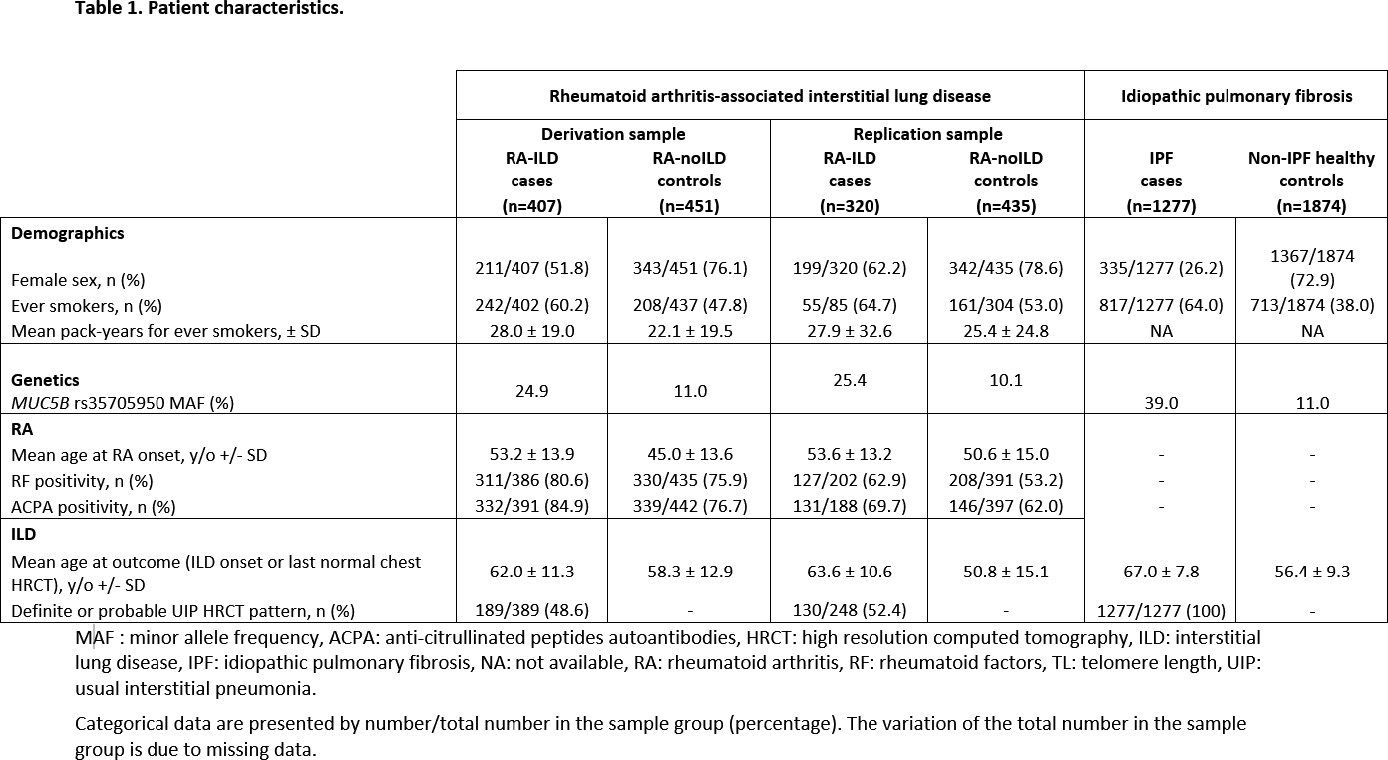
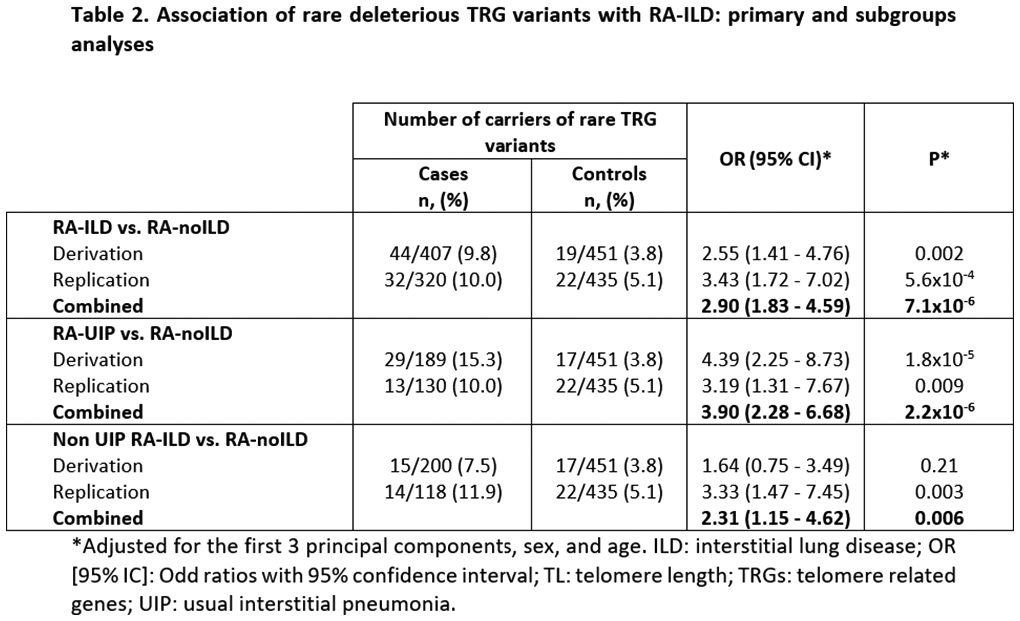
Results: The derivation study included 407 RA-ILD cases and 451 RA-no ILD controls without ILD, and the replication study included 320 RA-ILD cases and 435 RA-no ILD controls, table 1 . In both cohorts, the subjects with RA-ILD were less likely female (51.8% vs 76.1% in the derivation study and 62.2% vs 78.6% in the replication study) and were older at RA onset (mean 53.2 vs 45.0 years and 53.6 vs 50.6 years, respectively in each study) when compared to RA controls without ILD. The MUC5B rs35705950 T risk allele was more prevalent in RA-ILD cases than in RA-no ILD controls (24.9% vs 11.0% in the derivation study and 25.4% vs 10.1% in the replication study). A definite or probable UIP pattern on HRCT was observed in 48.6% of RA-ILD cases in the derivation study and 52.4% in the replication study. Rare deleterious TRG variants were significantly enriched in RA-ILD cases compared with RA-no ILD controls in both studies (derivation adjusted OR 2.55, 95% CI 1.41–4.76; replication adjusted OR 3.43, 95% CI 1.72–7.02), Table 2 . The meta-analysis confirmed a strong association (combined OR 2.90, 95% CI 1.83–4.59). TRG variant enrichment was observed in both RA-ILD patients with a definite or probable UIP pattern and those with non-UIP patterns. No significant interaction was detected between TRG variants and smoking status or MUC5B rs35705950 promoter variant. In comparative analyses, TRG variant enrichment in RA-ILD was similar in magnitude to that observed in IPF (adjusted OR 2.32, 95% CI 1.24–4.37). Among RA-ILD patients, carriers and non-carriers of TRG variants showed comparable clinical, serological, genetic, and radiological characteristics.
Conclusions: Rare deleterious variants in telomere-related genes are associated with an increased risk of ILD in patients with RA, independently of the MUC5B promoter variant. The comparable effect sizes observed in RA-ILD and IPF support defective telomere maintenance as a shared pathogenic mechanism underlying fibrotic lung disease across these conditions. These findings expand the genetic architecture of RA-ILD beyond common risk variants, reinforce the biological links between RA-ILD and IPF, and highlight telomere biology as a key contributor to RA-ILD susceptibility.
REFERENCES: NIL.
Acknowledgments: NIL.
Disclosure of Interests: Pierre-Antoine Juge: None declared, Leticia Kawano-Dourado: None declared, Amy Stockwell: None declared, Joyce S. Lee: None declared, Rachel Blumhagen: None declared, Steven Gazal: None declared, Pauline Brocard: None declared, Gregory McDermott: None declared, Keigo Hayashi: None declared, Jing Cui: None declared, Joshua Solomon: None declared, Paul J. Wolters: None declared, Benjamin Granger: None declared, Caroline Kannengiesser: None declared, Raphael Borie: None declared, Ibrahima Ba: None declared, Lidwine Wemeau Stervinou: None declared, Marie-Pierre Debray: None declared, Sylvain Marchand-Adam: None declared, Christophe Richez: None declared, Hilario Nunez: None declared, Philippe Froguel: None declared, Jerome Avouac: None declared, René-Marc Flipo: None declared, Vincent Cottin: None declared, Marie-Christophe Boissier: None declared, Thierry Schaeverbeke: None declared, Nathalie Saidenberg Kermanac’h: None declared, Bruno Crestani: None declared, Tracy Doyle Sanofi, Sanofi, Soumya Raychaudhuri: None declared, Elizabeth Karlson: None declared, Bryant L. Yaspan: None declared, David Schwartz: None declared, Jeffrey A. Sparks: None declared, Philippe Dieudé: None declared.