fetching data ... 
Background: Persistent pain and fatigue are frequently observed in patients with Systemic Lupus Erythematosus (SLE) and significantly impact their daily activities, overall well-being, and health-related quality of life. Whilst these symptoms can be associated with active disease, they frequently persist in those with low disease activity or remission.
Epigenetics is the study of DNA alterations that control gene expression without altering the genome sequence. One important epigenetic modification is the addition of a methyl group to the 5’ position of cytosine in cytosine phosphate guanosine (CpG) pairs, called DNA methylation.
Objectives: By performing epigenome-wide DNA methylation analysis, this study aims to identify epigenetic alterations associated with self-reported scores for pain, fatigue, and health in a group of women with long-term well-controlled SLE.
Methods: Forty-eight women with SLE from the SLEGOT cohort were included. Study participants exhibited low disease activity (median SLEDAI-2K= 0) and minimal damage (median SLICC damage index=0). An epigenome-wide DNA methylation analysis in whole blood identified 704,237 CpG loci, with 511,673 annotated to known genes. No CpG sites passed the FDR threshold of 0.05 for VAS for pain, fatigue nor overall health; therefore, we applied a stringent raw p -value cutoff of 0.001 in subsequent analyses to reduce the risk of false-positive findings.
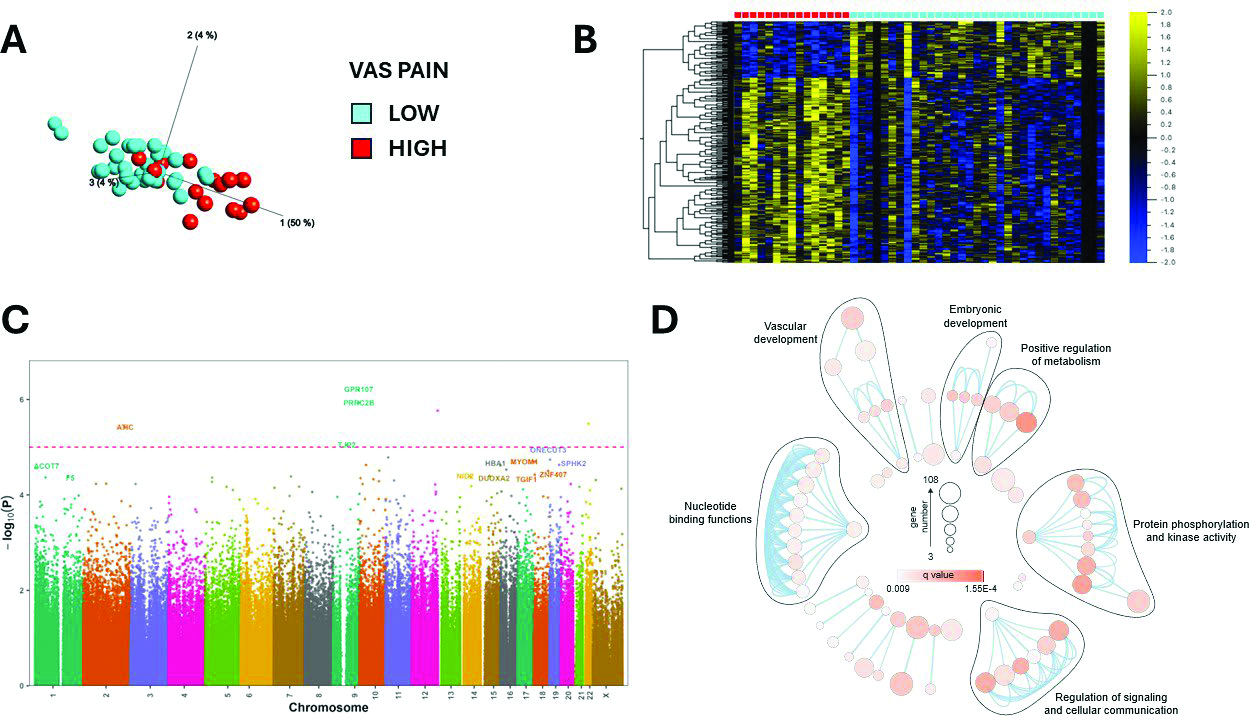
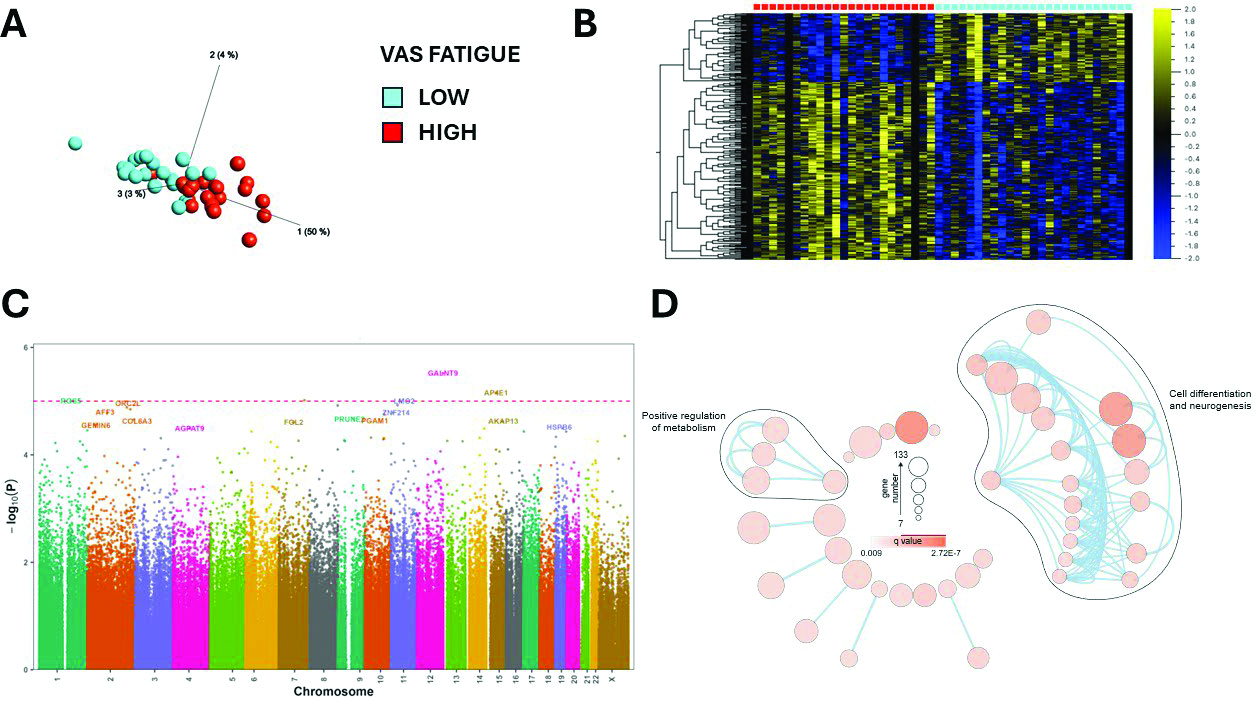
Results: We first dichotomized the cohort according to VAS for pain using a threshold of 35, to identify a group with “high pain” (VAS for pain≥35, n=15) and one with “low pain” (VAS for pain <35, n=33), as previously described for chronic musculoskeletal pain. PCA revealed stratification for patients based on VAS for pain (Figure 1A). The analysis identified 485 differentially methylated CpGs between participants with low and high pain (Figure 1B and C), belonging to 390 different genes, with GPR107, PRRC2B, and ATIC among the top ones. Gene Set Enrichment Analysis (GSEA) showed that the most impacted pathways for VAS pain in women with SLE were not related to inflammation or immunomodulation (Figure 1D), whereas the association of reported pain with CpGs in GPR107 , SPHK2 , HBA and RERE genes suggested a potential role for neuromodulation in pain perception in SLE. Several genes showed multiple CpGs linked to VAS for pain, including RASA3 with three CpGs associated with pain at p<0.001. For fatigue, PCA indicated stratification of patients based on VAS, with 23 patients in the high fatigue group (VAS ≥ 35) and the remainder in the low fatigue group (Figure 2A). The analysis identified 591 differentially methylated CpGs between participants with low and high fatigue, belonging to 479 different genes (Figure 2B and 2C), including GALNT9 and AP4E1 among the top ones. GSEA highlighted pathways related to positive regulation of metabolism, and cell differentiation and neurogenesis (Figure 2D). For overall health, the analysis revealed 577 differentially methylated CpGs between the low and high health groups, mapping to 418 different genes, with ZNF214 and RPS23 among the top hits.
Nine genes, including BDNF and TGIF1 , showed strong correlations with all three scores, suggesting a shared epigenetic influence that may underline pain, fatigue, and poor health in SLE. Specific microRNA genes, with MIR6850 and MIR6764 among the top ones, were differentially methylated in relation to pain and fatigue respectively.
Conclusions: By studying a cohort of women with well-controlled SLE, we identified several CpGs and genes associated with self-reported scores of pain, fatigue, and general health. Our findings show limited involvement of inflammatory pathways but suggest that epigenetic changes in genes involved in neuronal development and synaptic signalling could be involved in the chronicization of pain and fatigue in patients with SLE, even when the disease activity is low.
REFERENCES: NIL.
Acknowledgments: NIL.
Disclosure of Interests: Alessandro Camponeschi: None declared, Amin Ravaei: None declared, Tahzeeb Fatima: None declared, Chris Wincup Received honoraria from AbbVie, AstraZeneca, Bristol Myers Squibb, Kyverna, Otsuka and UCB, Advisory Board for Biogen, Research funding award to institution from AstraZeneca, Anna Rudin Received honoraria from AstraZeneca, Jan Bjersing: None declared, Cristina Maglio: None declared.