fetching data ... 
Background: The poor prognosis of systemic sclerosis (SSc) underscores the urgent need for early intervention to prevent disease onset and damage. Understanding the pathophysiological mechanisms driving the transition from pre-stages of the disease (pre-SSc) to established SSc (eSSc) is essential for developing preventive treatments.
Objectives: To provide an in-depth single-cell sequencing analysis of fibroblast and T cell subtypes and the molecular events driving immune–stromal interactions in pre-SSc.
Methods: We recruited patients with pre-SSc (n=6; VEDOSS criteria [1] without skin or other organ fibrosis), eSSc (n=7; 2013 ACR/EULAR criteria, disease duration < 5 years), and healthy controls (HC, n=6; age-, sex-, and ethnicity-matched). Site-matched forearm skin biopsies were collected, processed following the Chromium Next GEM protocol (10X Genomics), and analyzed with the Seurat pipeline. We utilized Harmony and STACAS integration methods to refine the fibroblast and T cell subclusters with functionally meaningful manual annotations. Over-Representation Analysis (ORA) of marker genes confirmed subcluster identities. Group-wise compositional differences were assessed with Speckle . Pairwise differential gene expression analysis was conducted with MAST . Pathway analyses, ORA and Gene Set Enrichment Analysis (GSEA), were performed with clusterProfiler using Gene Ontology (GO) database. Module scores were used to quantify features in fibroblasts and T cell subtypes based on defined gene sets. Cell-cell interaction analysis was performed with MultiNicheNet .
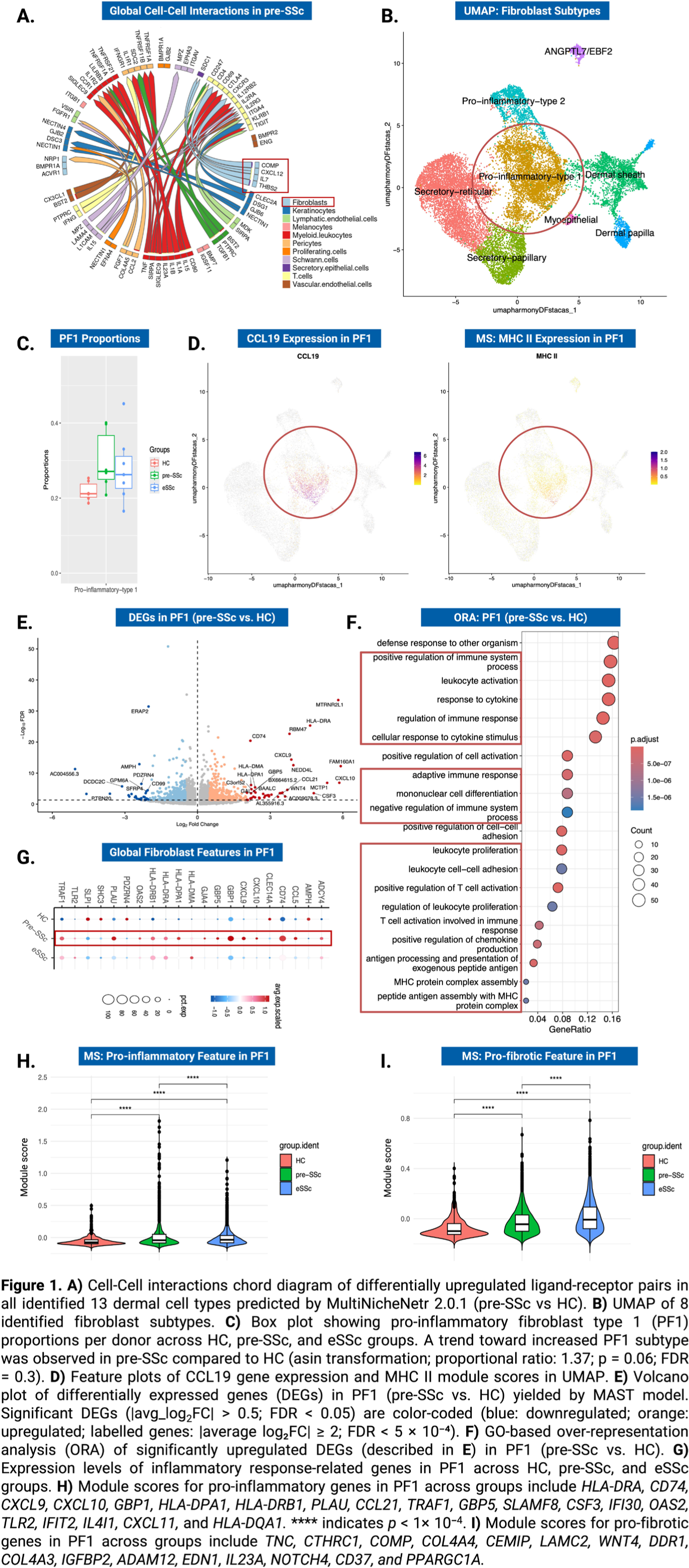
Results: Single-cell RNA sequencing of skin biopsies from pre-SSc revealed pronounced fibroblast alterations and predicted global signalling from fibroblasts to T cells ( Figure 1A ) as compared to HC, despite its normal, non-fibrotic clinical appearance. We identified eight dermal fibroblast subtypes, including pro-inflammatory fibroblast type 1 (PF1) ( Figure 1B ). Compositional analysis showed an expansion of PF1 fibroblasts in pre-SSc (proportional ratio: 1.37) ( Figure 1C ). ORA of top marker genes confirmed functional diversity among fibroblast subtypes and indicated a specific role of PF1 in cytokine-related immune responses. In pre-SSc versus HC, PF1 displayed 283 significantly upregulated genes, including HLA-DRA , CD74 , HLA-DPA1 , HLA-DMA , CXCL9 , CCL19 , CCL21 , and CCL5 ( Figure 1D-E ). Pathway analyses (ORA and GSEA) identified increased activation of cytokine/chemokine signalling, leukocyte and T cell activation, and antigen presentation together with upregulation of interferon-γ (IFN-γ) pathways in PF1 ( Figure 1F ). This suggests the existence of a pro-inflammatory state in fibroblasts already at pre-stages of SSc ( Figure 1G ). Further analysis revealed elevated pro-inflammatory and pro-fibrotic module scores in both pre-SSc and eSSc compared to HC ( Figure 1H-I ). Interestingly, pre-SSc was characterized by a higher pro-inflammatory signature, whereas eSSc demonstrates a shift towards a more pro-fibrotic phenotype in PF1, suggesting a shared mechanism that evolves from inflammation in pre-SSc toward fibrosis in eSSc.
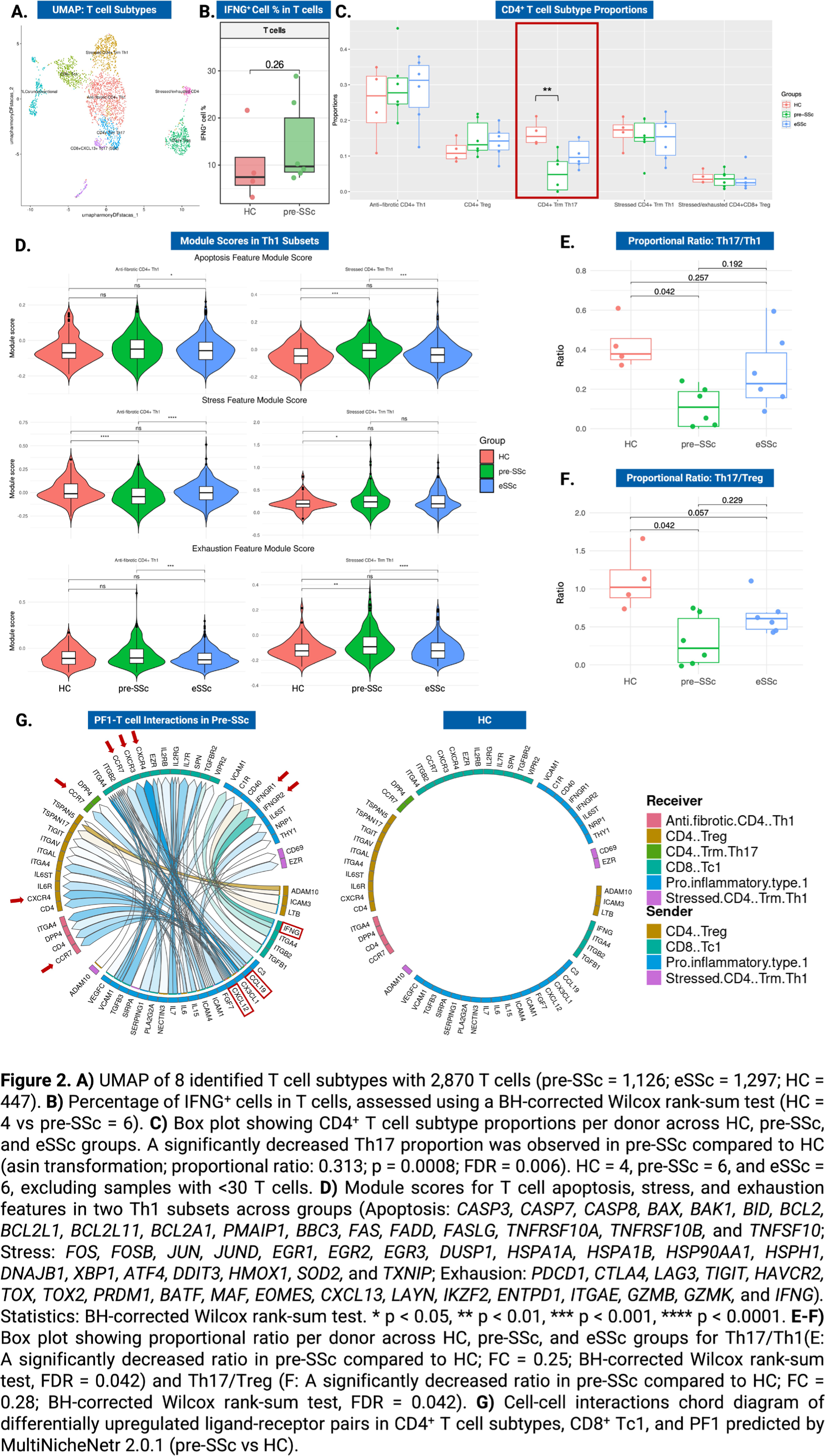
Building on the observation of global fibroblast–T cell interactions, we next performed an in-depth analysis of the T cell compartment. T cells were annotated into eight subtypes including CD4 + and CD8 + populations, with a minor fraction of natural killer (NK) cells, innate lymphoid cells (ILCs), and unconventional T cells ( Figure 2A ). When comparing to HC, we found a higher percentage of IFN-γ + T cells and T cell activation in pre-SSc consistent with the higher INF-γ response and HLA expression in PF1 ( Figure 2B ). Signs of a dysregulated immune tolerance were observed in CD4 + T cell subtypes: Th1, Th17, and Tregs. As assessed by module scores, in pre-SSc, stressed CD4 + Th1 exhibited high features of apoptosis, stress, and exhaustion, further supporting strong HLA stimulation ( Figure 2C-D ). The Th17/Th1 and Th17/Tregs ratios were reduced in pre-SSc, suggesting early CD4 + T cell dysfunction and a shift from Th17 toward Th1 and Treg polarization in an IFN-γ-rich environment ( Figure 2E-F ). In addition, metallothionein genes (MT1/MT2) were major genes enriched among the top upregulated pathways in both CD4 + (Th1, Th17, and Treg) and CD8 + (Tc1) subtypes, in line with an elevated activation-induced regulatory response.
Interestingly, cell–cell interaction analysis revealed key immune–stromal interactions centered on the CCL19–CCR7 axis between PF1 and Th17/Th1 cells, suggesting recruitment of CCR7 + T cells to inflamed dermal sites, highlighting early immune–stromal crosstalk as a central pathogenic mechanism of pre-SSc ( Figure 2G ).
Conclusions: Despite the clinically non-fibrotic, normal skin in pre-SSc, fibroblasts exhibit pronounced pro-inflammatory activation, primarily driven by the type 1 (PF1) subtype, which engages in early immune crosstalk with activated T cells in IFN–γ–rich tissue. This immune–stromal interaction is characterized by HLA-driven T cell activation and CCL19–CCR7-mediated recruitment. The concomitant emergence of dysfunctional Th1 and Th17 subsets highlights early local adaptive immune dysregulation preceding fibrosis. Early immune–stromal communication may therefore represent a central pathogenic mechanism and a potential therapeutic target for disease prevention.
REFERENCES: [1] Avouac, J. et al. Preliminary criteria for the very early diagnosis of systemic sclerosis: results of a Delphi Consensus Study from EULAR Scleroderma Trials and Research Group. Annals of the rheumatic diseases 70 , 476-481 (2011).
Acknowledgments: NIL.
Disclosure of Interests: Lumeng Li: None declared, Elena Pachera: None declared, Rucsandra Dobrota speaker fees/advisory board: Actelion, Boehringer-Ingelheim, speaker fees/advisory board: Actelion, Boehringer-Ingelheim, Grants/research funding from: Iten-Kohaut, Walter und Gertrud Siegenthaler Fellowship, Pfizer, and Actelion;
Congress/workshop participation support: Amgen, Otsuka, Sinziana Muraru: None declared, Kristina Buerki: None declared, Carina Mihai Speaker fees for Medbase, MED Talks Switzerland, Mepha, MedTrix, Novartis, PlayToKnow, advisory boards for Boehringer Ingelheim and Janssen, Congress support from Boehringer Ingelheim, Muriel Elhai Speaker fees from Boehringer Ingelheim., Grant/research support from Vontobel Stiftung, Pfizer, Novartis Foundation for Bio-Medical Research, Iten Kohaut foundation, Kurt und Senta Herrmann foundation, Foundation for research in Rheumatology (FOREUM), University Zurich, Walter and Gertrud Siegenthaler Foundation.
Congress Support from Janssen., Laura Much: None declared, Astrid Hofman: None declared, Pietro Bearzi: None declared, Shihan Xu: None declared, Madeleine Venables: None declared, Maryam Asadikorayem: None declared, Philip Stauffer: None declared, Anna-Maria Hoffmann-Vold Speakers bureau: Boehringer Ingelheim, Janssen, Medscape, Merck Sharp & Dohme, Novartis, Roche, Consultancy: AbbVie, Avalyn, AstraZeneca, Boehringer Ingelheim, Bristol Myers Squibb, Calluna Pharma, Genentech, Janssen, Medscape, Merck Sharp & Dohme, Pliant, Roche, Werfen, Grant/research support: AstraZeneca, Boehringer Ingelheim, Janssen, Oliver Distler Speaker: Boehringer Ingelheim, Consultancy: 4P-Pharma, Abbvie, Acepodia, Aera, AnaMar, Anaveon, Argenx, AstraZeneca, Avalyn, Boehringer Ingelheim, BMS, Calluna, Cantargia, CSL Behring, EMD Serono, Galderma, Galapagos, Gossamer, Hemetron, Innovaderm, Kali, Lilly, Mediar, MSD Merck, Nkarta, Novartis, Oorja Bio, Orion, Pliant, Prometheus, Quell, Scleroderma Research Foundation, Skyhawk, Tandem, Topadur, UCB and Umlaut.bio., Research Funding: Kymera, Mitsubishi Tanabe, UCB.