fetching data ... 
Background: Systemic sclerosis (SSc) shows a disproportionate prevalence in females compared to males, with approximately an 8:1 ratio, opposed to an increased severity and mortality in males. The limited cutaneous SSc (lcSSc) form of the disease is more frequent in females, whereas the diffuse cutaneous SSc (dcSSc), a more severe form, is more common in males. However, the molecular mechanisms underlying these differences remain poorly understood. Meanwhile, genetics plays a substantial role in disease risk. In a prior sex-stratified GWAS, eight loci showed sex-biased effects, including three novel loci , suggesting that genetic variants may affect risk differently in males and females. Therefore, we hypothesized that the HLA region, the strongest genetic determinant of SSc, may influence the observed sex-bias.
Objectives: We aimed to assess its sex-differential contribution to SSc susceptibility.
Methods: This study analysed the largest European-descent cohort in SSc, including 10,654 SSc patients (1,556 males and 9,097 females) and 18,043 controls (6,990 males and 11,053 females). After genotype quality control and imputation, classical alleles of the HLA genes were evaluated for sex-differential effects through three approaches: genotype-by-sex interaction, an intra-case by sex logistic regression, and stratified analysis (male-specific and female-specific). Conditional sequential analyses were conducted to identify independent classical alleles associations (R 2 < 0.2 and D’ < 0.5). Variants were considered independently associated if they showed a p value lower than 9.2 x 10 -5 after conditioning.
Results: We evidenced consistent associations in two HLA genes, namely HLA-DQA1 and HLA-C , both of which were identified in the genotype-by-sex interaction and the intra-case by sex analyses. Interestingly, HLA-DQA1 showed different associated alleles for each sex with opposite direction of effects: HLA-DQA1*05:01:01:01 was independently associated in males with SSc (Odds ratio [OR] with 95% confidence interval [95% CI]= 1.72 [1.50-1.96], p value = 1.96 x 10 -15 ) and HLA-DQA1*02:01:01:01 was an independent association in females (OR [95% CI] = 0.57 [0.51-0.62], p value = 2.43 x 10 -31 ). Notably, these alleles were previously associated in a sex-agnostic analysis with dcSSc and lcSSc, respectively, raising the hypothesis that they may be related to disease severity. Interestingly, HLA-C , a gene less well established in SSc susceptibility, showed an independent sex-differential genetic association in our study. It also revealed distinct alleles between sexes: HLA-C*07 was associated in males (OR [95%CI] = 1.30 [1.19-1.43], p value = 8.09 x 10 -9 ), while females showed an association for HLA-C*04:01:01:01 (OR [95% CI] = 1.24 [1.15-1.32], p value = 1.07 x 10 -9 ). Finally, HLA-DQB1*03 was an independent female-specific association, not identified in the male-stratified analysis, and the well-known HLA-DPB1*13 was consistently associated in both sexes, reinforcing its relevant role in the disease irrespectively of sex.
Conclusions: In this study, we have characterised sex-differences in the genetic architecture of the HLA region in SSc, highlighting the sex-differential contribution of HLA-DQA1 and HLA-C .
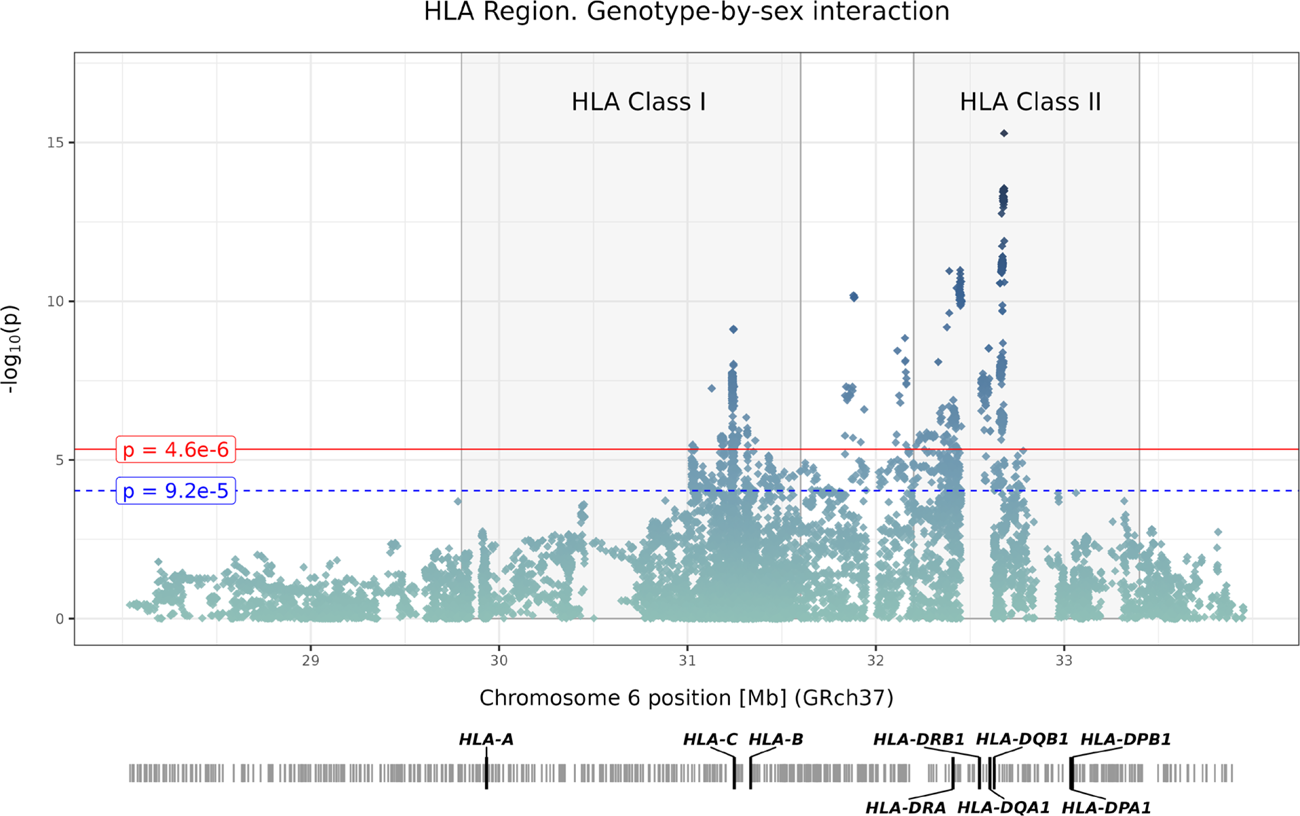
Regional plot of the HLA region for the genotype-by-sex interaction model in systemic sclerosis. The statistical significance is plotted as -log 10 of the p values against the chromosomal position. The red line indicates the threshold for significant association (p < 4.6 x 10 -6 ) and the blue-dashed line represents the threshold for suggestive association (p < 9.2 x 10 -5 ). Sex-differential genetic effects are observed in both HLA class I and class II regions.
REFERENCES: NIL.
Acknowledgments: NIL.
Disclosure of Interests: Inmaculada Rodriguez-Martin: None declared, Martin Kerick: None declared, Carlos Rangel-Peláez: None declared, Carlos Rosa-Baez: None declared, Gonzalo Borrego-Yaniz: None declared, Lourdes Ortiz-Fernández: None declared, Alfredo Guillen-Del-Castillo: None declared, Carmen P. Simeón-Aznar: None declared, José Luis Callejas: None declared, Oliver Distler: None declared, International SSc Group: None declared, PRECISESADS Clinical Consortium: None declared, Susanna M. Proudman has received honoraria by Janssen, Boehringer Ingelheim and MSD, has received research support by Janssen and Boehringer Ingelheim., Mandana Nikpour: None declared, Australian Scleroderma Interest Group (ASIG): None declared, Nicolas Hunzelmann: None declared, Jeska K. de Vries-Bouwstra has received speaker fees from Janssen-Cilag, Boehringer-Ingelheim, Pfizer, Astra-Zeneca, BMS, UCB, Novartis, Abbvie, Lilly, alfsigma, has received consultancy honoraria from Janssen-Cilag, Boehringer-Ingelheim, Abbvie, has received grants/research support from Galapagos, Vifor, Janssen-Cilag, ReumaNederland, NVLE. All payments are made to her institution., Ariane L. Herrick: None declared, Yannick Allanore: None declared, Marta Alarcon-Riquelme: None declared, Lorenzo Beretta: None declared, Shervin Assassi: None declared, Christopher P. Denton: None declared, Maureen D. Mayes: None declared, Javier Martin: None declared, Marialbert Acosta-Herrera: None declared