fetching data ... 
Background: A recent safety trial highlighted higher rates of infections (including serious) with tofacitinib, a JAK-inhibitor (JAKi), compared with TNF-inhibitors (TNFi) in patients with rheumatoid arthritis (RA). However, real-world observational studies have reported heterogeneous results, leaving some important uncertainty regarding the infectious burden associated with JAKi in routine practice, across different JAKi subtypes and compared to bDMARDs with other mode of actions (OMA).
Objectives: To address these uncertainties, we used data from the international JAK-pot collaboration to compare the risk of infections in RA patients treated with TNFi, JAKi or OMA.
Methods: Patients from 15 RA registries across Europe and Québec (Canada), starting a new treatment course with either a JAKi, TNFi or OMA were included. Tofacitinib, upadacitinib and baricitinib were also evaluated separately. We investigated the following outcomes: all infections, serious infections (SI; requiring hospitalization, intravenous treatment or resulting in death), all infections excluding herpes zoster (HZ), HZ, and specific infections (skin, lung, digestive, osteoarticular, and systemic). Exposure period started at treatment initiation and stopped either 3 months after discontinuation (1 year for rituximab), or loss to follow-up, death or study end, whichever came first. Multiple imputations techniques and propensity score adjustment with inverse probability weighting (IPW) were performed using patient’s characteristic such as age, sex, disease duration, seropositivity, previous use of bDMARD, concomitant use of bDMARD, use of glucocorticoid, Health Assessment Questionnaire, modified Rheumatic Disease Comorbidity Index and history of infections. Adjusted Incidence Rate Ratios (aIRRs) were computed using Poisson regression with 95% CI using generalized estimating equations (GEE) and adjusted for country of origin of the registry.
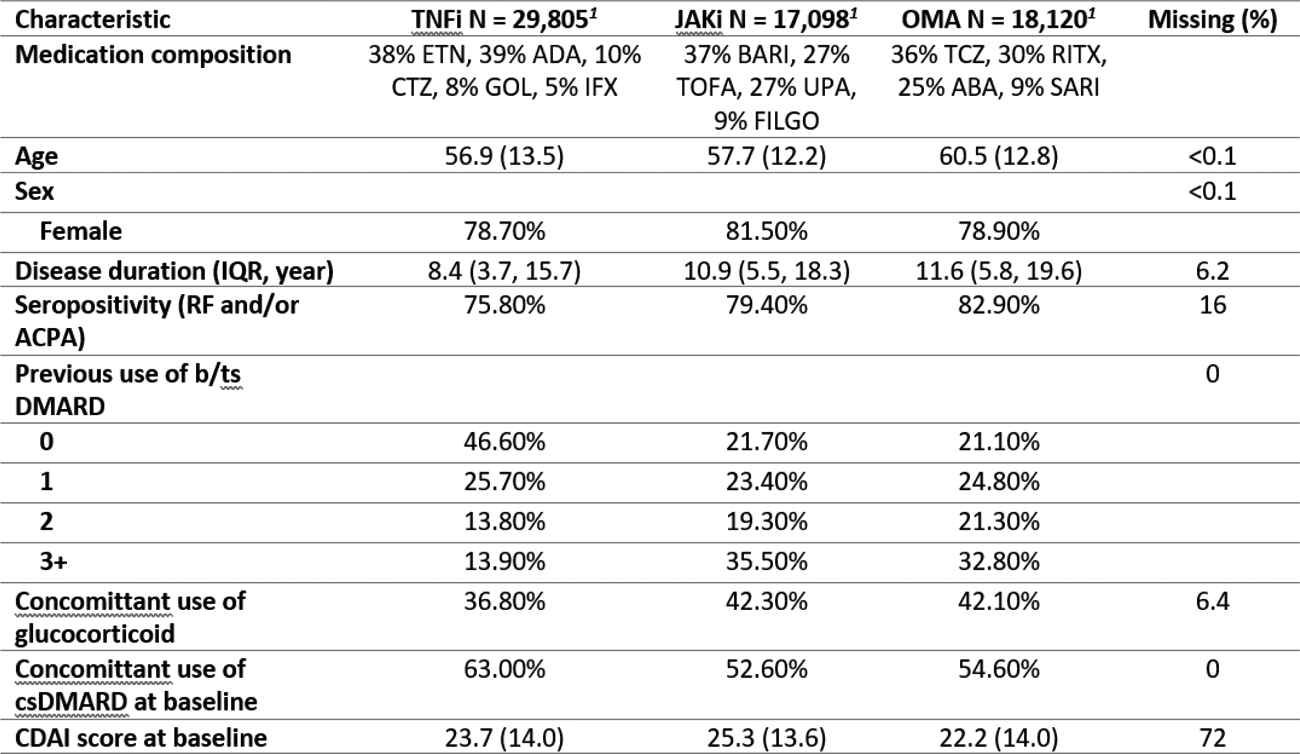
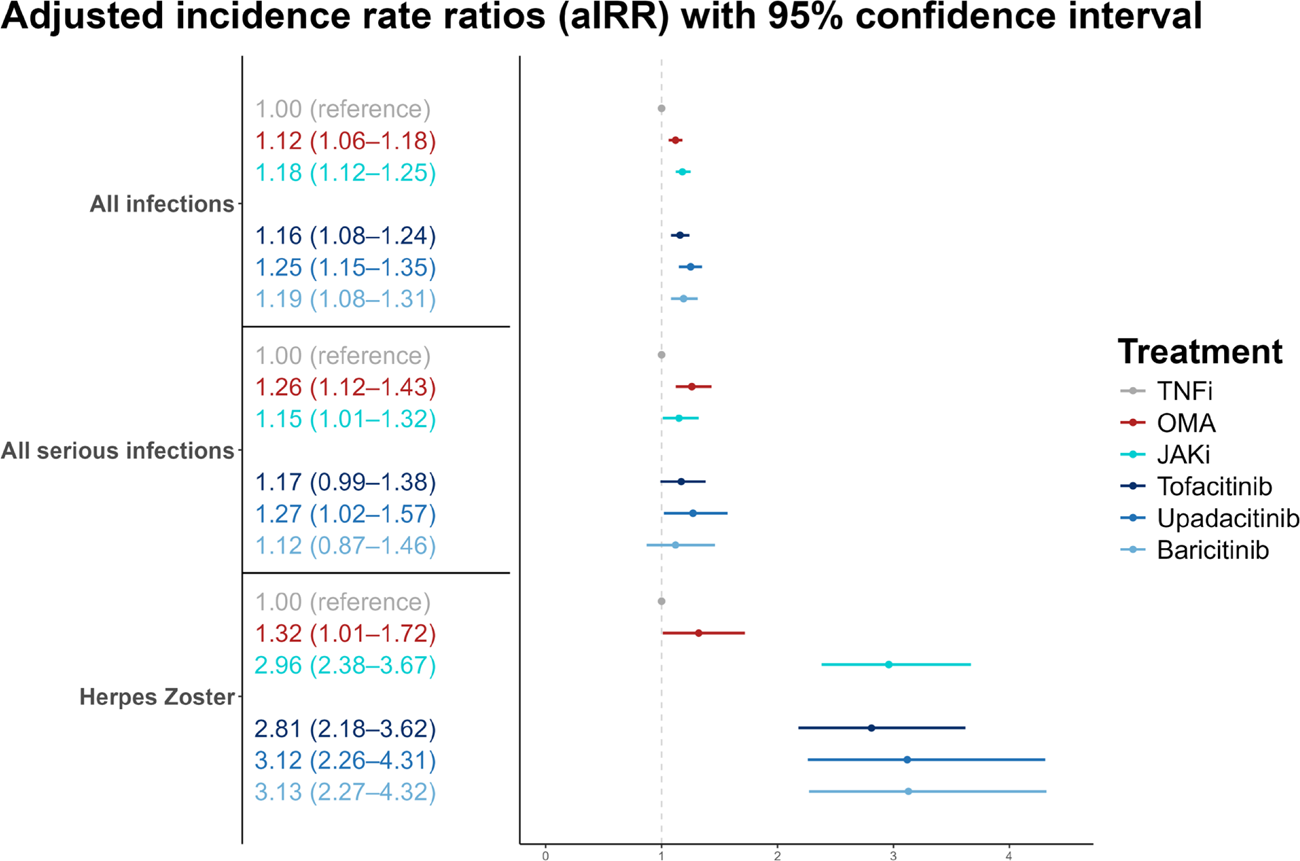
Results: Over the 66’492 treatment courses considered, in 42’541 individual patients, with a mean patient follow-up of 3.31 years, 11’375 incident infections were reported, including 2107 SI, 10’796 infections without HZ and 579 HZ (see table 1). Compared with TNFi, JAKi and OMA were associated with higher aIRRs for overall infections (1.18 [95% CI 1.12;1.25] and 1.12 [95% 1.06;1.18) respectively; see figure 1). We also found more infections excluding HZ with JAKi (1.12 [95% CI 1.06; 1.18] and with OMA 1.11 [95% CI 1.05; 1.17]); and more serious infection with JAKi 1.15 [95% CI 1.01; 1.32] and with OMA 1.26 [95% CI 1.12; 1.43]) (see figure 1). More specifically, we obtain higher aIRRs for HZ with JAKi 2.96 [95% CI 2.38;3.67] and with OMA 1.32 [95%CI 1.01;1.72] and for lung infections with JAKi (1.21 [95% CI 1.11;1.32] and with OMA 1.17 [95% CI 1.07; 1.27] when compared with TNFi(see figure 1). All JAKi subtypes (tofacitinib, upadacitinib, baricitinib) demonstrated higher aIRRs for overall infections (1.16 [95% CI 1.08;1.24], 1.25 [95% CI 1.15;1.35] and 1.19 [95% CI 1.08; 1.31] respectively) when compared with TNFi.
Conclusions: We observed that both OMA and JAKi are associated with higher rates of overall infections, all infections excluding HZ, SI, lung infections and HZ infections compared with TNFi. This result extended across all JAK subtypes for overall infections, with no differential risk of infection between individual JAK inhibitors. Our findings suggest an increased risk of infection with JAKi mainly during the first six months of treatment.
Table 1.
REFERENCES: NIL.
Acknowledgments: NIL.
Disclosure of Interests: Ophelia Zimmermann: None declared, Romain Aymon: None declared, Denis Mongin: None declared, Benoît Gilbert: None declared, Romain Guemara: None declared, Denis Choquette: None declared, Louis Coupal: None declared, Catalin Codreanu AbbVie, Amgen, AstraZeneca, Boehringer Ingelheim, Ewopharma, Lilly, Novartis, Pfizer, Sobi, UCB, Anja Strangfeld AbbVie, AlfaSigma, Janssen, Lilly, Pfizer, Takeda, UCB., Unconditional grant to my institution for the RABBIT register with equal parts from AbbVie, Amgen, BMS, Celltrion, Fresenius Kabi, Galapagos/Alfasigma, Hexal, Lilly, MSD, Viatris, Pfizer, Roche, Samsung Bioepis, Sanofi-Aventis, and UCB., Doreen Huschek: None declared, Kimme Hyrich Abbvie, Pfizer BMS, Sizheng Steven Zhao Novartis, UCB, AlfaSigma, AbbVie, Novartis, UCB, AlfaSigma, Florenzo Iannone Abbvie, Alfasigma, Amgen, Astra-Zeneca, Csl-Vifor, GSK, Janssen, Novartis, Lilly, UCB, Abbvie, Amgen, Astra-Zeneca, GSK, Janssen, Lilly, UCB, Roberto F. Caporali AbbVie, Alfasigma, Astra-Zeneca, GSK, Eli Lilly, Galapagos, Janssen, Novartis, Pfizer and UCB., AbbVie, Alfasigma, Astra-Zeneca, GSK, Eli Lilly, Galapagos, Janssen, Novartis, Pfizer and UCB., Tore K. Kvien Grünenthal, Janssen, Sandoz, AbbVie, Gilead, Janssen, Novartis, Pfizer, Sandoz, UCB, AbbVie, BMS, Galapagos, Novartis, Pfizer, UCB, Sella Aarrestad Provan: None declared, Ruth Fritsch-Stork: None declared, Dan Nordström Pfizer, UCB, BMS, Lilly, MSD, Novartis, Pfizer, UCB, BMS, MSD, UCB, Nina Trokovic: None declared, Karel Pavelka AbbVie, Eli Lilly, Sandoz, UCB, Medac, Pfizer, Jakub Závada Abbvie, Elli-Lilly, Sandoz, Novartis, Egis, UCB, Sanofi, AstraZeneca, Sobi, Abbvie, Novartis, AstraZeneca, Glaxo, Manuel Pombo-Suarez: None declared, Lucia Otero Varela: None declared, Elsa Vieira-Sousa: None declared, Ziga Rotar Abbvie, Pfizer, Eli Lilly, SOBI, Novartis, Astra Zeneca, Stada., Prodromos Sidiropoulos Abbvie, Pfizer, Lilly, Novartis, UCB, Abbvie, Pfizer, Lilly, Novartis, UCB, MSD, Roche, Amgen, GSK, BOEHRINGER-INGELHEIM, ASTRA ZENECA, Janssen, Sandoz, Biocon, Argyro Repa: None declared, Nevsun Inanc: None declared, Gokce Kenar Artin: None declared, Delphine S Courvoisier: None declared, Kim Lauper Abb Vie, Pfizer, Novartis, AbbVie, Eli-Lilly, Galapagos, Pfizer, Alfasigma, Axel Finckh AbbVie, BMS, Eli-Lilly, Gilead, MSD, Pfizer, Alfasigma, Astra Zeneca, UCB, AbbVie, Eli-Lilly, Galapagos, Pfizer, Alfasigma.