fetching data ... 
Background: LEVI-04 is a novel neurotrophin-3 (NT-3) inhibitor, comprising two extracellular domains of the p75 neurotrophin receptor (p75NTR) coupled to IgG1 Fc. In a phase 2 study in people with osteoarthritis (OA) of the knee, LEVI-04 provided analgesia, significantly improved function and stiffness and significantly reduced bone marrow lesions vs placebo[1,2].
Objectives: In order to better understand LEVI-04’s mechanism of action, we aimed to investigate its in vitro pharmacology and its effects in a rodent OA model.
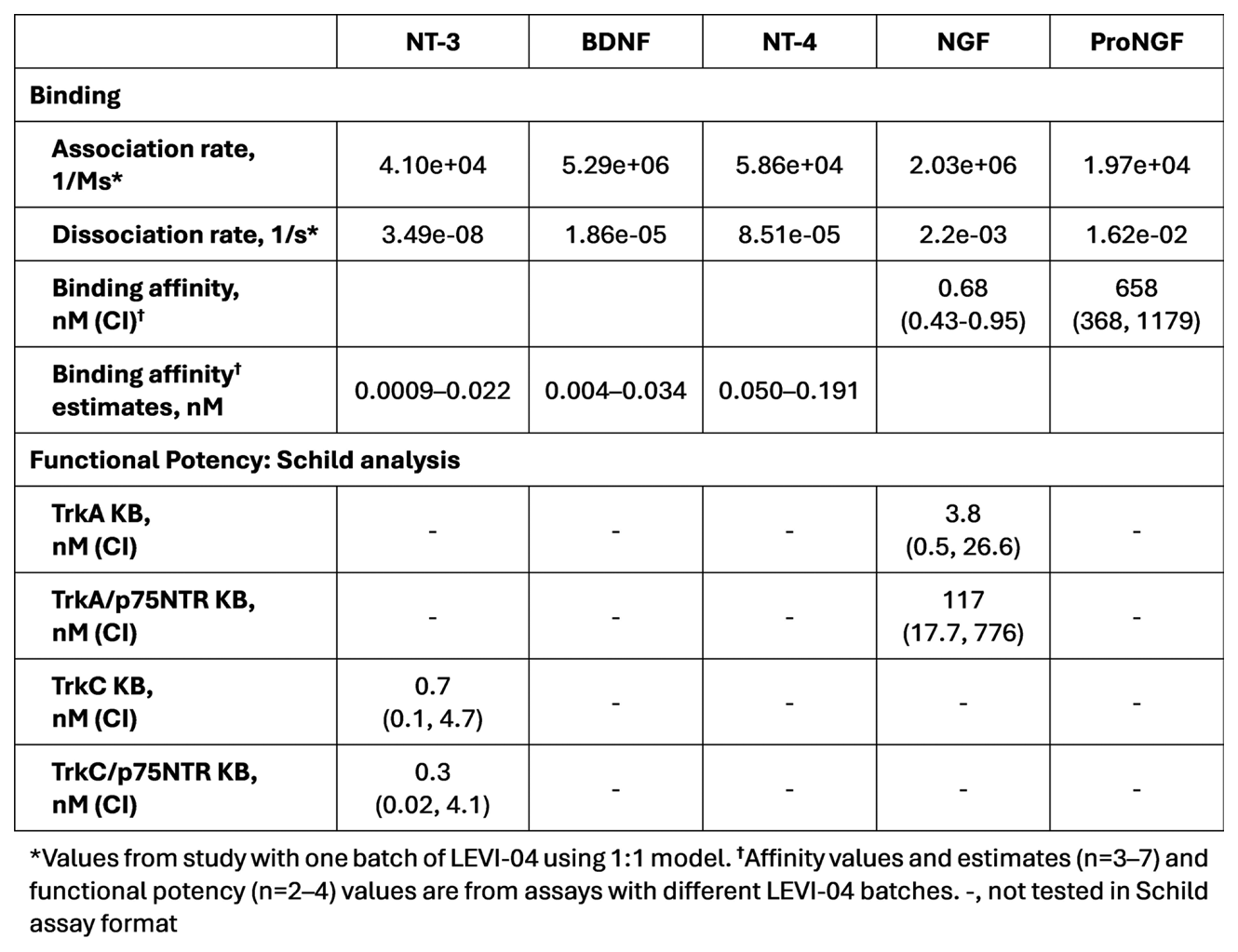
Methods: Binding affinities of LEVI-04 to neurotrophins (NTs) and pro nerve growth factor (NGF) were determined using surface plasmon resonance assays. Functional potency was assessed in cell-based assays measuring inhibition of NT-induced activation of Trk and p75NTR/Trk receptors. Analgesia (weight-bearing) and disease modification (histopathology) were assessed in a monosodium iodoacetate (MIA) induced OA model in the rat.
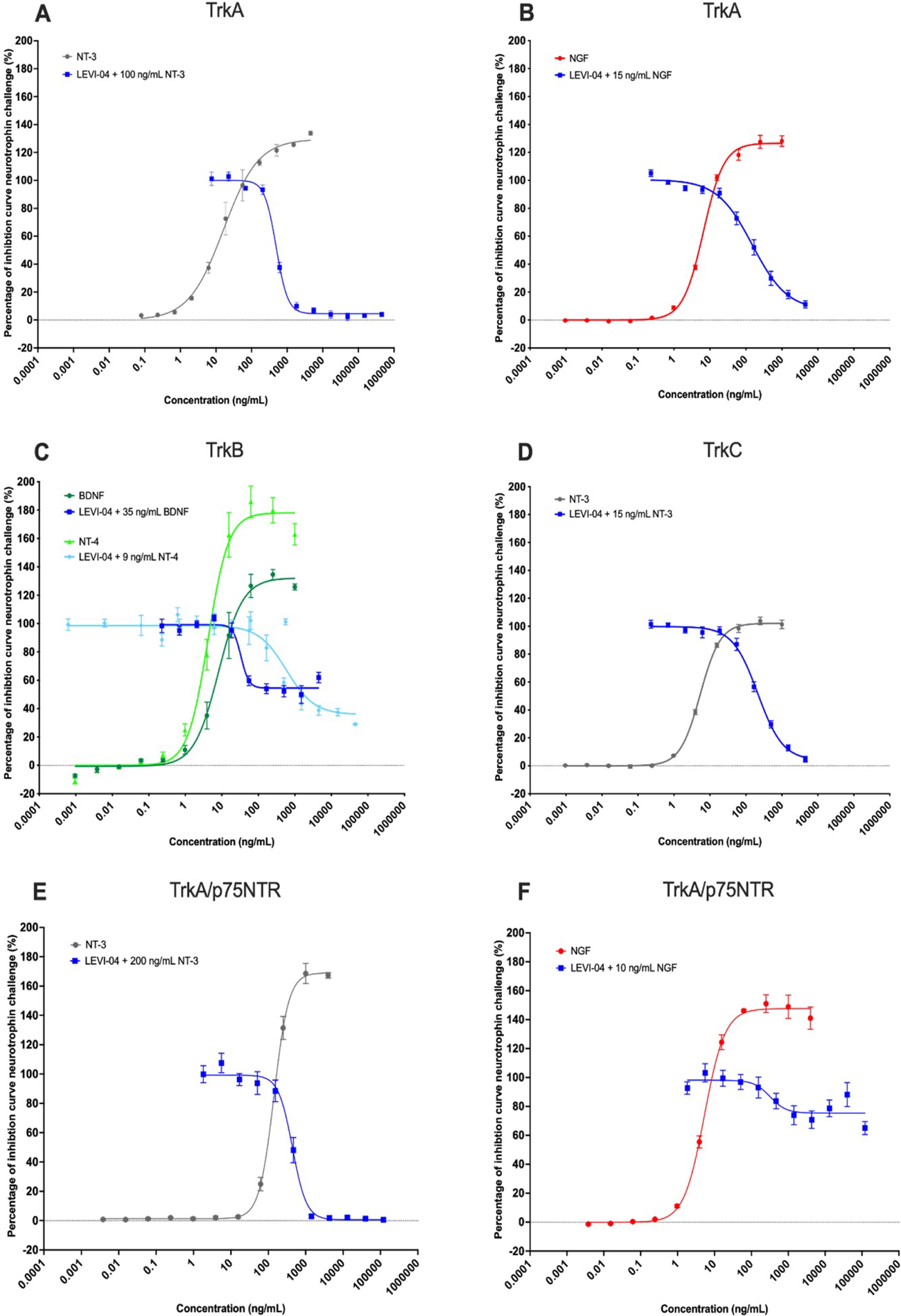
Results: Binding affinity rank order was NT-3, brain-derived neurotrophic factor (BDNF), NT-4, NGF, proNGF (Table 1). Dissociation from NT-3, BDNF, and NT-4 was slow, such that rate measurement was challenging but dissociation from NGF and proNGF was rapid and supported affinity value determination. LEVI-04 inhibited the activation of Trk receptors by all NTs. However, while LEVI-04 completely inhibited NT-3-induced activity, inhibition of NGF-, BDNF-, and NT-4-induced activity was not complete at Trk receptors (Figure 1). In particular, inhibition by LEVI-04 of the activation of TrkA receptors by NGF was notably reduced when coexpressed with p75NTR (Figure 1F). LEVI-04 had highest and similar potency for inhibition of NT-3 at TrkC receptors and TrkC receptors coexpressed with p75NTR (Table 1). In contrast the potency for inhibition of NGF at TrkA coexpressed with p75NTR was ~590-fold lower. In the MIA model of OA, analgesia was seen with therapeutic LEVI-04 treatment (0.03–3 mg/kg SC), initiated following established pain. LEVI-04 returned the MIA-induced imbalance in weight distribution to normal. MIA injection caused chondrocyte death, reduced cartilage thickness and reactive joint and bone pathology. LEVI-04 treatment resulted in chondroprotection, with reduced bone pathology and reduced osteolysis-mediated bone erosion compared with IgG control. In MIA-injected joints in the LEVI-04-treated groups vs IgG control there was reduction in osteolysis, thus limiting myeloid cell activation, and osteoblast pool expansion thereby augmenting the mesenchyme cell pool, leading to repair and reduction in MIA-induced histopathology.
Conclusions: LEVI-04 supplements endogenous soluble p75NTR; like soluble p75NTR, LEVI-04 interacts with all NTs but primarily inhibits NT-3. NGF-, BDNF- and NT-4-induced Trk receptor activity cannot be fully inhibited by LEVI-04. Therapeutic treatment with LEVI-04 provided analgesia and reduced histopathology severity in the MIA OA model. These preclinical findings mirror the clinical efficacy observed in terms of OA symptom and bone marrow lesion reductions seen in the phase 2 trial in over 500 people with OA 1,2 . Long term trials to assess the effect of sustained LEVI-04 treatment on OA symptoms and structural progression are planned.
Table 1. In vitro pharmacology of LEVI-04
Inhibition of NT-induced activity by LEVI-04 in U20S cells expressing (A, B) TrkA, (C) TrkB and (D) TrkC receptors and (E,F) TrkA and p75NTR
REFERENCES: [1] Conaghan P, et al. Arthritis Rheumatol . 2024;76 (suppl 9).
[2] Westbrook S, et al . Arthritis Rheumatol . 2025;77 (suppl 9)
Acknowledgments: NIL.
Disclosure of Interests: Simon Westbrook Levicept Ltd, Levicept Ltd, Kerry af Forselles Levicept Ltd, Levicept Ltd, Centessa Pharmaceuticals, Philip G. Conaghan AbbVie, Janssen, Kolon TissueGene, Moebius, Novartis, Levicept Ltd, Eli Lilly, Enlivex, Formation Bio, Genascence, Grunenthal, Kolon TissueGene, Moebius, Novartis, Pacira, Stryker & Takeda.