fetching data ... 
Background: Epidemiological studies indicate that psoriatic arthritis (PsA) develops after psoriasis in 70% of patients, occurs simultaneously in 15%, and precedes psoriasis in the remaining 15%.
Objectives: This study aimed to determine whether genetic factors influence the interval between psoriasis onset and PsA, and to develop a polygenic risk score to predict the onset of psoriatic arthritis among patients with psoriasis.
Methods: We analyzed 703 patients from the Gladman Krembil PsA program, recording the ages at onset of psoriasis and PsA. All samples underwent genome-wide association scanning, covering over one million single-nucleotide polymorphisms (SNPs). SNPs with more than 10% missing data or not meeting Hardy-Weinberg equilibrium were excluded. The age difference between PsA and psoriasis onset was treated as a quantitative trait, calculated by subtracting the age at PsA onset from the age at psoriasis onset for each patient. Quantitative trait locus (QTL) analysis was performed on age differences by genotype. Polygenic risk scores were developed using PRSice-2 after standard GWAS, quality control and SNP filtering using various p-value thresholds. Independent genetic variants were selected through clumping, and models were fitted across a range of thresholds, accounting for linkage disequilibrium and ancestry. Model performance was evaluated using area under the receiver operating characteristic (ROC) curve for predicting PsA (< 10 years or ≥ 10 years) after psoriasis onset.
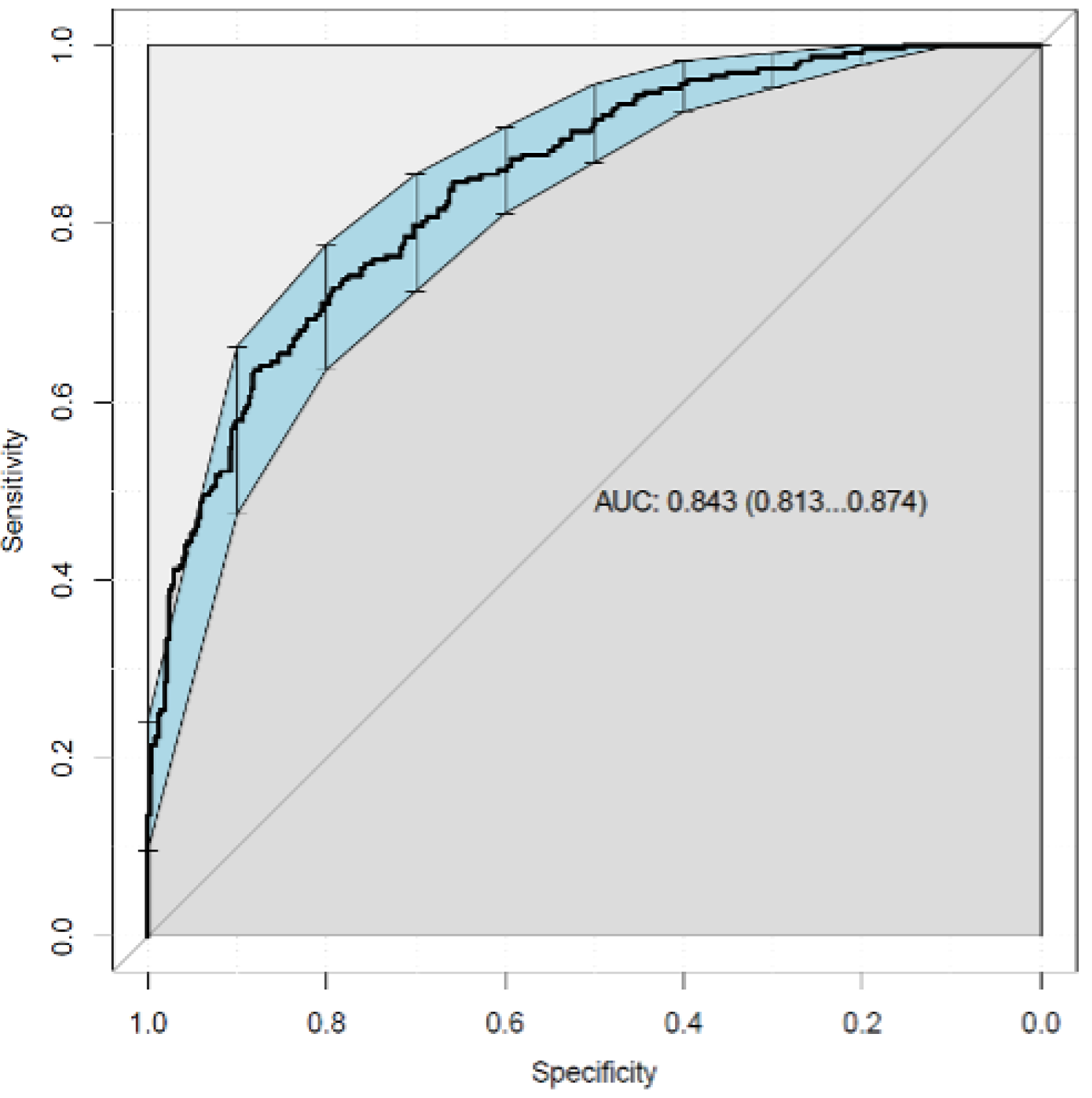
Results: The QTL analysis identified over 50 SNPs significantly influencing the onset of inflammatory arthritis (p < 1 × 10^-5). Most identified loci were associated with delayed PsA onset in individuals carrying the mutant allele compared to those with the wild-type allele. Genes linked to delayed PsA included PSORS1C1, CDSN, TXB5, and OSBLV. In contrast, loci on chromosome 15 (in linkage disequilibrium with MYO1E ) and chromosome 17 (in LD with CCDC43 and MEIOC ) were associated with earlier PsA onset. The area under the curve (AUC) for various p-value thresholds is presented in Table 1 for predicting PsA (< 10 years or ≥ 10 years) after psoriasis onset. For a p-value cutoff of <10^-4, an AUC of 0.843 was achieved for 70 SNPs from both MHC and non-MHC regions, while an AUC of 0.835 was noted for 62 SNPs restricted to non-MHC regions.
Conclusions: This study highlights the significant role of genetic variants in influencing the variability of PsA onset among patients with psoriasis. Polygenic risk scores may help predict the timing of inflammatory arthritis in this population.
AUC of predicting PsA (< 10 years or ≥ 10 years) after psoriasis onset at varous p value cut-offs
| Method PRSice-2 | AUC of PsA Cases | |
|---|---|---|
| P value cut-off | ALL SNPs (# of SNPs) | NON_MHC SNPs (# of SNPs) |
| <5x10 -8 | 0.587(7) | 0.502(6) |
| <10 -7 | 0.587(7) | 0.502(6) |
| <10 -6 | 0.587(7) | 0.502(6) |
| <10 -5 | 0.587(25) | 0.502(24) |
| <10 -4 | 0.843(70) | 0.835(62) |
| <10 -3 | 0.948(442) | 0.950(423) |
| <10 -2 | 0.988(3506) | 0.989(3453) |
| <10 -1 | 0.993(25759) | 0.993(25617) |
| 1 | 0.994(25769) | 0.993(25627) |
AUC of MHC and non-MHC SNPs of PsA (< 10 years or ≥ 10 years) after psoriasis onset with variant threshold at p < 10 -4
REFERENCES: NIL.
Acknowledgments: NIL.
Disclosure of Interests: Kathleen Dyer: None declared, Quan Li: None declared, Vinod Chandran: None declared, Dafna Gladman: None declared, Proton Rahman Abbott, AbbVie,
Amgen, Bristol-Myers Squibb, Celgene, Eli Lilly, Janssen, Novartis, Pfizer and UCB, Janssen and Novartis.