fetching data ... 
Background: IgG4-related disease (IgG4-RD) is a systemic fibroinflammatory disease characterised by recurring flares that can lead to organ damage and decreased quality of life. Inebilizumab (INEB), a CD19-targeted B-cell depleting therapy, has demonstrated efficacy and safety in the treatment of IgG4-related disease, as shown in the registrational Phase 3 MITIGATE trial (NCT04540497). Eligible subjects who completed the randomised controlled period (RCP) could enter an optional 3-year open label period (OLP) and receive INEB every six months. Characterising the long-term effects of sustained B-cell depletion on serum immunoglobulin (Ig) concentrations and the relationship between Ig changes and infection risk is important for informing safety monitoring.
Objectives: To describe longitudinal changes in serum IgG, IgA and IgM during extended INEB treatment and to evaluate whether reductions in Ig levels were associated with increased rates of infections or serious infections.
Methods: We performed a combined analysis of clinical trial RCP and OLP data in MITIGATE participants who received any INEB treatment (N = 119) through the May 2025 data cut-off, by which all remaining subjects had reached at least 1 year in the OLP or exited the study. Median number of INEB doses was 6 (range 1–9) with median exposure 818 days (range 90–1403). Serum Ig concentrations were assessed longitudinally. The relationships between reductions in IgG, IgA, and IgM and the occurrence of infections and serious infections were analysed using logistic regression. For these analyses, the lowest level of Ig was considered from the time of treatment initiation to the occurrence of infection or last assessment. The association of infectious AE incidence with duration of INEB treatment was also assessed.
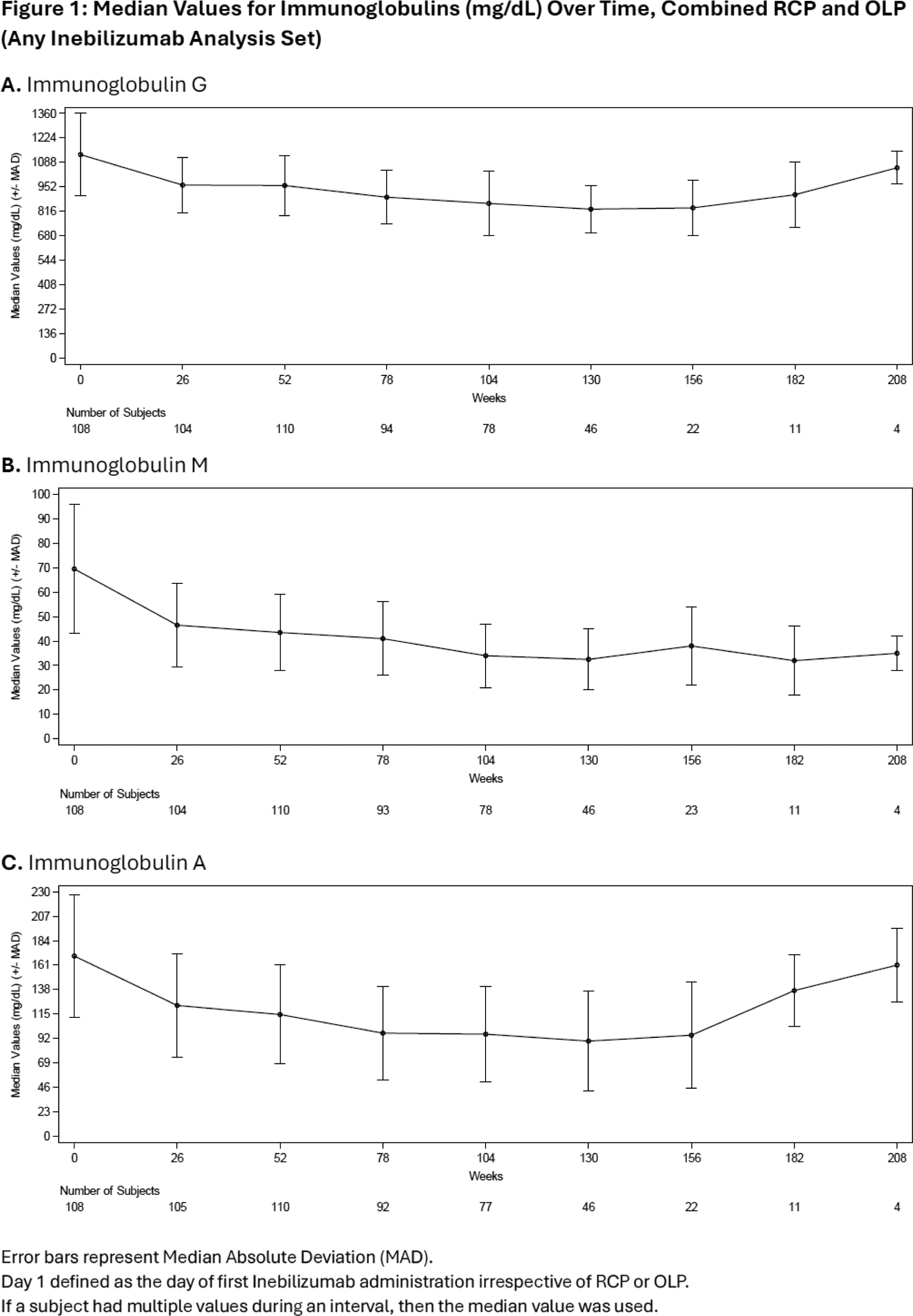
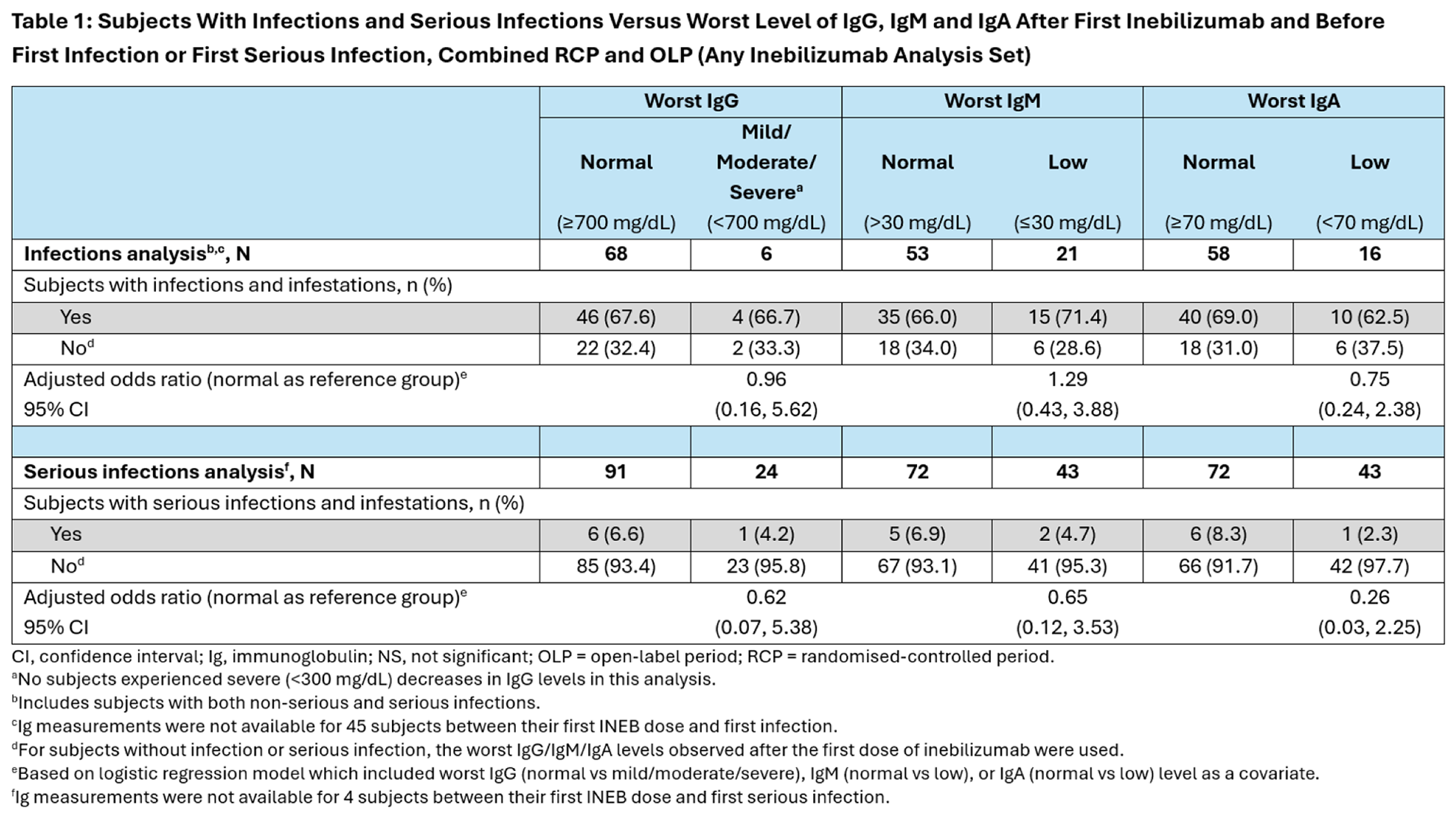
Results: Serum IgG, IgA, and IgM levels were gradually and modestly reduced with long-term INEB treatment (Figure 1 ). After 3 years of INEB treatment, IgG appeared least affected (approximately 26% reduction in median value) compared to IgM and IgA (approximately 45% and 44% reductions in median value, respectively). 27/119 (23%) subjects experienced low IgG (<700 mg/dL), with no severe decreases (<300 mg/dL) observed, while 43/119 (36%) and 45/119 (38%) experienced low IgM (≤30 mg/dL) or low IgA (<70 mg/dL), respectively. Importantly, subjects who experienced reductions in IgG, IgA or IgM did not have higher rates of infections or serious infections compared with subjects without Ig reductions ( Table 1 ). Furthermore, the incidence of infections and serious infections did not increase with each additional year of INEB treatment (data to be presented).
Conclusions: In this cohort with up to ~4 years of follow-up, long-term INEB therapy was associated with mostly mild reductions in serum immunoglobulins - most notably IgA and IgM - while IgG remained largely unaffected. Notably, reductions in Ig concentrations were not associated with increased infection risk, and infection incidence did not increase over time. These data support the favorable long-term infectious safety profile of INEB, although continued monitoring of immunoglobulin levels and infection outcomes is warranted.
REFERENCES: NIL.
Acknowledgments: NIL.
Disclosure of Interests: Emanuel Della Torre Zenas Biopharma, Acepodia, Recordati Rare Diseases, Amgen, John H. Stone Amgen; argenx; Bristol-Myers Squibb; F. Hoffman-LaRoche; IgG4ward! Foundation; Novartis; Q32 Bio; Sanofi; Sobi; Steritas; Zenas, National Institutes of Health, Emma L. Culver Amgen; Zenas, NIHR Oxford BRC, Arezou Khosroshahi Amgen, Wen Zhang Amgen, Kazuichi Okazaki Medpace, Yoshiya Tanaka Chugai; UCB; Abbvie; AstraZeneca; Eli-Lilly; Behringer-Ingelheim; GlaxoSmithKline; Eisai; IQVIA; Daiichi-Sankyo; Otsuka; Taisho; Gilead; Bristol-Mayers, Behringer-Ingelheim; Taisho; Chugai, Matthias Lohr: None declared, Nicolas Schleinitz Amgen, Lingli Dong: None declared, Hisanori Umehara: None declared, Marco Lanzillotta: None declared, Zachary S. Wallace Amgen, Amgen, Amgen, Mikael Ebbo: None declared, George Webster: None declared, Fernando Martínez-Valle: None declared, Manu Nayar: None declared, Vinciane REBOURS: None declared, Cory Perugino Amgen, Rong Luo Amgen, Amgen, Maya Osman Amgen, Amgen, Sue Cheng Amgen, Amgen, Daniel Cimbora Amgen, Amgen.