fetching data ... 
Background: Schnitzler syndrome (SchS) is a rare adult-onset autoinflammatory disorder characterized by chronic neutrophilic urticaria, recurrent fever, bone and/or joint pain, and an associated IgM monoclonal gammopathy, typically IgM-kappa. Excessive interleukin-1β (IL-1β) production driven by inflammasome activation is central to disease pathogenesis, yet the molecular link between clonal IgM-producing B cells and systemic autoinflammation remains unresolved. MYD88, a key adaptor of Toll-like receptor (TLR) and IL-1 receptor signaling, is recurrently mutated in IgM monoclonal gammopathy (IgM-MG), and the B-cell–specific consequences of the hotspot gain-of-function mutation (L252P) have been extensively characterized. In contrast, mosaic MYD88 L252P has been detected in only a subset of SchS patients based on peripheral blood analyses using an allele-specific oligonucleotide polymerase chain reaction (ASO-PCR) with a sensitivity of around 1%. Therefore, its prevalence, tissue and cellular distribution, as well as functional relevance, remain incompletely characterized.
Objectives: By studying patients with IgM-MG with and without Schnitzler syndrome, we aim to define the prevalence of somatic MYD88 L252P mosaicism and dissect its clonal architecture by using targeted NGS-based deep sequencing combined with a single-cell proteogenomic approach.
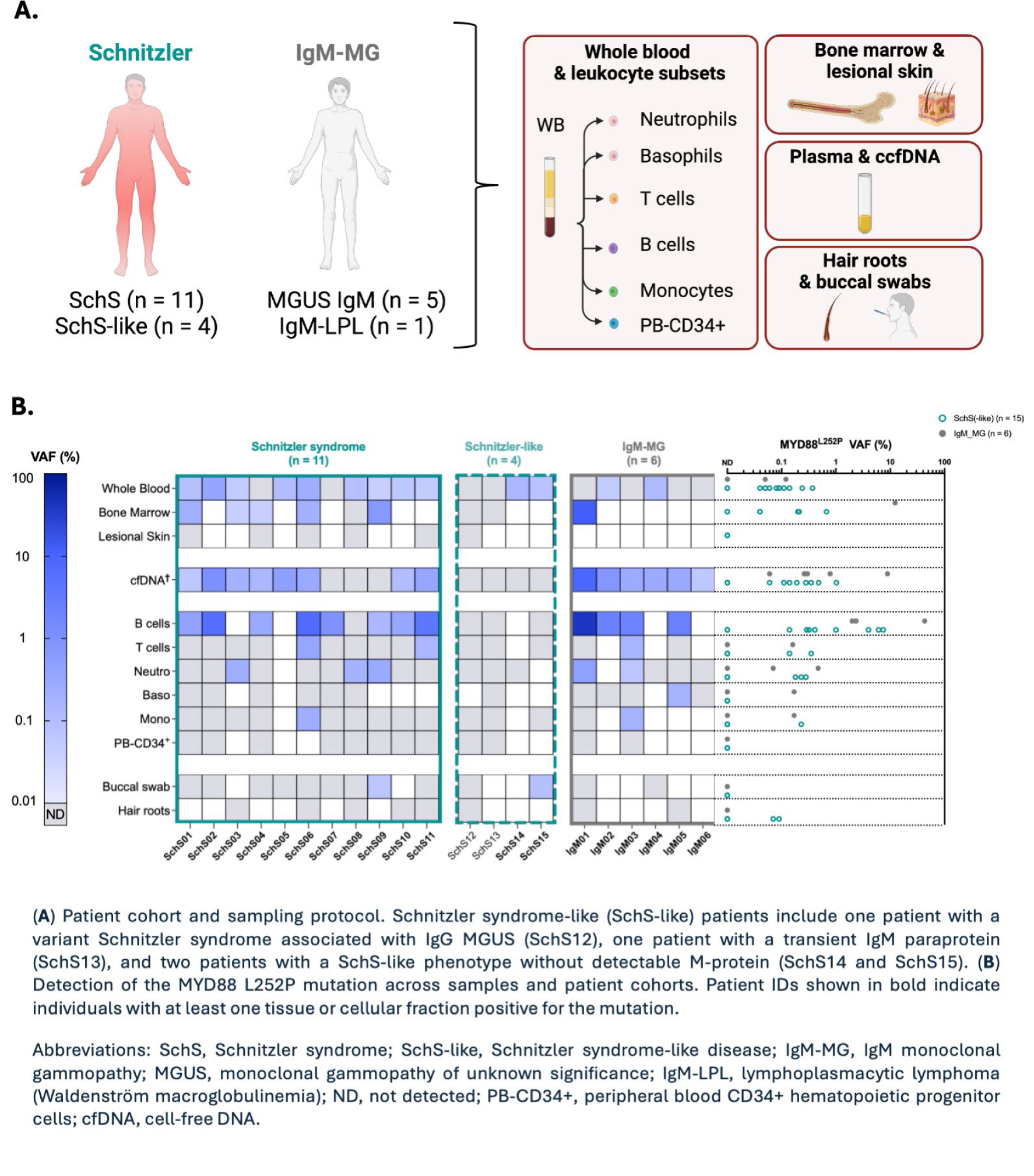
Methods: Patients with SchS and IgM-MG without autoinflammatory manifestations were prospectively enrolled at University Hospitals Leuven (Belgium). Samples included freshly isolated peripheral blood leukocyte subsets purified with immunomagnetic selection or flow cytometry cell sorting, plasma-derived circulating cell-free DNA (ccfDNA), buccal swabs, and hair roots. Archived bone marrow aspirates and formalin-fixed paraffin-embedded skin biopsies were analysed when available. DNA from all tissues and cell populations was assessed for MYD88 L252P by using error-corrected targeted deep sequencing with single-molecule molecular inversion probes (smMIP) and/or digital droplet PCR (ddPCR). Single-cell proteogenomic sequencing (Tapestri, Mission Bio) was performed on fresh bone marrow mononuclear cells from one SchS and one IgM-MG patient, enabling simultaneous analysis of targeted DNA genotypes and cell surface phenotypes using 45 oligo-tagged antibodies.
Results: Error-corrected deep sequencing across multiple tissues and cell fractions detected low-level MYD88 L252P mosaicism in all patients with SchS (n = 11/11) and asymptomatic IgM-MG (n = 6/6). In both groups, the mutation was enriched in circulating B cells, with variant allele frequencies (VAFs) of 0.14–7.42% in SchS and 1.99–42.84% in IgM-MG. In ccfDNA, MYD88 L252P was detected in 8 out of 11 patients with SchS and in all IgM-MG patients, at VAFs of 0.06–1.01% and 0.06–7.81%, respectively. The mutation was absent in a patient with IgG-associated variant SchS, suggesting a distinct underlying diagnosis, but was detected in two patients with paraprotein-negative IL-1–mediated inflammatory dermatosis (PANID), a condition proposed as a precursor or unrecognized subtype of SchS. Single-cell proteogenomic sequencing of bone marrow confirmed B-cell–restricted MYD88 L252P mosaicism in one SchS and one IgM-MG patient, without involvement of early hematopoietic progenitors. Additionally, a large, non-overlapping DNMT3A-mutant subclone was identified in the SchS patient.
Conclusions: Leveraging a large cohort of SchS patients with access to bone marrow samples and purified cell populations, our findings support a shared disease pathogenesis between Schnitzler syndrome (SchS) and IgM monoclonal gammopathy (IgM-MG) and identify somatic MYD88 L252P mosaicism as a promising biomarker to aid the clinical diagnosis of SchS. Somatic MYD88 gain-of-function (GOF) may represent the missing link between clonal B-cell lymphopoiesis and myeloid-driven autoinflammation, consistent with its central role in TLR–mediated innate immune activation. However, its precise molecular mechanisms remain undefined. Future studies should focus on delineating the disease-specific functional consequences of MYD88 mosaicism and its contribution to inflammatory signaling in SchS.
REFERENCES: NIL.
Acknowledgments: NIL.
Disclosure of Interests: None declared.