fetching data ... 
Background: Outpatient appointments for patients with inflammatory arthritis, including rheumatoid arthritis (RA), are commonly scheduled at fixed intervals or determined by healthcare professionals based on disease activity assessed at a single time point. This approach may overlook symptom fluctuations between visits and delay the identification of patients who require earlier clinical review. More proactive approaches to adjusting appointment timing could better reflect individual patient needs. Remotely collected patient-reported outcome measures (ePROMs) provide a longitudinal patient perspective on disease course and may support more responsive planning of outpatient care.
Objectives: To identify distinct subgroups of patients with RA based on longitudinal ePROM trajectories and to evaluate how disease trajectories can inform subsequent outpatient follow-up appointment planning.
Methods: This is a collaborative study between the University of Bristol and North Bristol NHS Trust, involving a secondary analysis of previously collected, de-identified real-world data. Adult patients (≥18 years) with a clinical diagnosis of RA, who attended routine rheumatology outpatient appointments at North Bristol NHS Trust were offered and consented to remote disease monitoring by reporting RAPID3 score between follow-up appointments using a smartphone-based symptom diary (Living With), which was co-designed with patients. Participants who agreed were fully trained in use of the app-based tool and were recommended to report disease severity (RAPID3) on weekly basis. The analysis included participants who provided more than two consecutive RAPID3 responses over a 12-month follow-up period. Latent class analysis was applied to longitudinal RAPID3 data to identify unique subgroups of patients with distinct trajectories of disease severity [1]. Statistical analyses were performed using RStudio version 4.3.1 (lcmm package), with p<0.05 considered statistically significant. The analysis has appropriate ethical approval.
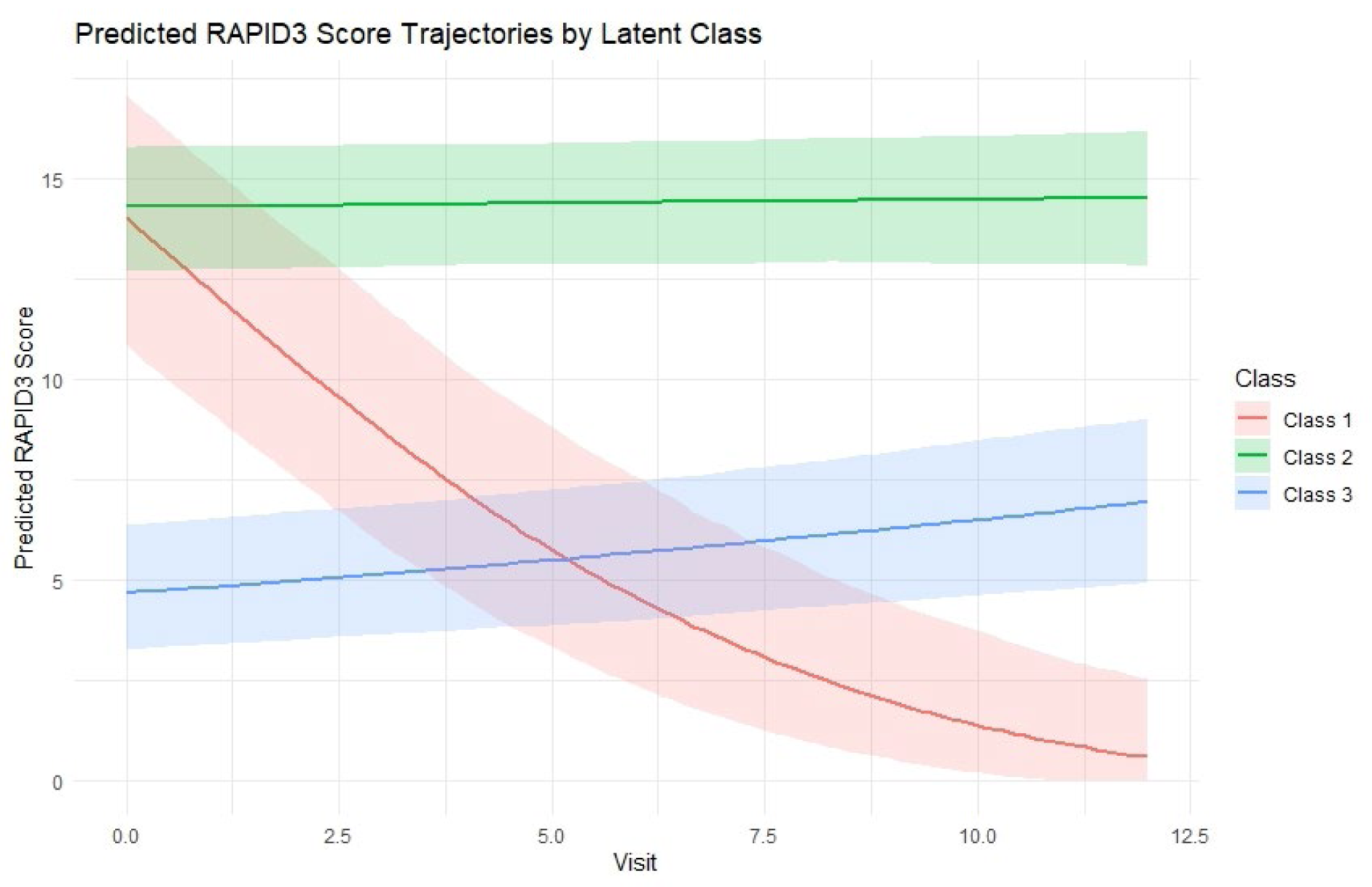
Results: 403 patients with RA who attended routine appointments in a rheumatology outpatient clinic were offered and agreed to use a smartphone-based symptom diary for remote monitoring between appointments. Our patient cohort was predominantly female (74.2 %) patients with a mean age of 55.5±14.0 years. Most participants engaged with remote monitoring, with 91.1% providing at least one RAPID3 assessment during follow-up. Of them, 321 (79.7%) RA patients who provided at least 2 RAPID3 responses over 12 months were included in the latent class analysis. Three distinct classes of RA longitudinal RAPID3 disease severity were identified: Class 1 (n-14, 4%) - Improving disease; Class 2 - Active Arthritis (n=224, 70%) Class 3 - Low to Moderate Arthritis (n=83, 26%). Trajectory classes included patients across all age groups, with no clear age-specific pattern. Gender distribution differed across classes, with women presenting the majority of patients in the persistently active disease trajectory (80%), while the improving trajectory included a higher proportion of men (64%). Our findings suggest different approaches to follow-up planning based on ePROM trajectory type. Patients in Class 1 (improving disease) may be suitable for extended follow-up intervals, whereas patients in Class 2 (persistently high disease severity) may benefit from earlier clinical review and treatment adjustment. Patients in Class 3 (low-to-moderate disease severity) may be appropriate for routine scheduled follow-up with extra remote review to enable early detection of symptom worsening. At the same time, RAPID3 scores may be influenced by non-inflammatory factors such as fibromyalgia, osteoarthritis, or even mood, interpretation of high ePROM trajectories should be supported by routinely collected clinical data, including joint count assessments and inflammatory markers.
Conclusions: Longitudinal RAPID3 trajectories identify unique subgroups of patients with RA, enhance patient care and may support personalised outpatient follow-up planning.
12-month RAPID-3 disease severity trajectories identified in patients with rheumatoid arthritis.
REFERENCES: [1] Sinha, Pratik MB, ChB, PhD1,2; Calfee, Carolyn S. MD, MAS1,2; Delucchi, Kevin L. PhD3. Practitioner’s Guide to Latent Class Analysis: Methodological Considerations and Common Pitfalls. Critical Care Medicine 49(1):p e63-e79, January 2021. | DOI: 10.1097/CCM.0000000000004710.
Acknowledgments: NIL.
Disclosure of Interests: Iuliia Biliavska: None declared, Erik Lenguerrand: None declared, Amy Howell: None declared, Philip Hamann In the past four years have received honoraria from Gilead and AbbVie Pharmaceuticals for the production of training materials on remote monitoring for patients with arthritis.