fetching data ... 
Background: Rheumatoid Arthritis (RA) is a chronic, systemic autoimmune disease characterized by persistent synovial inflammation that culminates in cartilage and bone destruction, pain and disability. Despite the availability of conventional, biological and targeted synthetic DMARDs, current therapies predominantly modulate late events in the inflammatory cascade and fail to prevent disease onset or fully halt structural damage in a substantial fraction of patients[1-3]. A preclinical “pre-RA” phase, in which RA-specific autoantibodies and systemic immune alterations are already present while joints remain structurally intact, has been recognized as a critical window of opportunity for therapeutic intervention, where early modulation of inflammatory trajectory could avert progression to established RA and irreversible bone erosion 4 . Inflammation in RA arises from the convergence of innate and adaptive immune responses: PRR-mediated sensing of PAMPs and DAMPs drives production of proinflammatory cytokines such as TNF, IL-1 and IL-6, which act in concert with fibroblast-like synoviocytes and infiltrating lymphocytes to perpetuate synovitis and joint damage[1,5-6]. Existing DMARDs primarily block cytokine–receptor interactions or downstream JAK/STAT signaling, when the extracellular microenvironment is already dominated by pathogenic mediators[1,4]. Targeting earlier checkpoints, specifically the secretion of proinflammatory cytokines by primary human immune cells, offers an attractive strategy to reprogram the inflammatory response, reduce tissue-destructive potential and ultimately maintain immune tolerance.
Objectives: This project aims to move beyond late-stage cytokine blockade and instead find orally available small molecules that suppress proinflammatory cytokine secretion at the very beginning of the inflammatory response.
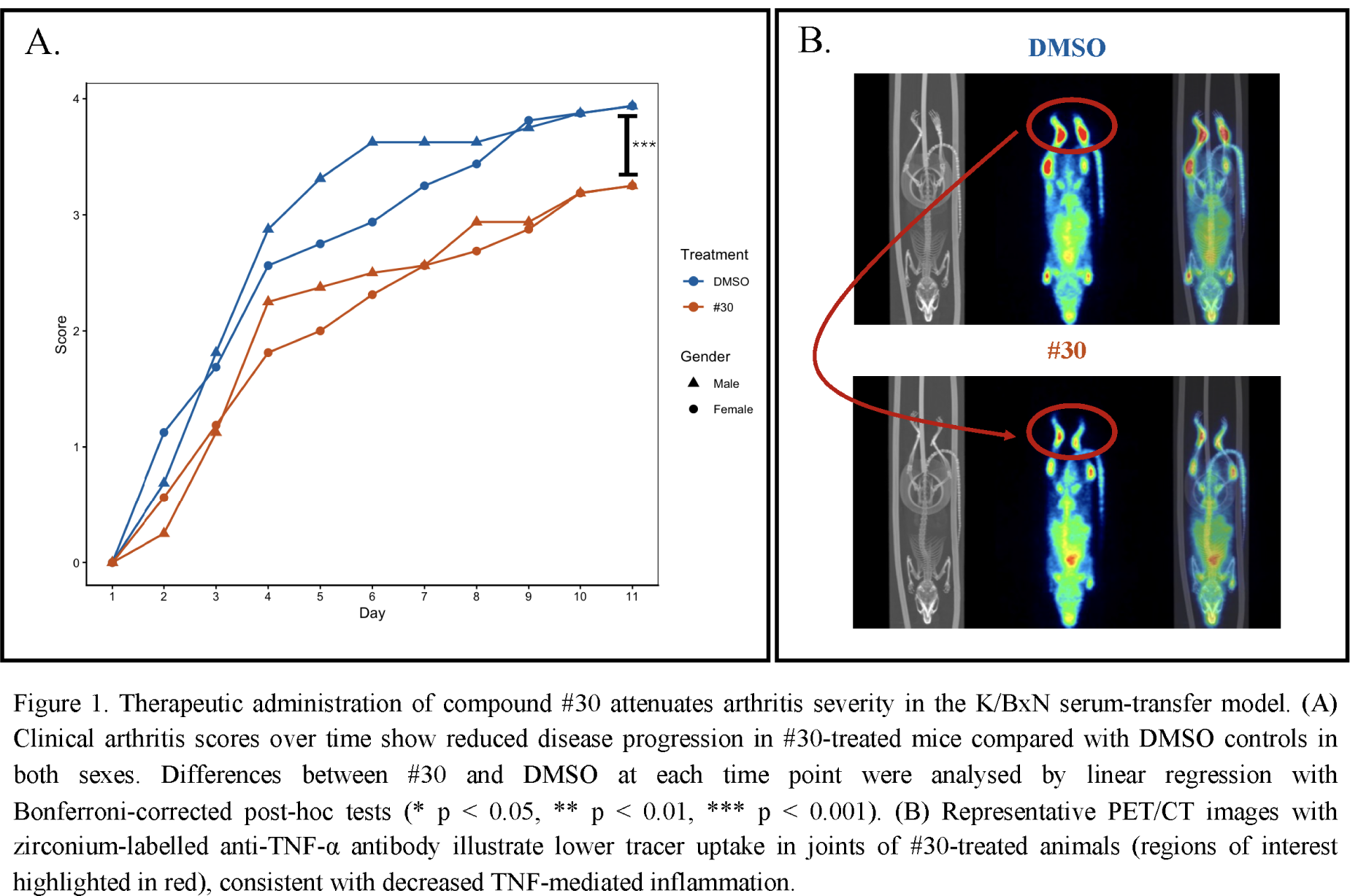
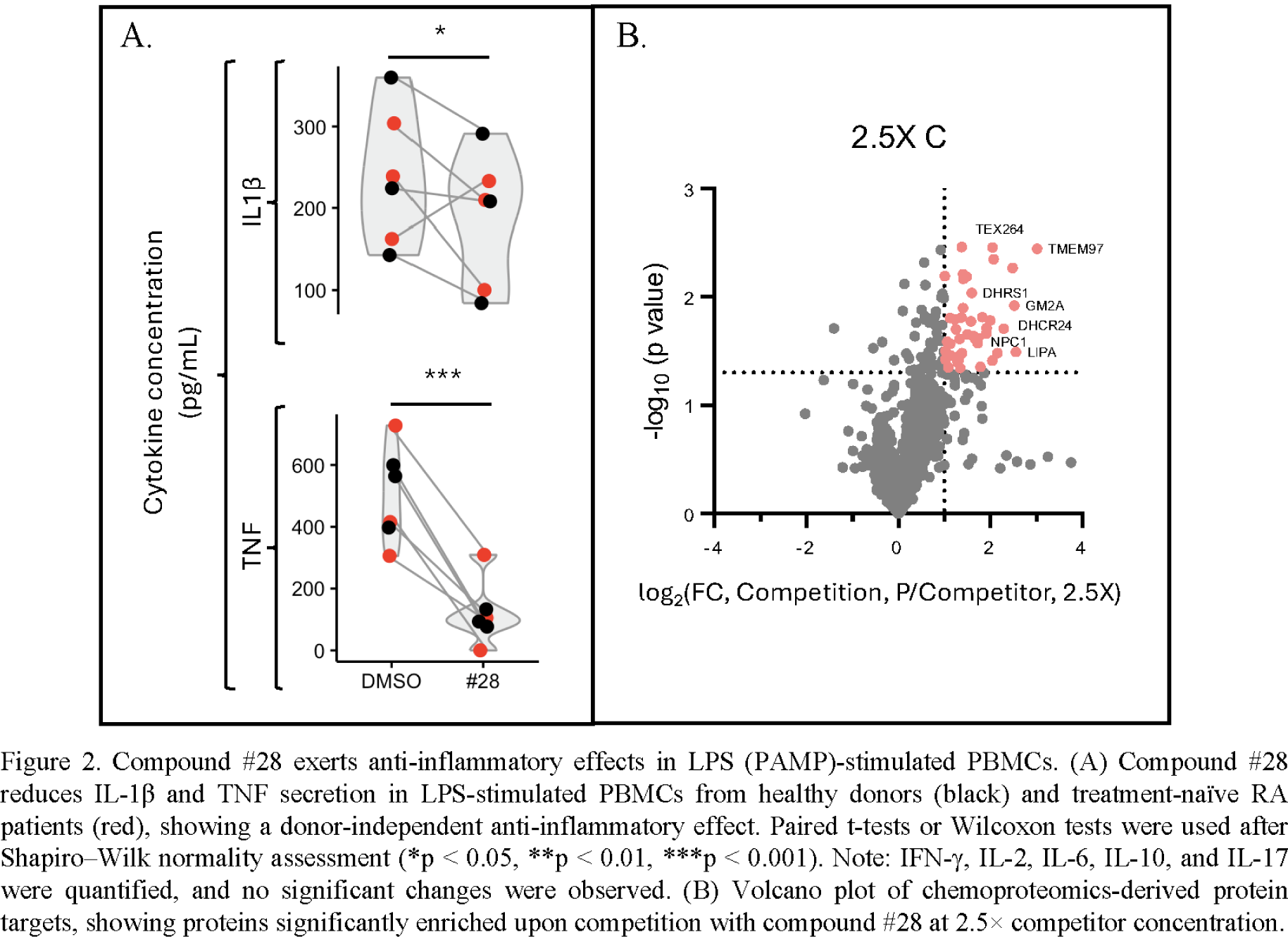
Methods: We first performed a high-throughput, multi-assay screen of ~3,000 small molecules (repurposing and novel) in primary PBMCs stimulated with different PAMP and PAMP/DAMP combinations, quantifying TNF and IL-1β secretion. Twenty-seven hits with consistent cytokine reduction were then characterized across multiple stimuli and time points in PBMCs from three healthy donors and three treatment-naïve RA patients, and the most robust candidates were further tested in an expanded cohort of RA patients stratified as responders or non-responders to standard therapies, measuring seven cytokines (IL-1β, TNF, IL-6, IFN-γ, IL-10, IL-17A, IL-2). On this basis, two compounds were prioritized: #30, a repurposed drug with established safety record, and #28, a newly synthesized chemical entity. Compound #30 progressed directly to in vivo testing in the K/BxN serum-transfer arthritis model, using longitudinal clinical scoring, PET/CT imaging with a zirconium-labelled anti-TNF antibody, ankle joint histology (H&E for inflammation and synovial hyperplasia; toluidine blue for cartilage and proteoglycan loss), and qPCR analysis of Tnf mRNA in joint tissue. In parallel, compound #28 was characterized mechanistically before in vivo efficacy studies. Chemoproteomic competition in LPS-stimulated PBMCs was used to identify protein targets, transcriptomic profiling (RNA-seq) to define pathway-level effects, and structure-based studies (AlphaFold modelling of TMEM97 followed by docking and molecular dynamics simulations) to map the most plausible binding site. TMEM97 dependency is being tested through gene-silencing approaches in primary PBMCs. In preparation for in vivo evaluation, an ADMET analysis was implemented for #28, including in vitro assays of plasma protein binding, microsomal stability and metabolic profiling, permeability and solubility, as well as an ongoing broad off-target safety panel and an oral bioavailability study in mice to determine exposure–time profiles and inform dose and dosing interval.
Results: The primary screen identified 27 cytokine-lowering compounds, several of which induced a donor-independent reduction of TNF and IL-1β across diverse PAMP and PAMP/DAMP conditions in PBMCs from treatment-naïve RA patients and healthy donors. Among these, compound #30 showed a high ex vivo activity and was therefore selected for in vivo validation. In the K/BxN serum-transfer arthritis model, therapeutic dosing of #30 reduced clinical arthritis scores in both male and female mice (Figure 1A), improved histological indices with a reduction of leukocyte infiltration and synovial hyperplasia by H&E, and preserved cartilage and proteoglycans in toluidine-blue-stained sections. PET/CT imaging revealed lower anti-TNF tracer uptake in arthritic joints (Figure 1B), and qPCR confirmed reduced Tnf mRNA expression, linking systemic administration of #30 to suppression of local TNF driven inflammation. Compound #28, identified as one of the candidates that suppresses pro-inflammatory cytokine secretion in LPS-stimulated PBMCs (Figure 2A), was subsequently linked by chemoproteomics to TMEM97 as its main cellular target (Figure 2B). RNA-seq demonstrated selective downregulation of inflammatory pathways without global immune shutdown, and ADMET results indicated suitable metabolic stability, plasma protein binding and oral availability. Gene-silencing experiments targeting TMEM97, together with ongoing off-target safety screening panel and oral bioavailability studies, are expected to consolidate the mechanism of action and de-risk in vivo evaluation of #28.
Conclusions: Taken as a whole, this work indicates that our compound portfolio, and specifically compounds #30 and #28, represents a promising and previously unexplored therapeutic avenue for rheumatoid arthritis, particularly suited for intervention in pre-/early disease.
REFERENCES: [1] Smolen, J. S. et al. Nat Rev Dis Primers 4, 18001 (2018).
[2] McInnes, I. B. et al. Nat Rev Rheumatol 12, 63-68 (2016).
[3] Smolen, J. S. et al. Ann Rheum Dis 82, 3-18 (2023).
[4] Stadinski, B. D. et al. Nat. Immunol. 17, 946-955 (2016).
[5] Azuaje, J. et al. J Org Chem 80, 1533-1549 (2015).
[6] Dobin, A. et al. Bioinformatics 29, 15-21 (2013).
Acknowledgments: NIL.
Disclosure of Interests: None declared.