fetching data ... 
Background: Individuals at risk of rheumatoid arthritis (RA) have systemic autoimmunity, commonly defined by anti-cyclic citrullinated peptide (CCP) antibody positivity, in the absence of clinically apparent inflammatory arthritis. Risk of progression to RA is heterogeneous and influenced by several factors including musculoskeletal symptoms, autoantibody levels and the presence of subclinical synovitis on imaging [1]. Palindromic rheumatism (PR) represents a distinct at-risk phenotype characterised by self-limiting episodes of articular and peri-articular inflammation, a proportion of whom, particularly those who are CCP+, progress to RA. Across CCP+ at-risk populations, the systemic immune processes that precede progression to clinical arthritis remain poorly defined.
Objectives: We hypothesised that specific molecular networks are enriched in CCP+ at-risk individuals who progress to inflammatory arthritis. We further hypothesised that CCP+ PR patients who progress to RA exhibit immune programs distinct from non-palindromic counterparts. Integrative analysis across molecular layers may reveal coordinated immune processes preceding clinical arthritis and inform improved risk stratification.
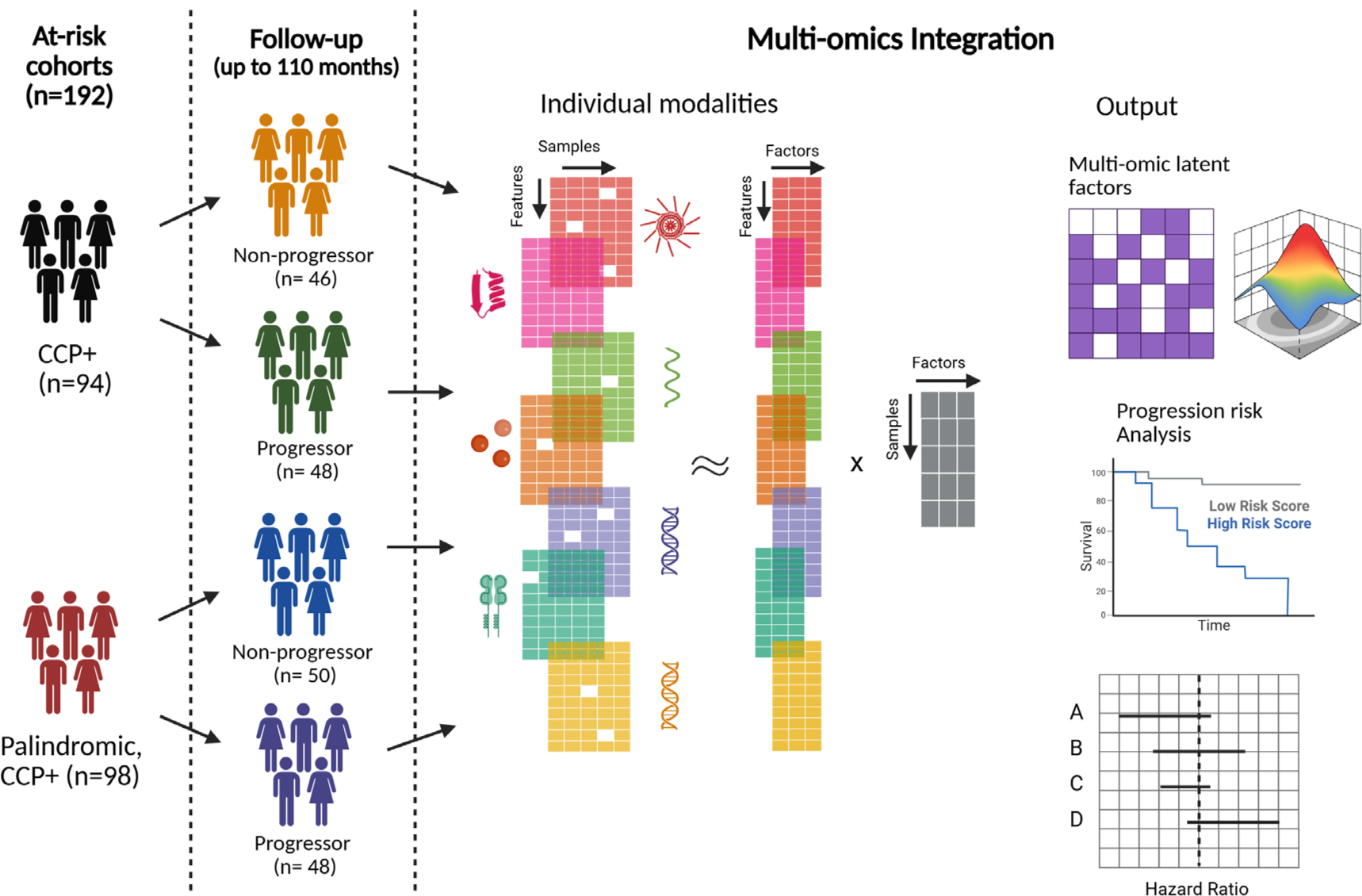
Methods: We applied unsupervised multi-omics integration to a cohort of CCP+ individuals (n=192, of whom 98 were PR) without established RA (Figure 1). Seven molecular modalities were analysed: HLA genotypes, germline genetic features, somatic mutation burden, peripheral blood RNA sequencing, circulating inflammatory proteins, interferon (IFN) protein scoring, and inflammasome activity measured by ASC specks. These data were integrated using multi-omics factor analysis to identify the latent immune programmes, which underpin progression to RA. Associations between latent factors and time to progression to inflammatory arthritis were assessed using Cox proportional hazards models, while associations with palindromic status were evaluated using logistic regression.
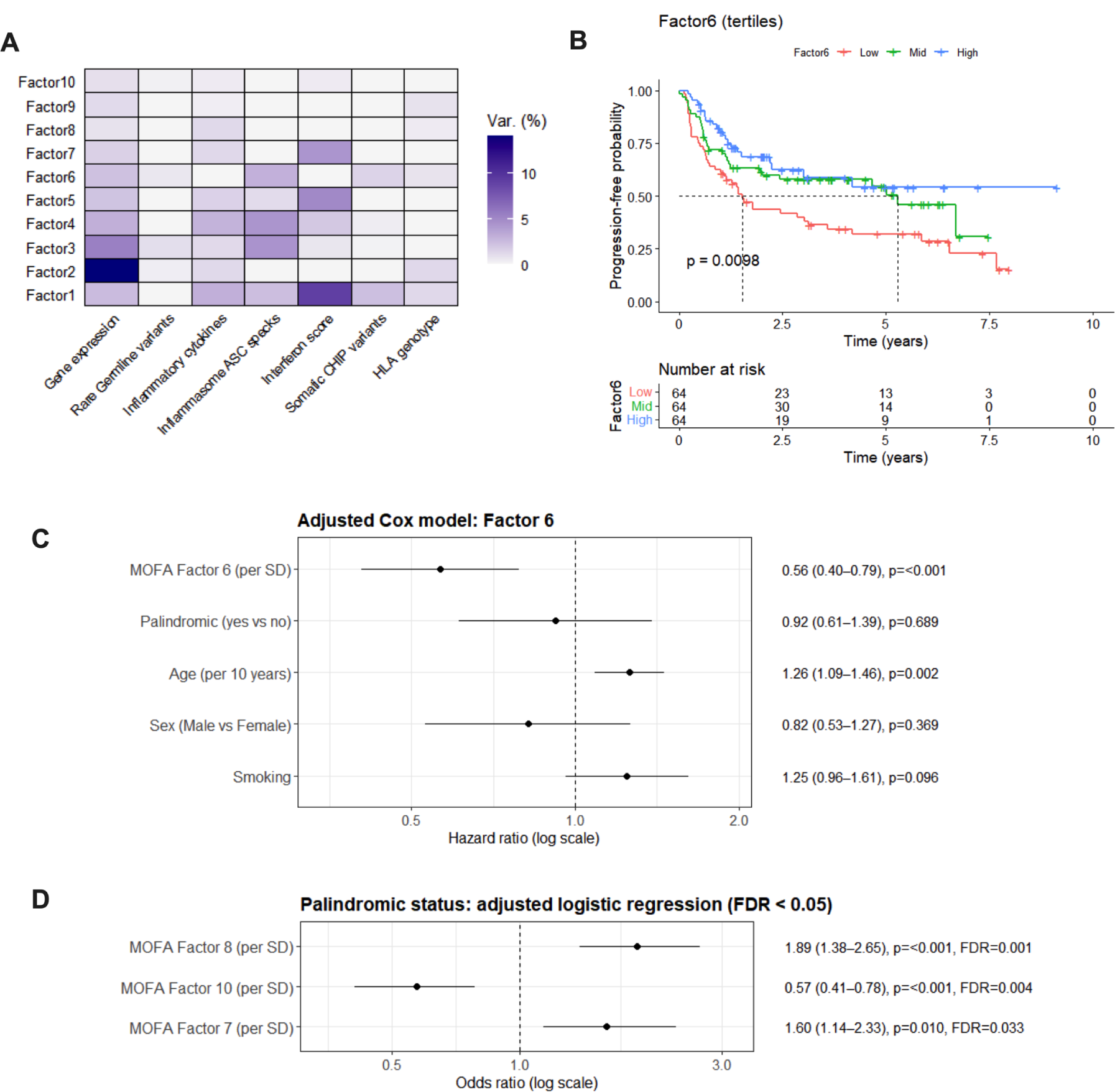
Results: Multi-omics latent factor analysis identified several distinct molecular programmes in CCP+ at-risk individuals. One immune programme (Latent Factor 6) was associated with delayed progression to inflammatory arthritis. In multivariable Cox regression adjusting for age, sex, smoking status, and PR, higher Factor 6 scores were associated with a reduced hazard of progression (hazard ratio per standard deviation 0.56, 95% CI 0.40–0.79; p < 0.001). Kaplan–Meier analysis stratified by Factor 6 tertiles demonstrated graded separation in time to progression (log-rank p = 0.0098), with median progression times of approximately 2 years in the lowest tertile, 5 years in the intermediate tertile, and the median not reached in the highest tertile. The association between Factor 6 and progression was not modified by palindromic status (interaction p = 0.72). Variance decomposition indicated that Factor 6 was primarily driven by inflammasome ASC specks activity and peripheral blood gene expression, with secondary contributions from somatic clonal haematopoiesis, HLA genotype, and rare germline variants. Gene expression was enriched for mitochondrial and metabolic transcripts, consistent with a preserved, low-activation immune state.
In contrast, PR was associated with a distinct set of latent factors (Factors 7, 8, 10). In multivariable logistic regression adjusting for age, sex, and smoking, Factor8 (odds ratio [OR] 1.89, 95% CI 1.38–2.65; FDR-adjusted p = 0.001) and Factor7 (OR 1.60, 95% CI 1.14–2.33; FDR-adjusted p = 0.033) were positively associated with palindromic status, while Factor10 was inversely associated (OR 0.57, 95% CI 0.41–0.78; FDR-adjusted p = 0.004). Variance decomposition demonstrated that these PR-associated factors were predominantly driven by interferon activity, inflammatory cytokines, and gene expression, with additional contribution from HLA genotype for Factor8. Factor6, which was associated with delayed progression, was not associated with PR.
Conclusions: This work introduces a multi-omic framework for stratifying CCP+ at-risk individuals without synovitis, revealing distinct immune programmes that separately define palindromic phenotype and progression risk. Palindromic disease was characterised by interferon and cytokine-dominated inflammatory programmes with additional genetic context, whereas progression risk was independently associated with a contrasting inflammasome and metabolism-associated immune state that conferred delayed progression irrespective of palindromic status. These findings highlight the biological heterogeneity of CCP+ at-risk states and support immune-state–guided approaches to risk stratification and early preventive intervention.
Overview of the study design and unsupervised multi-omic integration framework applied to CCP+ individuals at-risk of rheumatoid arthritis. Seven molecular modalities were integrated using multi-omic factor analysis to identify latent immune programs preceding clinical arthritis and to explore associations with progression risk.
Multi-omic latent factors associated with progression and palindromic rheumatism in CCP+ at-risk individuals. (A) Variance decomposition showing the contribution of each molecular modality to the latent factors. (B) Kaplan–Meier analysis of time to progression stratified by Factor 6 tertiles (log-rank p = 0.0098). (C) Multivariable Cox regression demonstrating an independent association between higher Factor 6 scores and delayed progression, adjusted for age, sex, smoking, and palindromic status. (D) Multivariable logistic regression identifying latent factors independently associated with palindromic rheumatism (FDR < 0.05).
REFERENCES: [1] Duquenne L, Hensor EM, Wilson M, Garcia-Montoya L, Nam JL, Wu J, Harnden K, Anioke IC, Di Matteo A, Chowdhury R, Sidhu N, Ponchel F, Mankia K, Emery P. Predicting Inflammatory Arthritis in At-Risk Persons: Development of Scores for Risk Stratification. Ann Intern Med. 2023 Aug;176(8):1027-1036.
Acknowledgments: NIL.
Disclosure of Interests: Leon Chang: None declared, Fareeha Tariq: None declared, Amreen Azeem: None declared, Daniel Clayton: None declared, Kierran Flack: None declared, Thomas Young: None declared, Alice Ibbotson: None declared, Ana Martinez Rodriguez: None declared, Samuel Lara Reyna: None declared, Aisha Aman: None declared, Emilia Cross: None declared, Laurence Duquenne: None declared, Andrea Di Matteo: None declared, Paul Emery: None declared, Kulveer Mankia: None declared, Sinisa Savic Novartis and SOBI, Novartis.