fetching data ... 
Background: Arthritis is a leading cause of chronic pain and disability worldwide, and its global burden continues to rise. Frailty, a clinical syndrome characterized by age-related declines in physiological reserve, has become an important global public health concern and is associated with a wide range of adverse health outcomes. Evidence suggests a close relationship between frailty and arthritis, showing that frailty is commonly observed among individuals with arthritis. However, little is known about whether frailty status and its longitudinal trajectories are associated with the subsequent development of arthritis. Understanding how frailty status and its trajectories influence incident arthritis in older adults may provide important insights for prevention and management strategies.
Objectives: This study aimed to examine the associations between baseline frailty status, frailty trajectories, and the incidence of arthritis among older adults.
Methods: Data were derived from the Health and Retirement Study (HRS) and the English Longitudinal Study of Ageing (ELSA). The frailty index (FI) was constructed from 30 health deficits. Baseline frailty status was categorized as robust (FI ≤ 0.10), pre-frail (0.10 < FI < 0.25), and frail (FI ≥ 0.25). Frailty trajectories were modeled using the FI from the first four waves of each cohort. Arthritis was defined as self-reported physician-diagnosed arthritis. Cox proportional hazards models were used to estimate hazard ratios (HRs) and 95% confidence intervals (95% CIs).
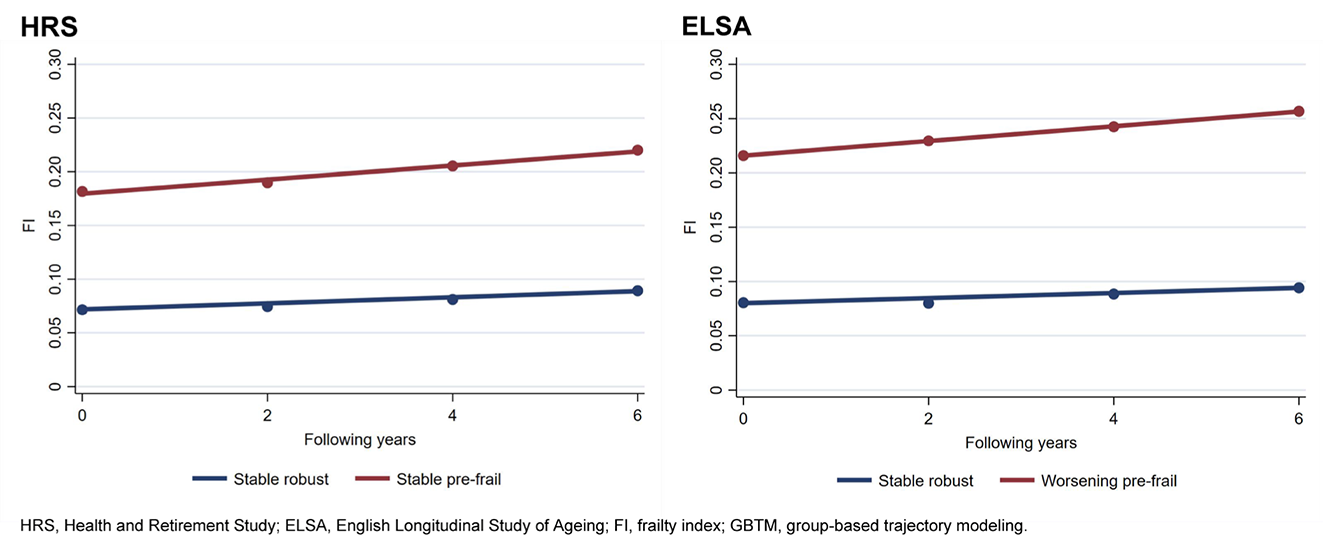
Results: Baseline frailty analyses included 5,148 participants (HRS = 2,948; ELSA = 2,200) with median follow-up times of 193 and 166 months, respectively. Compared with robust participants, those who were frail at baseline had a higher risk of incident arthritis (HRS: HR = 1.56, 95% CI: 1.24-1.95; ELSA: HR = 1.64, 95% CI: 1.16-2.33). Participants who were pre-frail at baseline also exhibited a higher risk of incident arthritis compared with robust participants (HRS: HR = 1.32, 95% CI: 1.20-1.46; ELSA: HR = 1.38, 95% CI: 1.18-1.63). Analyses of frailty trajectories included 4,041 participants (HRS: 2,162; ELSA: 1,879) with median follow-up times of 166 and 96 months, respectively. Two trajectories were identified: the stable robust trajectory (n = 1,777, 82.2%) and the stable pre-frail trajectory (n = 385, 17.8%) in HRS; the stable robust trajectory (n = 1,637, 87.1%) and the worsening pre-frail trajectory (n = 242, 12.9%) in ELSA (Figure 1). Compared with the stable robust trajectory, the stable pre-frail trajectory in HRS (HR = 1.27, 95% CI: 1.09-1.48) and the worsening pre-frail trajectory in ELSA (HR = 1.58, 95% CI: 1.20-2.10) were associated with a higher risk of arthritis (Table 1).
Conclusions: Frailty and pre-frailty, as well as their longitudinal progression, were associated with an increased risk of incident arthritis. Frailty assessment may play an important role in the early identification and prevention of arthritis among older adults.
Frailty trajectories estimated by GBTM.
Association between frailty trajectories and incident arthritis.
| HRS (n = 2162) | ELSA (n = 1879) | |||||||||
|---|---|---|---|---|---|---|---|---|---|---|
| Events/N | HR1 (95% CI) a | P1 a | HR2 (95% CI) b | P2 b | Events/N | HR1 (95% CI) a | P1 a | HR2 (95% CI) b | P2 b | |
| Trajectory 1 c | 830/1777 | 1 (reference) | 1 (reference) | 294/1637 | 1 (reference) | 1 (reference) | ||||
| Trajectory 2 d | 226/385 | 1.34 (1.16, 1.56) | < 0.001 | 1.27 (1.09, 1.48) | 0.002 | 69/242 | 1.64 (1.25, 2.14) | < 0.001 | 1.58 (1.20, 2.10) | 0.001 |
HR1 and P1 were adjusted for sex and age.
HR2 and P2 were adjusted for age, sex, race, education, marital status, smoking status, drinking status, and BMI.
Trajectory 1 represented the stable robust trajectory in the HRS and ELSA.
Trajectory 2 represented the stable pre-frail trajectory in the HRS, and the worsening pre-frail trajectory in the ELSA.
HRS, Health and Retirement Study; ELSA, English Longitudinal Study of Ageing; HR, hazard ratio; CI, confidence interval; BMI, body mass index.
REFERENCES: NIL.
Acknowledgments: NIL.
Disclosure of Interests: None declared.