fetching data ... 
Background: The digital therapeutic Axia is a CE-certified medical app that combines patient-tailored home-based exercise, patient education, and disease management functions as central non-pharmacological treatment modalities in axial spondyloarthritis (axSpA). In the Bechterew-App Trial I, a monocentric randomised controlled interventional trial (RCT) with nationwide enrolment among 200 German patients with axSpA, Axia improved patient-perceived disease activity, functional status, and quality of life after 12 weeks of use [1]. However, due to the remote nature of this nationwide RCT, objective parameters such as spinal mobility could not be assessed.
Objectives: In this accompanying study (Bechterew-App Trial II), objective parameters were assessed during in-person visits in addition to the patient-reported outcomes of the nationwide RCT.
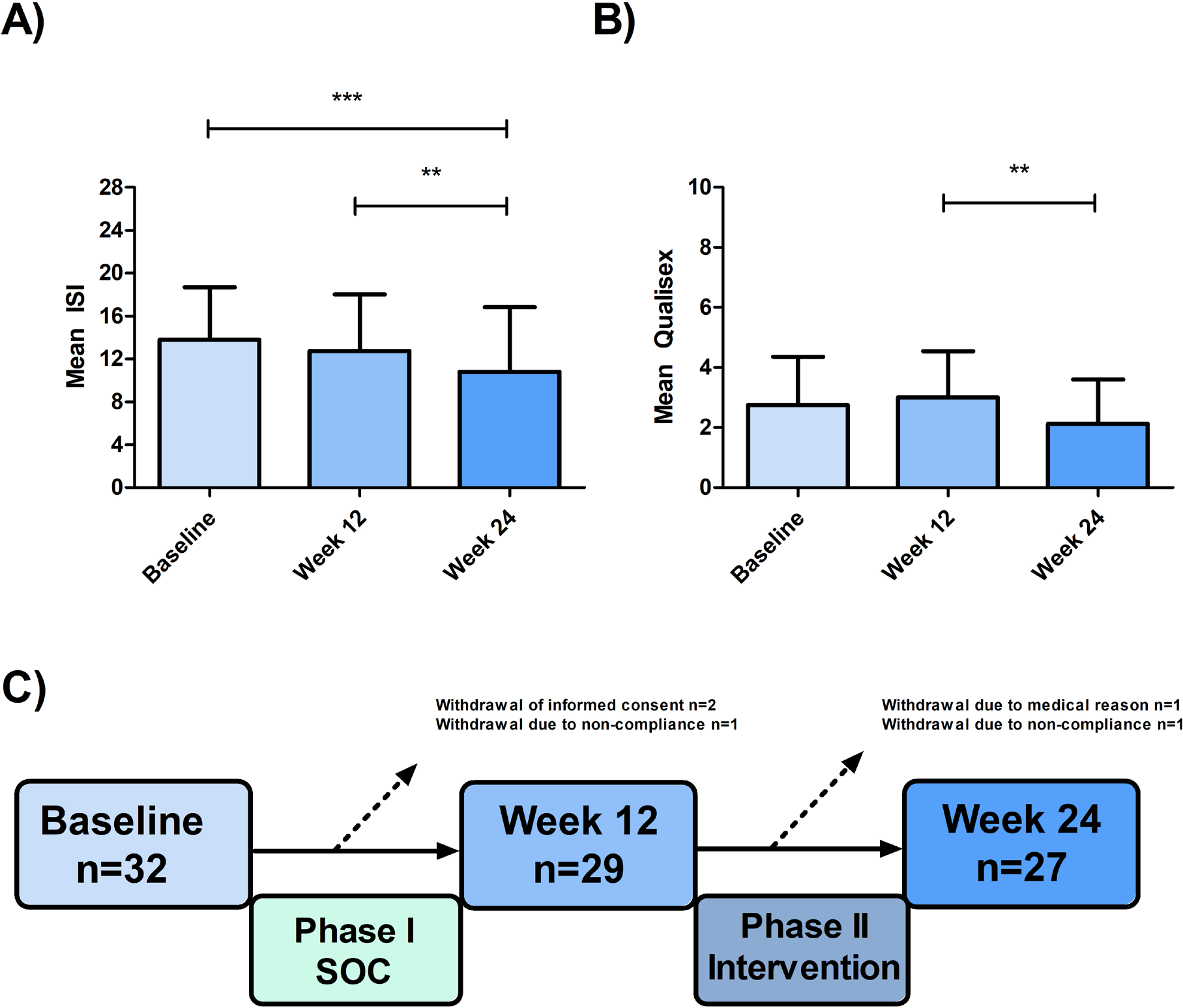
Methods: The Bechterew-App Trial II was designed as a single-centre, two-phase pre–post intervention study over 24 weeks, including 32 participants with axSpA receiving stable pharmacotherapy. Figure 2C displays the study design. Participants completed phase I with standard of care (SOC) for 12 weeks before entering phase II with additional intervention using Axia for another 12 weeks. The primary outcome was change in the Bath Ankylosing Spondylitis Metrology Index (BASMI) at week 24 compared to baseline (BL) and week 12. Secondary outcomes included isometric strength of the spinal extensor muscles, severity of insomnia (measured by the Insomnia Severity Index [ISI]), patient-perceived disease activity (assessed by the Bath Ankylosing Spondylitis Disease Activity Index [BASDAI]), and axSpA-related sexual dysfunction (assessed by Qualisex), as well as safety signals. Higher scores of BASMI, BASDAI, ISI, and Qualisex indicate greater impairments. Outcomes were assessed at BL, week 12, and week 24. Magnetic resonance imaging (MRI) of the sacroiliac joints was performed to assess bone marrow oedema or structural damage. The trial was registered in the German Registry of Clinical Trials (DRKS-ID: DRKS00038067).
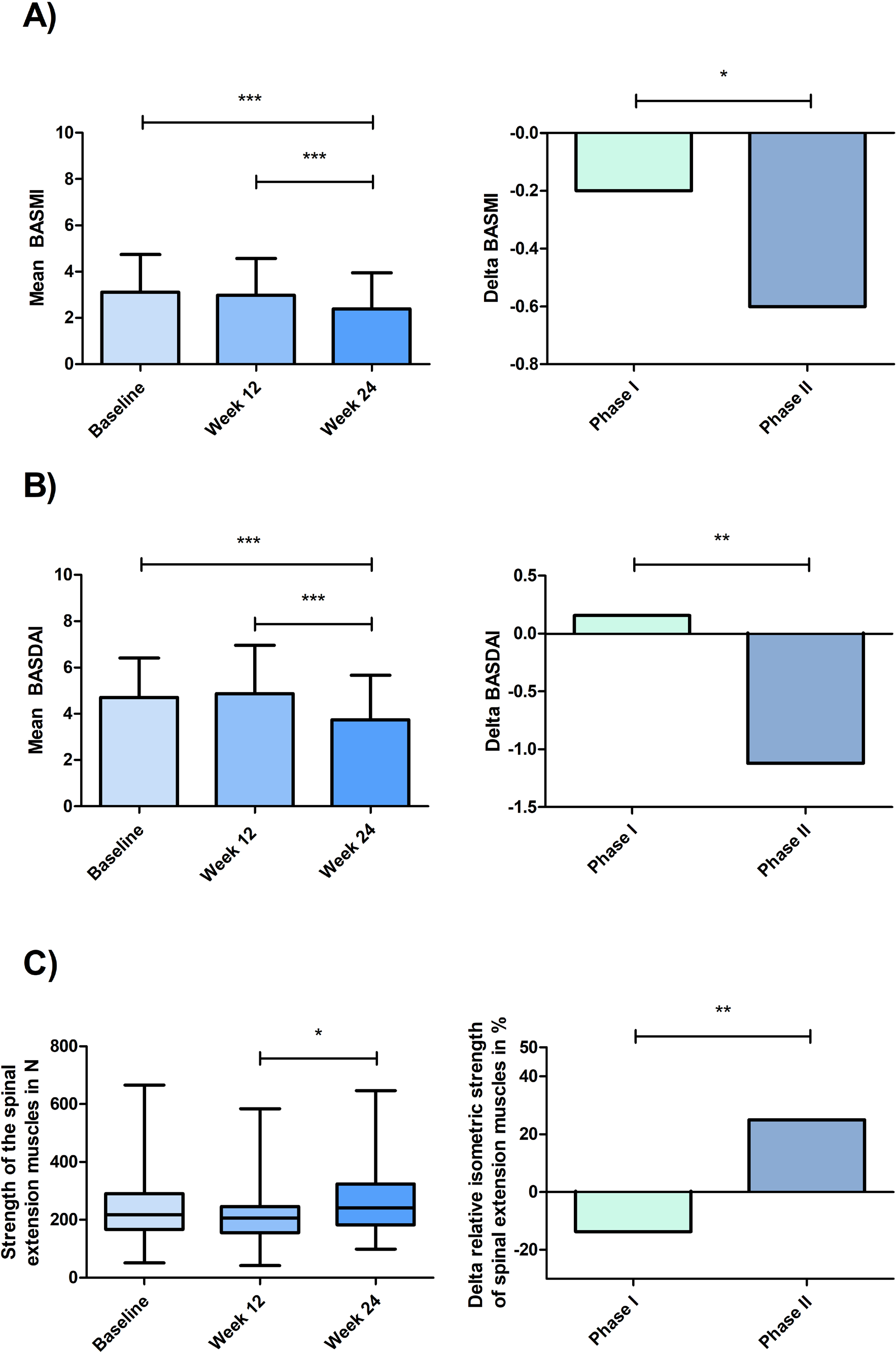
Results: Of the 32 enrolled participants, 27 (84%) completed the trial (mean age 49.1 years; 48% female; 48% with radiographic axSpA; 66.7% receiving biological or targeted synthetic DMARDs). Mean BASMI and BASDAI scores were significantly lower at week 24 compared with week 12 and baseline (BASMI BL: 3.1, week 12: 3.0, week 24: 2.4, p<0.001; BASDAI BL: 4.7, week 12: 4.9, week 24: 3.7, p<0.001) (Figure 1A–B). While median relative isometric strength of the spinal extensor muscles decreased by 14% during phase I, it increased by 25% during phase II (p<0.01) (Figure 1C). Mean ISI and Qualisex scores were significantly lower at week 24 compared to BL and week 12 (Figure 2A–B). No concerning safety signals or device-related adverse events were reported. No increase in bone marrow oedema or structural changes was observed on MRI (data not shown).
Conclusions: This trial suggests that regular use of Axia in addition to SOC is associated with improvements in spinal mobility and spinal extensor muscle strength. These functional improvements were accompanied by reductions in disease activity, insomnia severity, and axSpA-related sexual dysfunction. No safety concerns were identified.
Improvement of BASMI, BASDAI, and isometric strength of the spinal extension muscles by Axia
Mean BASMI and BASDAI and the median of isometric muscle strength did not change between baseline and week 12 (1A-C left side). Between week 12 and week 24 significant improvements were seen in all three outcome measures. The corresponding deltas were significantly higher in phase II (intervention with Axia) compared to phase I (SOC) (A-C right side).
The Data is shown as means with standard deviations (A-B) and median with minimum and maximum (C). Differences are shown on the right side. For analysis of differences, one-way ANOVA was used in case of normal distribution (A-B left side). When values were not normally distributed, Kruskal-Wallis test was applied to compare medians (C). For 1A-C on the right side, a two-sided t-test or Wilcoxon signed rank test was used; *: p<0.05; **: p<0.01; ***: p<0.001.
BASDAI, Bath Ankylosing Spondylitis Disease Activity Index; BASMI, Bath Ankylosing Spondylitis Metrology Index; SOC, standard of care.
Improvement of Insomnia and Impairment of sexual function during intervention phase
2A-B) Mean ISI (A) and Qualisex (B) were significantly higher at baseline and week 12 compared to week 24 after intervention by Axia. The Data is shown as means with standard deviation. An one-way ANOVA was used to test for statistical differences; **: p<0.01; ***: p<0.001.
ISI, Insomnia Severity Index; SOC, standard of care.
2C) shows the study design.
REFERENCES: [1] Strunz PP et al. LB0002 The novel digital therapeutic AXIA improves disease activity, functionality, and quality of life in axial spondyloarthritis patients: results from a randomized controlled crossover trial (Bechterew-App trial) (abstract). Ann Rheum Dis 84(Suppl 1):LB2.
Acknowledgments: NIL.
Disclosure of Interests: Patrick-Pascal Strunz Research funding from Novartis, Abbvie, and Chugai., Amelie Wüst: None declared, Patricia Possler: None declared, Maxime le Maire Shareholder of Applimeda, CEO of Applimeda, Tobias Heusinger Shareholder of Applimeda, Chief regulatory and medical officer of Applimeda, Anna Fleischer: None declared, Karsten Sebastian Luetkens: None declared, Michael Gernert: None declared, Hannah Labinsky: None declared, Ottar Gadeholt: None declared, Robert Leppich Shareholder of Applimeda, Chief technology officer of Applimeda, Astrid Schmieder: None declared, Ludwig Hammel: None declared, Billy Sperlich: None declared, Hermann Einsele: None declared, Matthias Fröhlich: None declared, Marc Schmalzing: None declared.