fetching data ... 
Background: Pathological synovial angiogenesis is a pivotal early event in rheumatoid arthritis (RA), driving pannus formation and joint destruction. Current therapies inadequately address this vascular component. Neutrophil extracellular traps (NETs), abundant in RA synovium, are emerging as key mediators of pathological angiogenesis in other diseases, but their role and mechanisms in RA remain unclear.
Objectives: This study aimed to: 1) Define the spatial relationship between NETs and neovessels in RA synovium; 2) Investigate the pro-angiogenic capacity of RA-derived NETs and identify key effector molecules; and 3) Evaluate the therapeutic potential of inhibiting the NETs pathway in vivo.
Methods: We performed multiplex immunofluorescence (mIF) on synovial tissues from RA and osteoarthritis (OA) patients to visualize NETs (MPO + or citH3 + ) and vessels (CD31 + ). NETs isolated from RA patients were used to stimulate human umbilical vein endothelial cells (HUVECs); tube formation and migration assays assessed angiogenic phenotypes. NETs proteins were analysed by mass spectrometry, with bioinformatic screening identifying Peptidyl-prolyl isomerase A (PPIA) as a candidate. Its functional role was validated using the inhibitor Cyclosporin A (CsA). A collagen-induced arthritis (CIA) mouse model was treated with the NETs inhibitor GSK484 or CsA, and joint damage/vascularity were assessed by histology and micro-CT.
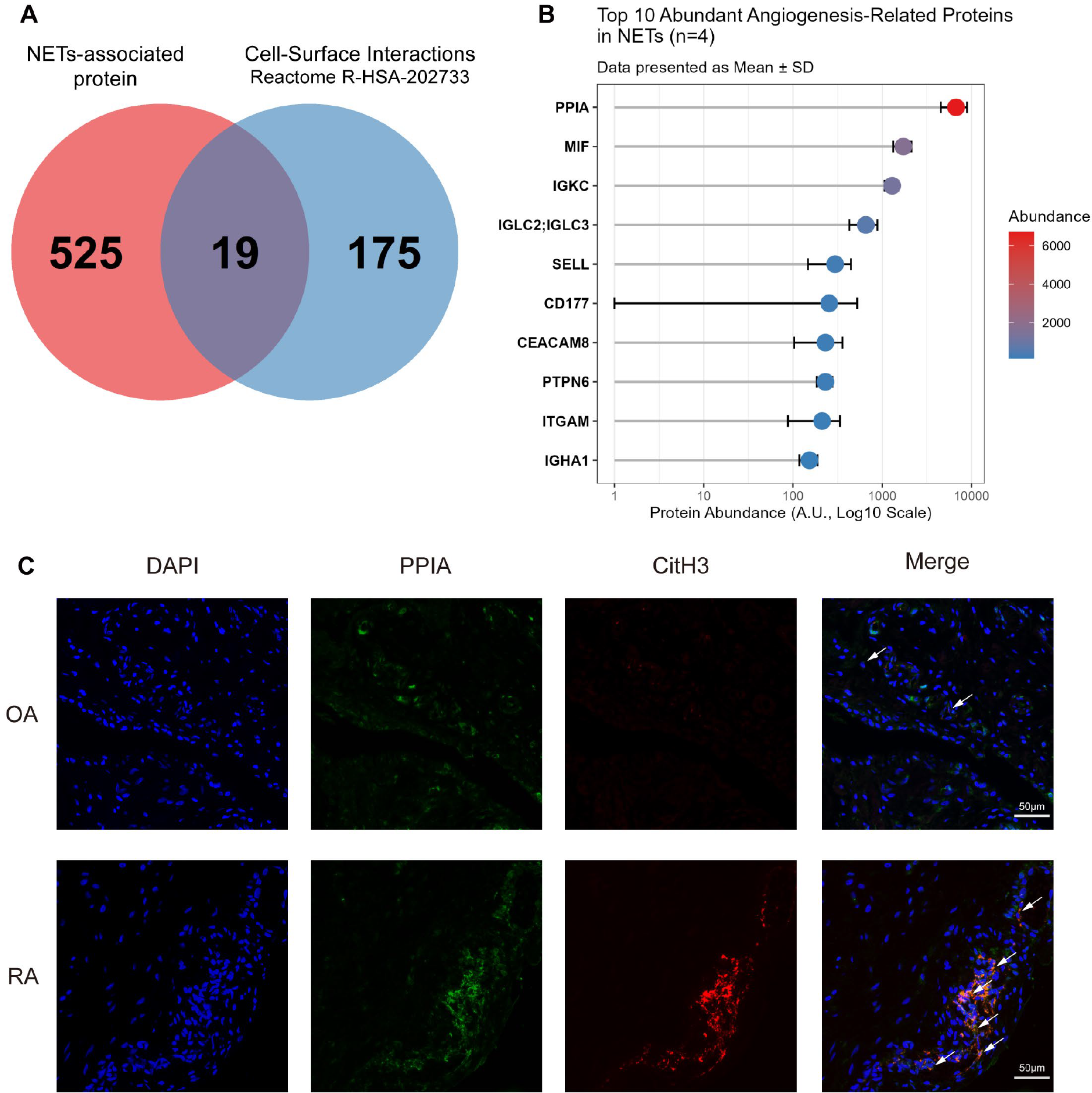
Results: 1) Synovial analysis revealed significantly increased vascularity and substantial spatial co-localization of NETs with CD31 + neovessels in RA versus OA. 2) RA-derived NETs potently enhanced HUVEC migration and tube formation. Proteomics identified significant enrichment of PPIA within NETs, confirmed by immunofluorescence in RA synovium. The PPIA inhibitor CsA effectively reversed NETs-induced pro-angiogenic effects in vitro. 3) In CIA mice, inhibition of NETs (via GSK484) or PPIA (via CsA) significantly reduced synovial angiogenesis and mitigated bone erosion, with efficacy correlating with reduced NETs deposition.
Conclusions: Our study demonstrates that NETs drive pathological angiogenesis in RA. We identify PPIA as a crucial effector molecule carried by NETs and show that targeting the NETs-PPIA axis potently suppresses neovascularization and joint damage in vivo. These findings reveal a novel immuno-angiogenic pathway and nominate PPIA as a promising therapeutic target for RA.
Increased synovial vascularity and perivascular infiltration in RA synovium, with MPO positivity suggesting neutrophil extracellular traps (NETs).
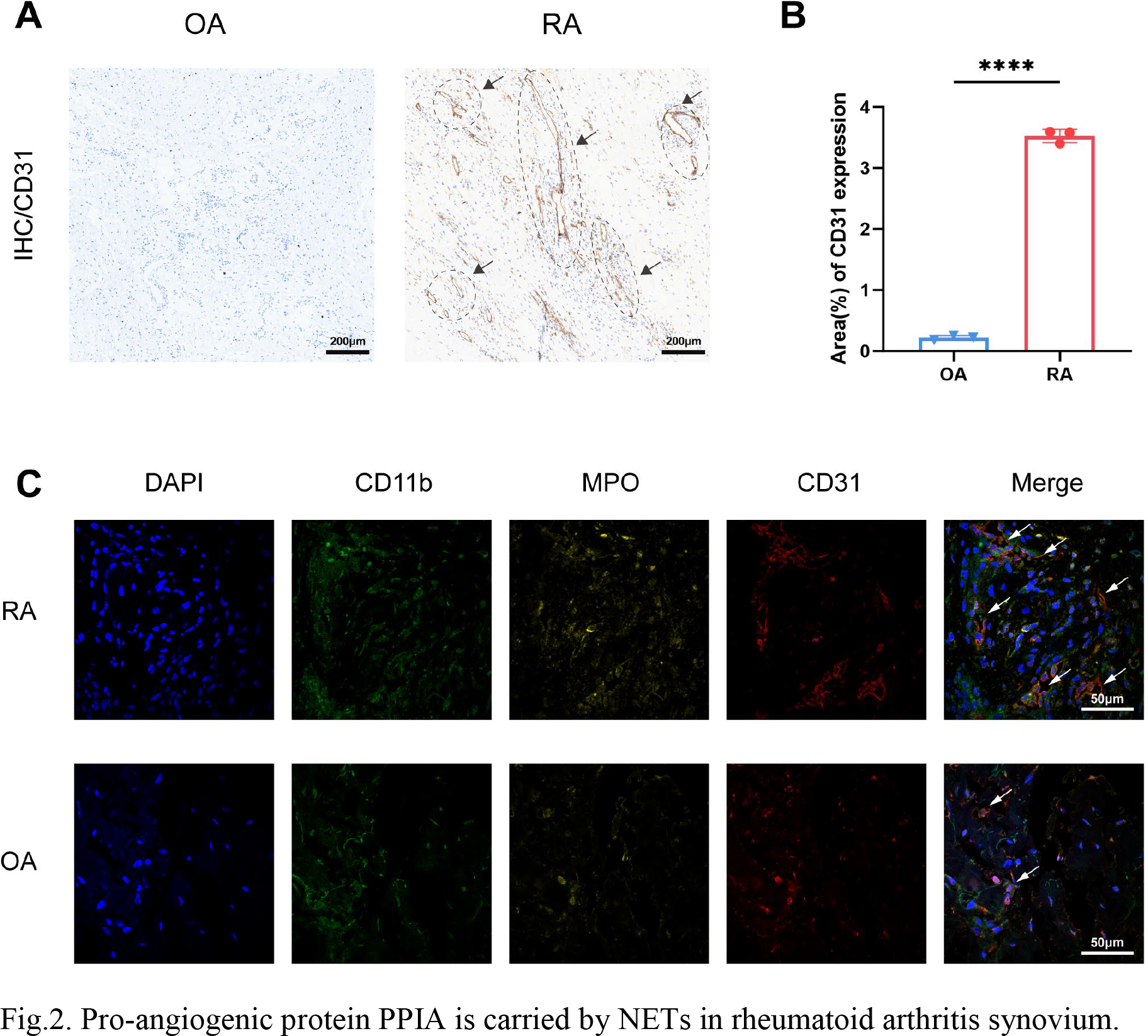
Pro-angiogenic protein PPIA is carried by NETs in rheumatoid arthritis synovium.
REFERENCES: [1] Zhao F, Hu Z, Li G, et al. Angiogenesis in rheumatoid Arthritis: Pathological characterization, pathogenic mechanisms, and nano-targeted therapeutic strategies. Bioact Mater . 2025;50:603-639. Published 2025 May 2. doi:10.1016/j.bioactmat.2025.04.026.
[2] Wigerblad G, Kaplan MJ. Neutrophil extracellular traps in systemic autoimmune and autoinflammatory diseases. Nat Rev Immunol . 2023;23(5):274-288. doi:10.1038/s41577-022-00787-0.
Acknowledgments: NIL.
Disclosure of Interests: None declared.