fetching data ... 
Background: Rheumatoid arthritis (RA) is clinically heterogeneous, and response to targeted therapies varies substantially among patients. Although there is a strong need for predictive biomarkers to guide treatment selection, robust predictors of response to abatacept are still lacking.
Objectives: To identify immunological predictors of abatacept response, we performed peripheral blood mass cytometry in RA patients initiating abatacept. To further characterize abatacept-induced immune modulation in the cell populations of interest, we conducted paired pre-/post-treatment single-cell (sc)RNA-seq.
Methods: The PREDICTABA (PREDictors of ABAtacept efficacy in immunomics) study recruited RA patients starting abatacept across six hospitals in Japan. Peripheral blood mass cytometry was performed in discovery and validation cohorts (n=79 and n=22, respectively, after quality control) with Helios (Fluidigm). Associations between baseline T- and B-cell clusters and subsequent clinical response (CDAI improvement at 3 months) were evaluated using mixed-effects association testing for single cells (MASC). In addition, scRNA-seq of flow-sorted CD8 T cells was performed using the 10x Genomics Chromium platform on paired samples obtained before and after abatacept treatment, with healthy controls included for reference.
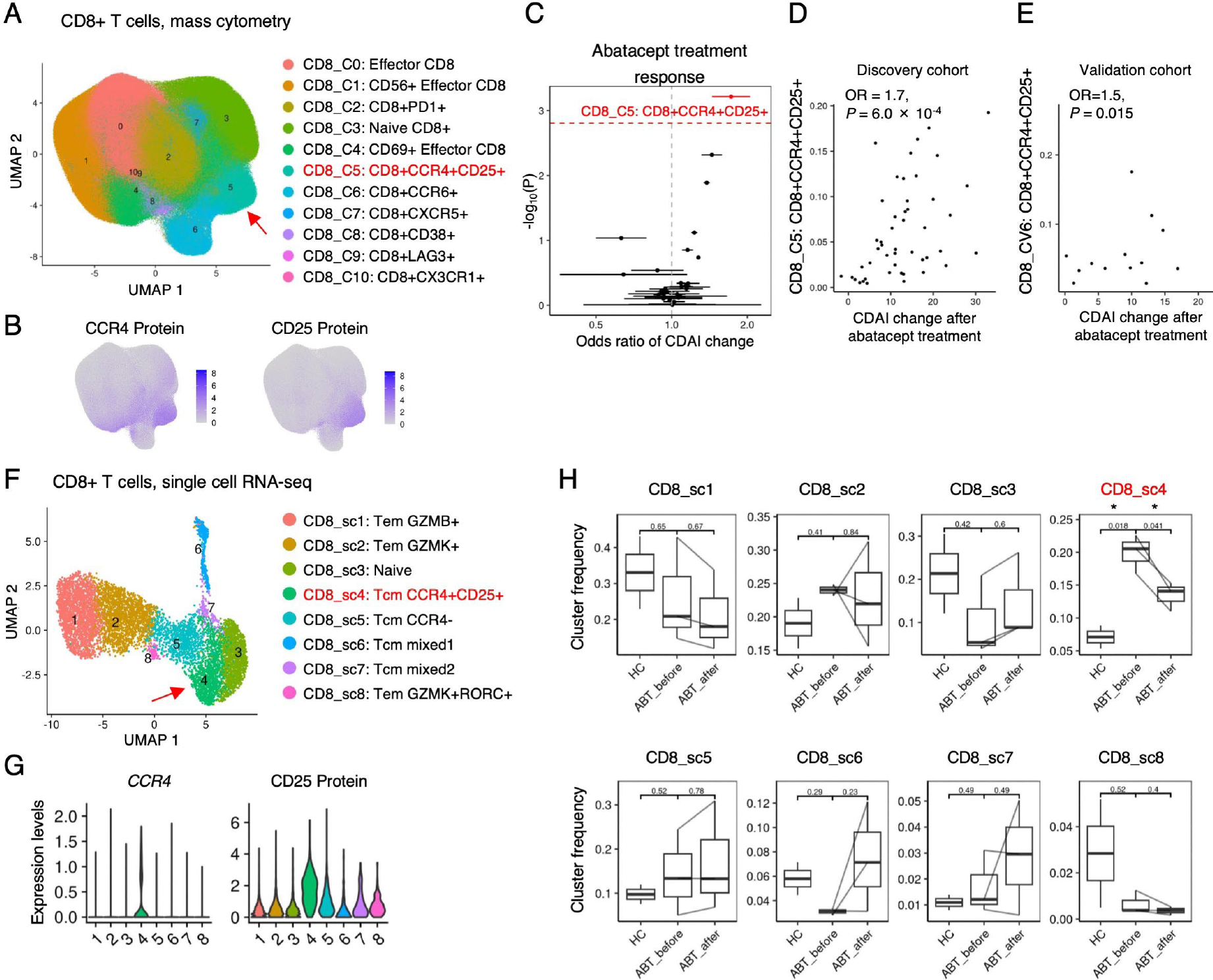
Results: At baseline, the median age was 73 years; 80% were female and 80% were ACPA positive. Median CDAI improved from 17.7 at baseline to 5.0 at 3 months. Baseline frequencies of CD8 + CCR4 + CD25 + T cells were significantly and reproducibly associated with CDAI improvement after abatacept (odds ratio [OR] 1.7 in the discovery cohort and 1.5 in the validation cohort; P = 6.0×10 −4 and P = 0.015, respectively; Figure 1A–E ), supporting their potential as a predictive biomarker for abatacept efficacy. Unsupervised clustering of CD8 T-cell scRNA-seq data confirmed a CD8 + CCR4 + CD25 + cluster (CD8_sc4, Figure 1F-G ). Among CD8 T-cell clusters, CD8 + CCR4 + CD25 + cells exhibited the most pronounced frequency changes between pre- and post-treatment samples ( Figure 1H ). Abatacept significantly downregulated type I and type II interferon response programs and a proteolysis-related gene signature within CD8 + CCR4 + CD25 + T cells (GO-BP gene signatures, P < 0.01).
Conclusions: CD8 + CCR4 + CD25 + T cells represent a key abatacept-responsive CD8 T-cell subset. Their baseline abundance may serve as a practical predictive biomarker for therapeutic efficacy of abatacept in RA.
CD8 + CCR4 + CD25 + T cells and abatacept response.
(A) Uniform manifold approximation and projection (UMAP) plot showing 11 CD8 + T-cell clusters in the discovery cohort. (B) Representative feature plots showing expression of the indicated proteins. (C) Associations between 3-month change in CDAI from baseline (ΔCDAI) and 32 T- and B-cell mass cytometry clusters, assessed using mixed-effects association testing for single cells (MASC) models. Error bars indicate 95% confidence intervals. The red dashed line indicates the Bonferroni-corrected significance threshold (P = 0.05/32). (D–E) Dot plots showing the associations between ΔCDAI at 3 months and the frequency of the CD8 + CCR4 + CD25 + T-cell cluster in the discovery (D) and validation (E) cohorts. Cluster frequencies were calculated as the proportion of the cluster within the parent CD8 + population. MASC odds ratios (ORs) and P values are shown. (F) UMAP of eight CD8 + T-cell clusters from single-cell RNA-seq. (G) Expression of key marker gene (CCR4) and CITE-seq protein (CD25) across the eight clusters. (H) Proportions of each cluster in healthy controls (HC, n=2), patients before abatacept treatment (ABT_before, n=3), and patients after abatacept treatment (ABT_after, n=3). Group differences were tested using Student’s t-test (*P < 0.05).
REFERENCES: NIL.
Acknowledgments: NIL.
Disclosure of Interests: Yasuo Nagafuchi Bristol-Myers Squibb, I belonged to the Social Cooperation Program, Department of functional genomics and immunological diseases, supported by Chugai Pharmaceutical., Saeko Yamada Bristol-Myers Squibb, Yuichi Suwa: None declared, Mineto Ota I belonged to the Social Cooperation Program, Department of functional genomics and immunological diseases, supported by Chugai Pharmaceutical., Hiroaki Hatano: None declared, Kanae Kubo Bristol-Myers Squibb, Kenichi Shimane: None declared, Keigo Setoguchi: None declared, Takanori Azuma: None declared, Mizuko Mamura: None declared, Tomohisa Okamura I belonged to the Social Cooperation Program, Department of functional genomics and immunological diseases, supported by Chugai Pharmaceutical., Kojiro Sato: None declared, Kazuyoshi Ishigaki Bristol-Myers Squibb, Keishi Fujio Bristol-Myers Squibb, Bristol-Myers Squibb, Ono pharmaceutical.