fetching data ... 
Background: Rheumatoid arthritis (RA) is a heterogeneous autoimmune disease characterised by dynamic interactions between circulating immune cells and stromal synovial cells, leading to joint destruction and variable treatment response. There are now no reliable biomarkers to predict response to biologic treatment in RA [1-2]. Digital twin technologies have emerged as innovative tools in rheumatology to simulate disease trajectories and stratify treatment strategies; however, their implementation requires mechanistic models capable of capturing spatial cellular behaviours and drug effects at the tissue level [3].
Objectives: To develop DigiTREAT, a digital health framework for RA that integrates: (1) a spatially explicit agent-based model (ABM) of synovial inflammation, (2) experimental omics datasets from preclinical models, and (3) prospective clinical data, with the ultimate goal of supporting precision treatment recommendations in RA.
Methods: A multiscale ABM of the RA knee joint was developed to simulate interactions among stromal (fibroblast-like synoviocytes, chondrocytes, osteoclasts) and immune cells (macrophages, T cells, B cells, neutrophils) within cartilage, synovial fluid, and synovial tissue compartments. Cytokines (TNF-α, IL-6, IL-1β, IL-10, MCP-1, RANKL) were represented as diffusive fields in the tissue microenvironment, while cell–cell and cell–matrix mechanical interactions were handled by built-in biomechanical rules. Model initialisation was informed by scRNA-seq data from synovial fluid and tissue, identifying 19 immune and stromal cell types and their relative abundances. A total of 199 mechanistic rules were encoded, extended to 241 to simulate tofacitinib action via JAK-STAT inhibition. Simulation outputs included spatial snapshots, cytokine concentration profiles, and cell population dynamics over time, with demonstrated scalability (25.000 agents).
Results: The ABM reproduced cardinal features of RA synovitis, including fibroblast proliferation, pannus formation, cartilage degradation, and synovial swelling.
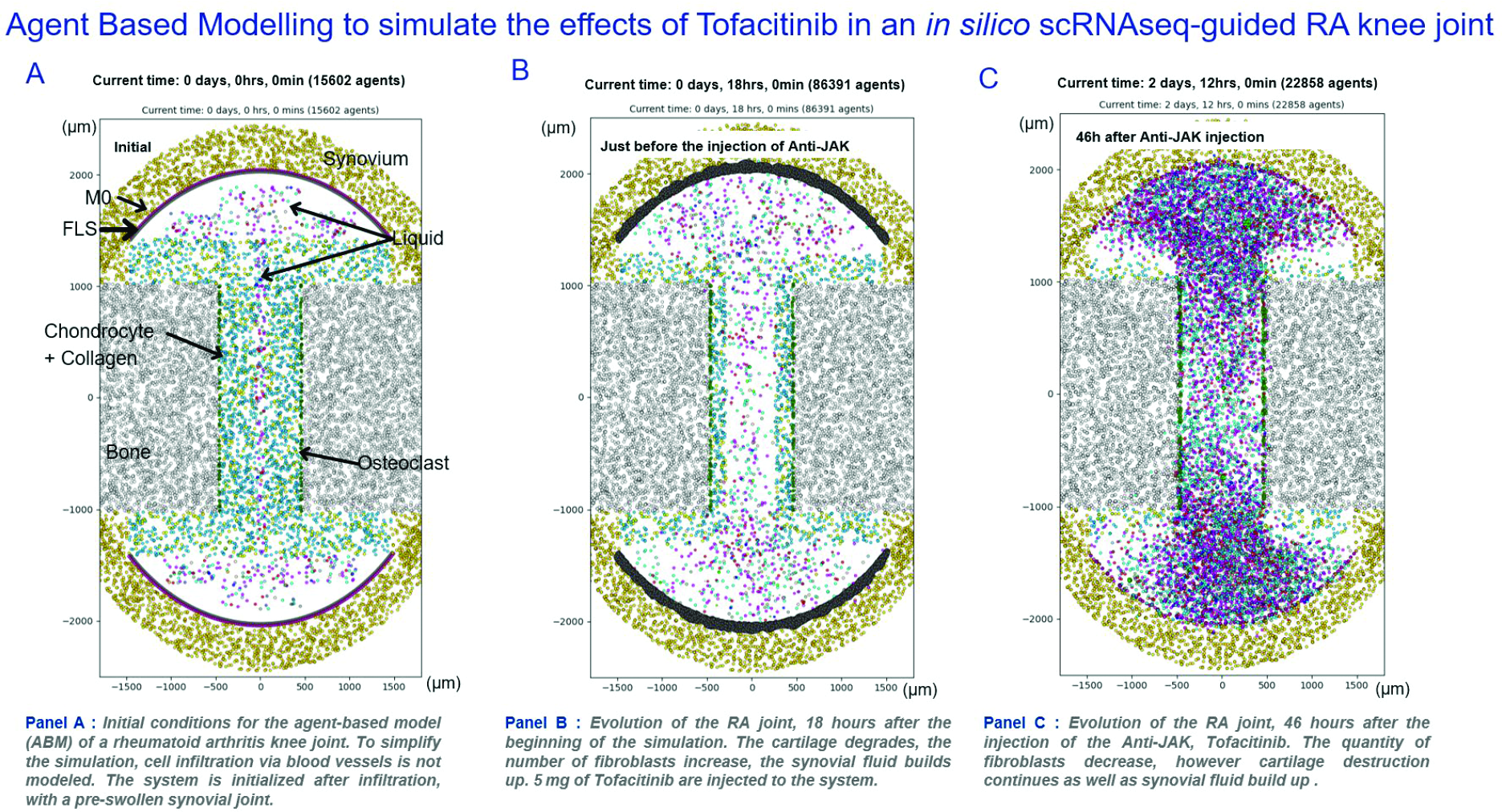
Preliminary results of anti-JAK simulation experiments showed reduced fibroblast-like synoviocyte density and inflammatory cytokine concentrations, consistent with known tofacitinib effects. Temporal simulation plots showed decreases in FLS and TNF-α/IL-1β levels after virtual dosing, but did not prevent cartilage destruction or synovial fluid infiltration. Ongoing work will focus on improving calibration of the model’s spatiotemporal dynamics, integrating spatial omics readouts [4] from collagen-induced arthritis (CIA) mice to provide biological calibration, and baseline blood single-cell RNAseq data from a prospective clinical cohort initiating etanercept, tocilizumab, rituximab to evaluate biomarker predictivity of response to treatment [5] and enable patient-specific model personalisation.
Conclusions: DigiTREAT delivers an innovative digital health framework for mechanistic simulation and treatment stratification in RA. The ABM component provides biologically grounded spatial simulations of synovitis and drug effects, enabling hypothesis generation, virtual perturbations, and in silico trialling. Integration with experimental and clinical datasets could pave the way toward operational RA digital twins to support personalised therapeutic decisions in rheumatology.
Example of an in-silico simulation of the effects of Tofacitinib using an agent-based model of an RA knee joint
REFERENCES: [1] Loh C, Park S-H, Lee A, Yuan R, Ivashkiv LB, Kalliolias GD. TNF-induced inflammatory genes escape repression in fibroblast-like synoviocytes: transcriptomic and epigenomic analysis. Ann Rheum Dis. 2019 Sep;78(9):1205–14.
[2] Humby F, Durez P, Buch MH, Lewis MJ, Rizvi H, Rivellese F, et al. Rituximab versus tocilizumab in anti-TNF inadequate responder patients with rheumatoid arthritis (R4RA): 16-week outcomes of a stratified, biopsy-driven, multicentre, open-label, phase 4 randomised controlled trial. Lancet. 2021 Jan 23;397(10271):305–17.
[3] Niarakis A, Laubenbacher R, An G [...] et al, Immune digital twins for complex human pathologies: applications, limitations, and challenges, NPJ Syst Biol Appl. 2024 Nov 30;10(1):141.
[4] Lozachmeur G, Bramoulle A, Aubert A, Stüder F, Moehlin J, Madrange L, et al. Three-dimensional molecular cartography of human cerebral organoids revealed by double-barcoded spatial transcriptomics. Cell Rep Methods. 2023 Sep 25;3(9):100573.
[5] Duquesne J, Bouget V, Cournède PH, Fautrel B, Guillemin F, de Jong PHP, et al. Machine learning identifies a profile of inadequate responder to methotrexate in rheumatoid arthritis. Rheumatology (Oxford). 2023 Jul 5;62(7):2402–9.
Acknowledgments: NIL.
Disclosure of Interests: Elisa Mages: None declared, Samuel Bitoun: None declared, Marco Antonio Mendoza-Parra: None declared, Anna Niarakis L’Oréal Paris, R&I, Sanofi Aventis, R&D.