fetching data ... 
Background: Meniscal pathologies are a common component of knee OA. While much is known about the relationship between meniscal damage and cartilage loss, the relationship between meniscus and OA bony changes and are less studied. It has been postulated that OA bony changes are in part a response to mechanical instability. The development of automated 3D knee femoral bone shape (B-score), which provides a continuous measure of OA status, enables feasible exploration of this relationship [1].
Objectives: We aimed to explore the association between baseline meniscal extrusion (as a sign of meniscus dysfunction), and the rate of B-score bone shape change in knee OA.
Methods: Osteoarthritis Initiative (OAI) TSE MR images of all knees included in the FNIH OA Biomarkers Consortium sub cohort at baseline, 1, and 2-year timepoints were scored for meniscal extrusion in four positions (lateral anteriorly, lateral laterally, medial anteriorly, medial medially) from 0-3 using the semi-quantitative MRI Osteoarthritis Knee Score (MOAKS) system. We chose the maximum of the four scores for each knee. B-scores were automatically derived from corresponding DESS MR images. B-score annual rates of change (slopes) were modelled by linear least-squares (LLM) regression over 2 years. Associations between baseline maximum meniscal extrusion and B-score slopes were explored using violin plots and Kendall’s rank correlation coefficient (tau). Statistical significance of differences between successive MOAKS scores of mean baseline B-scores and mean annual B-score rates were tested using unpaired two-sided t-tests.
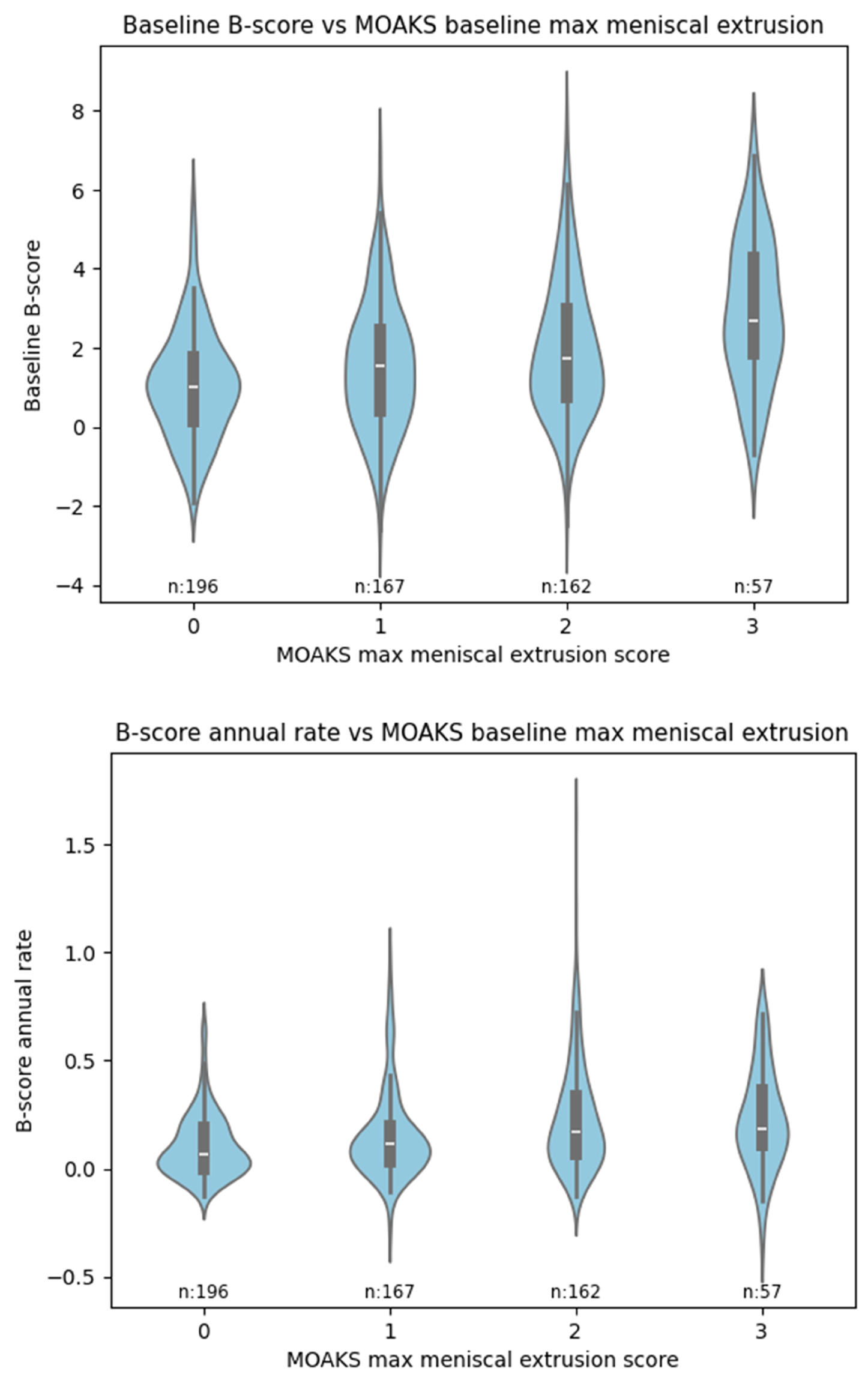
Results: 582 knees were included (59% female, KLG1: 12%, KLG2: 51%, KLG3: 37%) with MR images available at all three timepoints. Mean baseline MOAKS maximum meniscal extrusion score was 1.25 (range 0-3), mean (SD) B-score was 1.68 (1.69) and mean (SD) B-score annual rate of change was 0.17 (0.22). Mean baseline B-scores and mean B-score annual rates of change are shown in Table 1. Violin plots of the MOAKS scores vs baseline b-scores are shown in Figure 1 (top) and MOAKS scores vs mean B-score rate of change are shown in Figure 1 (bottom). Kendall’s tau coefficient for baseline B-scores was 0.21 (p < 0.0001) and for B-score slope was 0.19 (p < 0.0001).
Conclusions: Baseline and annual rates of change for bone shape both showed highly significant correlations with baseline MOAKS maximum meniscal extrusion scores. Higher baseline MOAKS meniscal extrusion scores were associated with both higher baseline B-scores and higher rates of change, indicating a possible contribution of meniscal incompetence an associated mechanical instability to rate of knee bone shape change.
Mean baseline B-scores and mean B-score annual rates of change for different MOAKS baseline maximum meniscal extrusion scores. Significance of differences of means between successive MOAKS scores: *p<0.05, **p<0.005, ***p<0.0005.
| Baseline MOAKS extrusion score | N | Mean baseline B-score (SD) | Mean B-score rate per annum (SD) |
|---|---|---|---|
| 0 | 162 | 1.06 (1.37) | 0.10 (0.15) |
| 1 | 167 | 1.54 (1.61)** | 0.15 (0.20)* |
| 2 | 196 | 1.96 (1.73)* | 0.24 (0.26)** |
| 3 | 57 | 2.90 (1.79)** | 0.23 (0.23) |
Mean baseline B-score (top) and mean 2-year B-score LLM slopes (bottom) for different MOAKS baseline maximum meniscal extrusion scores.
REFERENCES: [1] Bowes et al. (2021) ARD 80(4) 502-508.
Acknowledgments: NIL.
Disclosure of Interests: Alan Brett: None declared, Philip G. Conaghan AbbVie, Janssen, Novartis, Sandoz, Alfasigma, Eli Lilly, Eupraxia, Formation Bio, Genascence, GSK, Grunenthal, Janssen, Kolon TissueGene, Levicept, Medipost, Moebius, Novartis, Stryker & Takeda.