fetching data ... 
Background: Timely access to specialized rheumatological care is a general health care issue in many European countries. Improving the quality of the preclinical assessment in basic medical care by using AI-powered diagnostic tools is a yet unexplored approach for accelerating targeted rheumatologic care. The AI-powered ultrasound robot ARTHUR has been validated for the recognition of rheumatoid arthritis and osteoarthritis in defined patient populations [1,2,3].
Objectives: We aimed to evaluate the use of ARTHUR in a preclinical real world triage setting at a big rheumatological center in Germany.
Methods: Patients were referred to the outpatient triage unit by non-rheumatologic physicians with suspicion of an inflammatory rheumatic disease and were seen by a rheumatologist, who after clinical assessment and due to unexplored tender and/or swollen hand and finger joints initiated ultrasound robot scans of the most severely involved hand on the same day. Patients with clinical suspicion of an inflammatory symptom origin and laboratory abnormalities prior to triage consultation were referred to a further evaluation in a in-patient setting within 3 months, including conventional radiographs, MRI and professional ultrasound of the hand and an overall assessment by a professional rheumatologist.
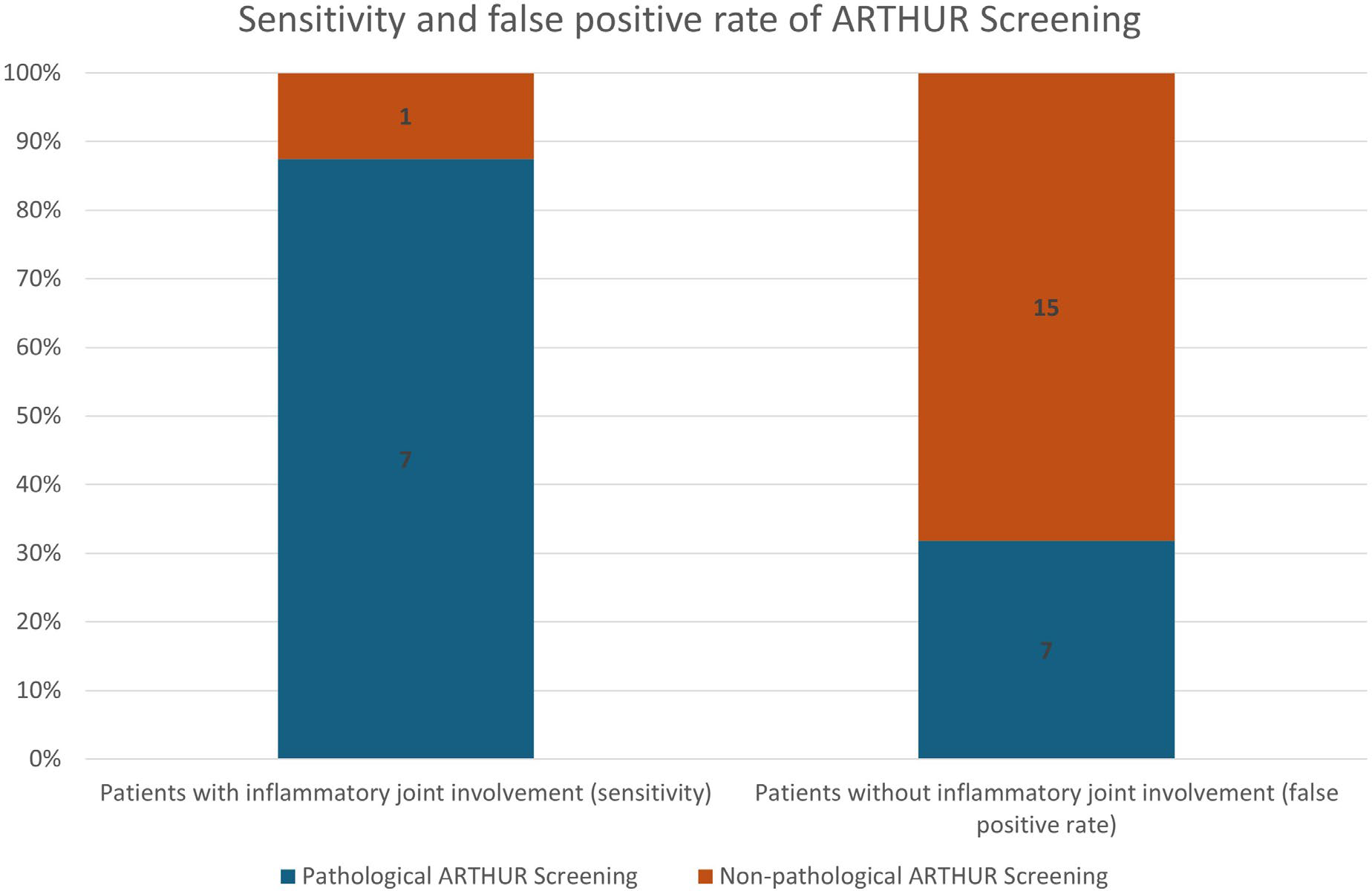
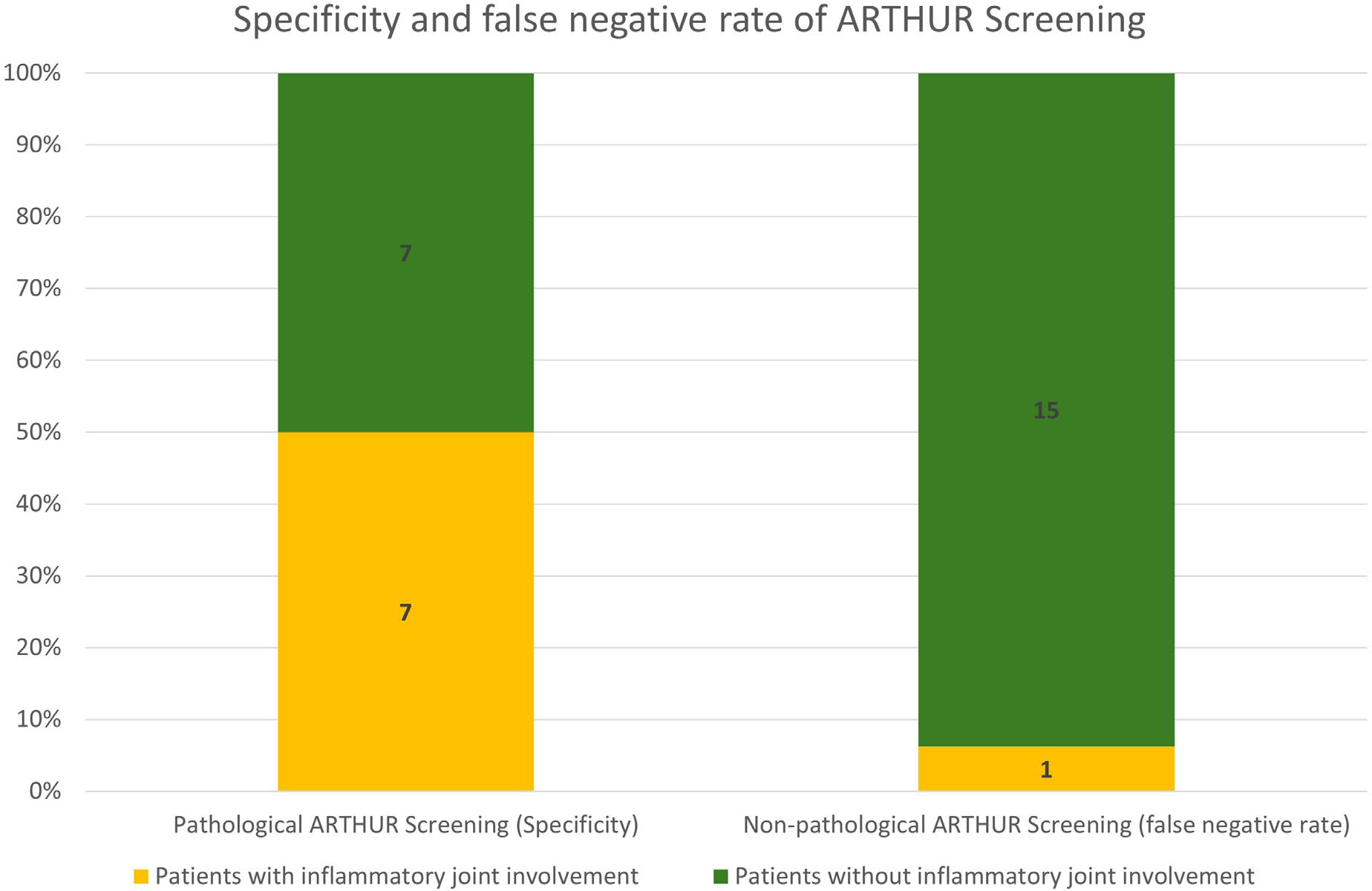
Results: Between August and December 2025, 76 patients were included and preclinically screened, while 30 patients underwent in-patient evaluation until January 2026. The median age at screening was 51 years, 24 patients were female. Overall, 10 patients were diagnosed with an inflammatory rheumatic disease (2 seropositive rheumatoid arthritis, 3 Polymyalgia rheumatica, 1 systemic sclerosis, 1 Sjögren`s Syndrome, 1 CPPD-Arthritis, 1 psoriatic arthritis, 1 reactive arthritis). A median of 10,8 joints was evaluated by the ultrasound robot. At least 1 joint with synovitis grade 2 or 3 (OMERACT combined score) was detected in 14/30 patients (46,67%), 7 (50%) of which were diagnosed with an inflammatory rheumatic disease (specificity 50%). A Power-Doppler signal grade 1 or higher in the pathologic joints increased the specificity to 60% (10 patients detected, 6 with confirmed inflammatory diagnosis). Of the 20 patients with non-inflammatory diagnosis, 7 (35%) had a pathological screening result (false positive rate 35%), in 3/20 patients (15%) Power-Doppler-signal was detected by the ultrasound robot. Of the 10 of the patients with newly diagnosed inflammatory rheumatic diseases 7 (2 seropositive rheumatoid arthritis, 2 Polymyalgia rheumatica, 1 systemic sclerosis, 1 CPPD-arthritis, 1 reactive arthritis) had a pathological screening result, whereas the undetected cases had no peripheral joint involvement (2/3) or were not screened at the affected joints (1/3), what we interpreted as an user error. A total of 7/8 patients with an inflammatory peripheral joint involvement were detected by the ultrasound robot (sensitivity 87,5%, 100% without user error). Of the 8 patients with inflammatory joint involvement, 1 patient hat a non-pathological screening result, caused by incorrect joint selection (false negative rate 12,5%).
Conclusions: An AI-powered ultrasound robot (ARTHUR) proved useful tool in screening inflammatory arthropathies. A reliable detection of inflammatory joint involvement could be observed in rheumatoid arthritis and other systemic inflammatory conditions in a real world setting. A targeted and correct use should be ensured to minimize false negative results. Due to the relatively high number of false positive results, especially when a moderate or severe synovitis (OMERACT combined score 2 or 3) is caused by synovial hypertrophy only, a detailed rheumatologic evaluation in a more intensive setting is necessary.
REFERENCES: [1] Frederiksen BA et al, Automated Ultrasound System ARTHUR with AI Analysis DIANA Matches Expert Rheumatologist in Hand Joint Assessment of Rheumatoid Arthritis Patients, ACR Convergence 2024.
[2] Weber A et al, Performance of an Artificial Intelligence Model Compared to Multiple Human Experts in Scoring Synovitis Severity and Osteophyte Severity on Joint Ultrasound Image, ACR Convergence 2024.
[3] Frederiksen BA et al, Automated ultrasound system ARTHUR V.2.0 with AI analysis DIANA V.2.0 matches expert rheumatologist in hand joint assessment of rheumatoid arthritis patients, RMD Open 2025;11:e005805. doi:10.1136/rmdopen-2025-005805.
Acknowledgments: NIL.
Disclosure of Interests: Philipp Schulte-Terhusen: None declared, Philipp Sewerin The author states that all conflicts of interest are already disclosed to EULAR. The author states that all conflicts of interest are disclosed to EULAR. The author states that all conflicts of interest are disclosed to EULAR. Styliani Tsiami: None declared, Aiham Ali: None declared, Xenofon Baraliakos The author states that all conflicts of interest are disclosed to EULAR. The author states that all conflicts of interest are disclosed to EULAR. The author states that all conflicts of interest are disclosed to EULAR.