fetching data ... 
Background: Health literacy (HL) is increasingly acknowledged as a critical determinant of health that should be considered to deliver effective, equitable, and person-centered care. HL encompasses the competencies and resources required to access, understand, appraise, and use health information and services [1]. It enables individuals to navigate the healthcare system, interact effectively with professional and personal networks, and successfully manage their disease. As part of a FOREUM grant, ongoing work focuses on developing an intervention to introduce HL responsiveness in rheumatology practice, equipping rheumatology healthcare providers (HCPs) to recognise patients’ HL needs and align their communication and provision of care accordingly. However, to ensure sustainable integration into routine workflows, a comprehensive understanding of current practices and implementation needs among HCPs in Europe is essential.
Objectives: The aims of this study were to explore rheumatology HCPs’ perceptions about HL, the strategies they employ to recognise their patients’ HL needs, and the perceived facilitators and barriers associated with the recognition of these needs.
Methods: A co-created cross-sectional online survey was distributed in seven languages among rheumatologists and other health professionals (e.g. nurses and physiotherapists) involved in rheumatology care, through national rheumatology networks and associations across eight European countries (Belgium, Denmark, France, Germany, Spain, Sweden, The Netherlands and The United Kingdom), between July and November 2025. Open-ended questions explored HCPs’ perceptions about HL, as well as facilitators and barriers encountered specifically during the recognition of their patients’ HL needs. Additionally, the survey quantitatively captured their familiarity with and training needs related to HL using single-response items, perceived impact of and organisational attention to HL via 0-100 Visual Analogue Scales, and strategies used to recognise HL needs using a multiple-response item. Qualitative data were coded inductively via ATLAS.ti and analysed thematically, while quantitative data were analysed descriptively using IBM SPSS Statistics.
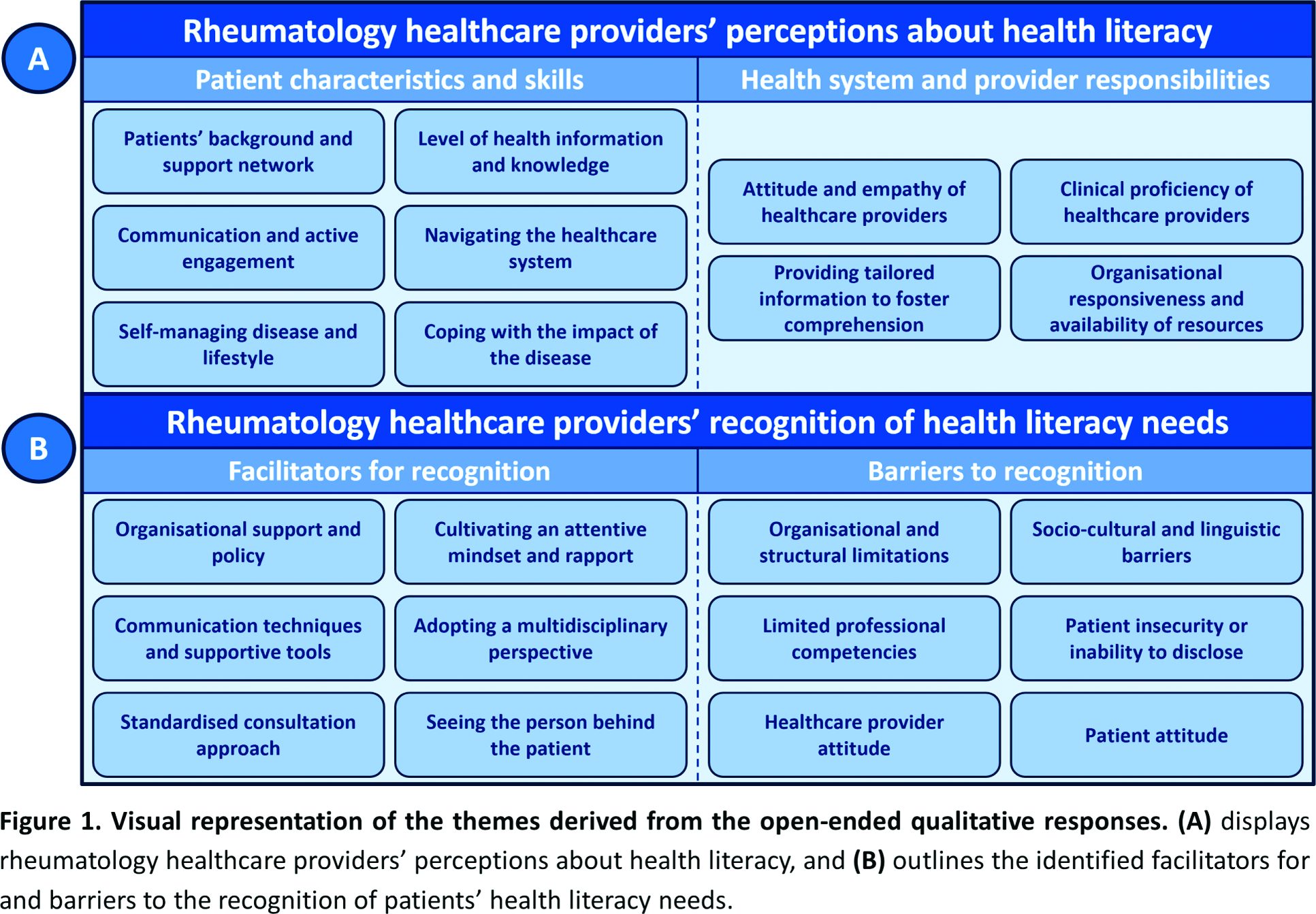
Results: A total of 757 HCPs consented. Notably, a substantial loss of respondents was observed early in the survey: 41% (n=306/757) discontinued the survey either before or immediately after answering the first section, which included a yes/no question on familiarity with the term “HL” and an open-ended question on perceptions about HL. Further decline occurred across subsequent sections. The 350 respondents who completed all sections of the survey had a mean age of 51 years, were predominantly female (n=237; 68%), and represented a mix of professions (58% rheumatologists, 15% nurses, 11% physiotherapists and 16% other professions). 60% of respondents (n=395/654) reported being familiar with the term “HL” and thematic analysis of the open-ended question on their perceptions about HL revealed 10 themes ( Figure 1A ). Six of these themes related to patient characteristics and skills (e.g. ‘level of health information and knowledge’) and four to health system and provider responsibilities (e.g. ‘attitude and empathy of healthcare providers’). The impact of HL on patient care and health outcomes was rated as high (mean±SD 78±20; scale range 0-100 (high), n=325). In contrast, respondents rated the attention devoted to HL within their organisation as considerably lower (mean±SD 41±24; scale range 0-100 (very good), n=325). When respondents had to indicate which strategies they used to recognise their patients’ HL needs, if any, 40% (n=144/357) reportedly applied the teach-back method and 37% (n=131/357) asked specific screening questions. Thematic analysis of open-ended responses regarding facilitators to recognise HL needs represented six themes, with emphasis on organisational solutions and HCP responsibilities ( Figure 1B ). Barriers to recognise needs revealed again six themes which encompassed structural/organisational, HCP-related but also patient-related barriers ( Figure 1B ). Finally, regarding HCPs’ training needs, 82% (n=289/353) reported never having attended a specific course on HL, and 77% (n=272/353) expressed a desire to receive (further) training. Notably, this demand for training was equally high among HCPs with prior training (78%) and without (77%).
Conclusions: Rheumatology HCPs across Europe reported familiarity with the term “HL”, and a multidimensional understanding of the concept was observed overall, with differences between respondents. Despite this conceptual awareness, a substantial gap persists between the perceived importance of HL by HCPs and the limited attention it currently receives at an organisational level. The high early dropout rate suggests that HL may still be perceived as complex or insufficiently prioritised in routine practice. These survey findings provide a strong rationale for a roadmap for organisational strategies and the development of HL training for rheumatology HCPs when aiming to integrate HL responsiveness into daily rheumatology care.
REFERENCES: [1] Bröder J, Chang P, Kickbusch I, Levin-Zamir D, McElhinney E, Nutbeam D, Okan O, Osborne R, Pelikan J, Rootman I. IUHPE position statement on health literacy: A practical vision for a health literate world. Glob Health Promot. 2018;25(4):79-88. doi: 10.1177/1757975918814421.
Acknowledgments: NIL.
Disclosure of interest: Jelle Pergens: None declared, Elias De Meyst Strategic basic research fellowship Fonds Wetenschappelijk Onderzoek (FWO), the Flemish Research Foundation [grant number 1SH4P24N], Ioana Andreica UCB, GSK, Lilly, Alfasigma, Celltrion, UCB, GSK, Alfasigma, Celltrion, GSK, Carina Boström: None declared, Loreto Carmona: None declared, Mrinalini Dey: None declared, Francis Guillemin: None declared, Uta Kiltz AbbVie, Alfasigma, Eli Lilly, GSK, J&J, UCB, AbbVie, Alfasigma, Eli Lilly, GSK, J&J, UCB, AbbVie, Amgen, Fresenius, GBA, GSK, Hexal, Novartis, UCB, Kanta Kumar: None declared, Souzi Makri: None declared, Elena Nikiphorou UCB, Pfizer, Gilead, Galapagos, AbbVie, Eli Lilly, Alfasigma, Fresenius, Novartis, UCB, Pfizer, Lilly, Annette de Thurah: None declared, Maarten de Wit: None declared, Annelies Boonen Johnson & Johnson, Abbvie, Phizer, UCB, AbbVie, Eli Lilly, Rene Westhovens: None declared, Mark Matthijs Bakker Eli Lilly, Sandoz, Eli Lilly.