fetching data ... 
Background: Effective therapeutic targets to restore salivary function are lacking in Sjögren’s Disease (SjD). Understanding the mechanisms driving salivary gland dysfunction, particularly in the early stage before lymphocytes infiltration in the gland, is critical for developing novel treatment strategies. Human endogenous retroviruses (ERVs), genomic remnants of ancient retroviral infections, are normally silenced by epigenetic mechanisms. Their reactivation under pathological conditions can disrupt cellular homeostasis and promote chronic inflammation, yet their role in SjD remains unknown.
Objectives: This study aimed to determine whether ERV reactivation contributes to early salivary dysfunction in SjD and to evaluate the therapeutic potential of inhibiting the downstream necroptosis pathway.
Methods: Bulk RNA-sequencing, single-cell RNA-sequencing, qPCR and western blotting were used in this study to examine ERVs transcription, Z-DNA-binding protein 1 (ZBP1) expression and necroptosis in human and mouse tissues. Z-form nucleic acids were detected by immunofluorescence analysis. To dissect the role of necroptosis in salivary dysfunction independent of immune cells, we generated bone marrow chimeras by transferring WT bone marrow into lethally irradiated WT, Ripk3 -/- (receptor-interacting protein kinase 3, RIPK3) or Mlkl -/- mice (mixed lineage kinase domain-like pseudokinase, MLKL). Eight weeks post-reconstitution, chimeras were immunized with salivary gland protein to induce experimental SjD (ESS). To evaluate the therapeutic potential of inhibiting the necroptosis pathway, ESS mice were treated with the RIPK3 inhibitor GSK’872.
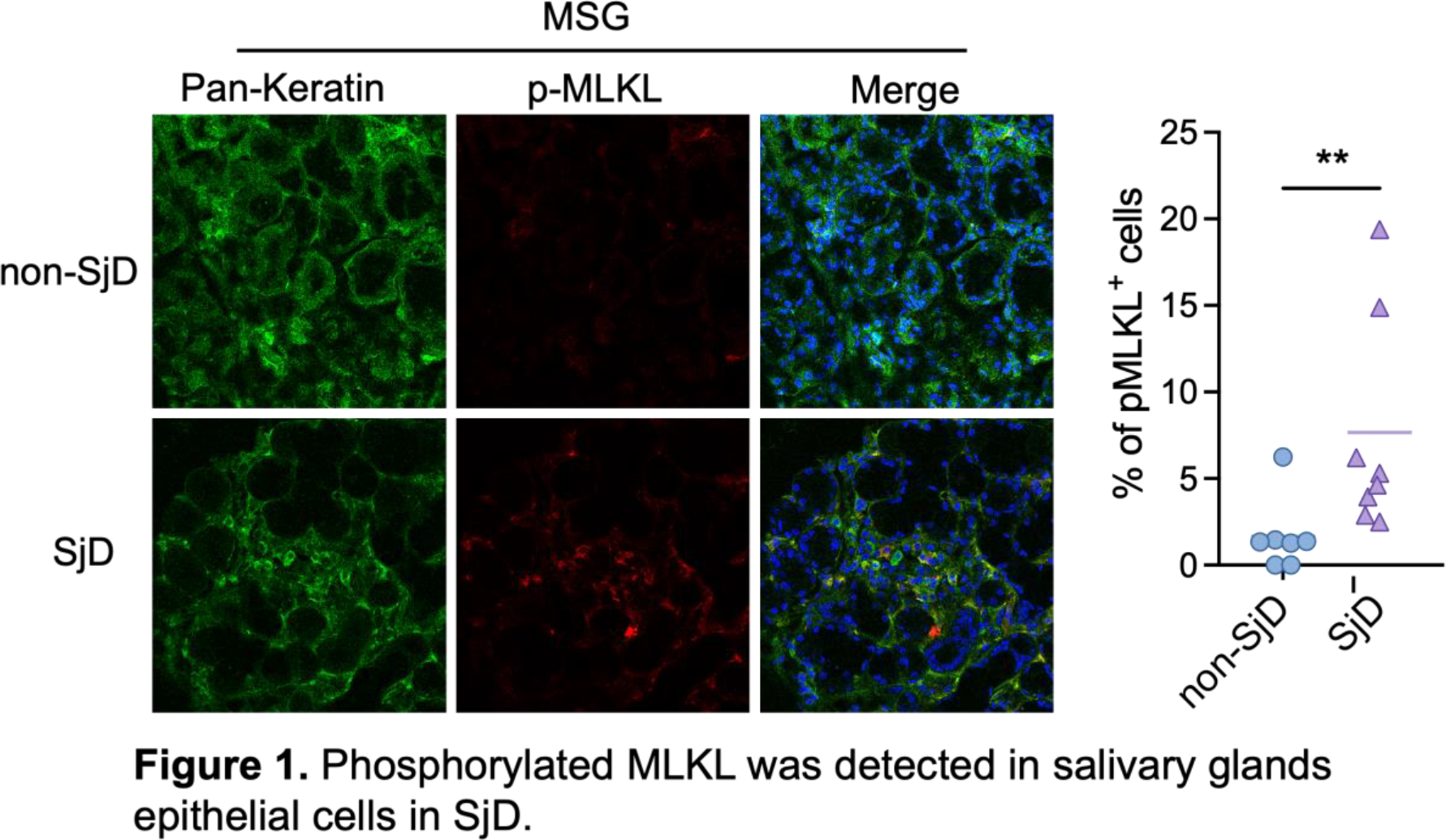
Results: Reactivated ERVs were detected in SjD salivary epithelial cells, producing Z-RNA ligands that activated ZBP1. This triggered RIPK3- and MLKL-dependent epithelial necroptosis. Significantly elevated levels of ZBP1 and necroptosis markers were found in SjD patient’s tissues and in ESS mice before focal lymphocyte infiltration. Stroma defection of necroptosis ameliorates the dysfunction of saliva secretion, focal lymphocytic infiltration, and release of inflammatory molecules. Pharmacological RIPK3 inhibition with GSK‘872 led to marked improvements in saliva secretion and alleviation of tissue damage, as revealed by TUNEL staining.
Conclusions: We identify a novel pathogenic axis in early SjD, whereby ERV reactivation drives ZBP1-dependent epithelial necroptosis, leading to salivary dysfunction prior to lymphocytic infiltration. Targeting this necroptotic pathway, particularly via RIPK3 inhibition, represents a promising therapeutic strategy to preserve salivary function in SjD.
REFERENCES: NIL.
Acknowledgments: NIL.
Disclosure of Interests: None declared.