fetching data ... 
Background: The pathophysiology of Sjögren’s disease (SjD) remains poorly understood. Effective therapeutic targeting can help in understanding disease-associated molecular pathways.
Objectives: This study aimed to identify transcriptomic profiles distinguishing SjD from healthy controls. It also examined transcriptomic changes associated with systemic disease activity and clinical outcomes upon treatment with leflunomide and hydroxychloroquine (LEF-HCQ), these were analyzed locally in the parotid gland (PG) and systemically (whole blood).
Methods: Weighted gene co-expression network analysis (WGCNA) was applied to bulk RNA-sequencing data from parotid gland (verum, n = 19; placebo, n = 9) and whole blood samples (WB; verum, n = 21; placebo n = 8) collected at baseline and after 24 weeks from the RepurpSS-I cohort (1), as well as WB from healthy controls (n = 12). All SjD patients fulfilled the 2016 ACR-EULAR SjD criteria and had active disease (ESSDAI ≥ 5). Gene expression modules significantly correlating with ≥ 1 clinical parameter that formed part of the main network were retained. Module-trait associations were evaluated for clinical (incl. ESSDAI, ESSPRI, IgG, RF, STAR, CRESS) and histological features, and interferon (IFN) scores. Interferon scores were calculated for type I (IFIT1, IFI44, MX1) and type II IFN (GBP1, CXCL9). Longitudinal changes following leflunomide and hydroxychloroquine therapy (LEF-HCQ) and their associations with clinical outcomes were assessed.
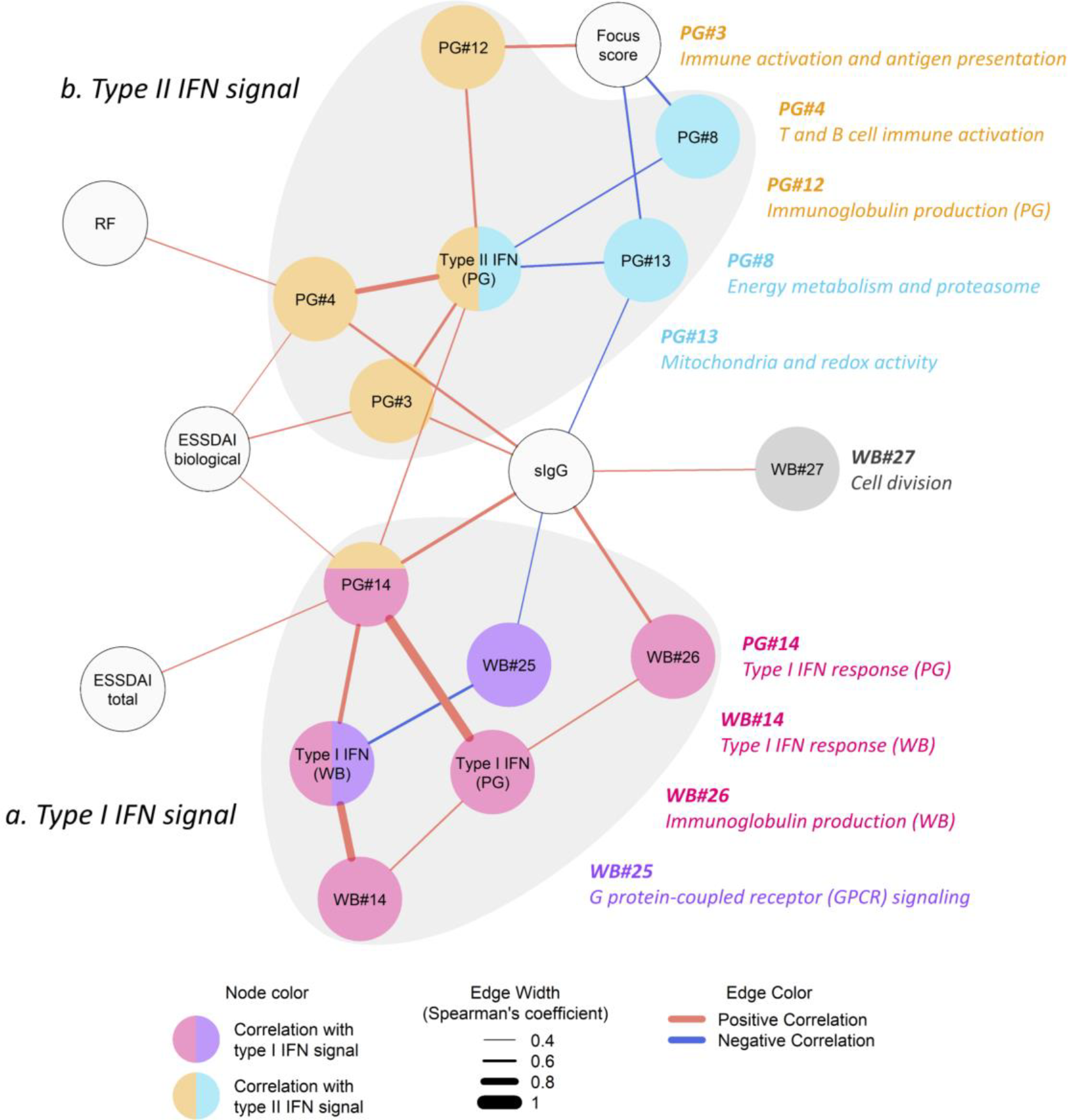
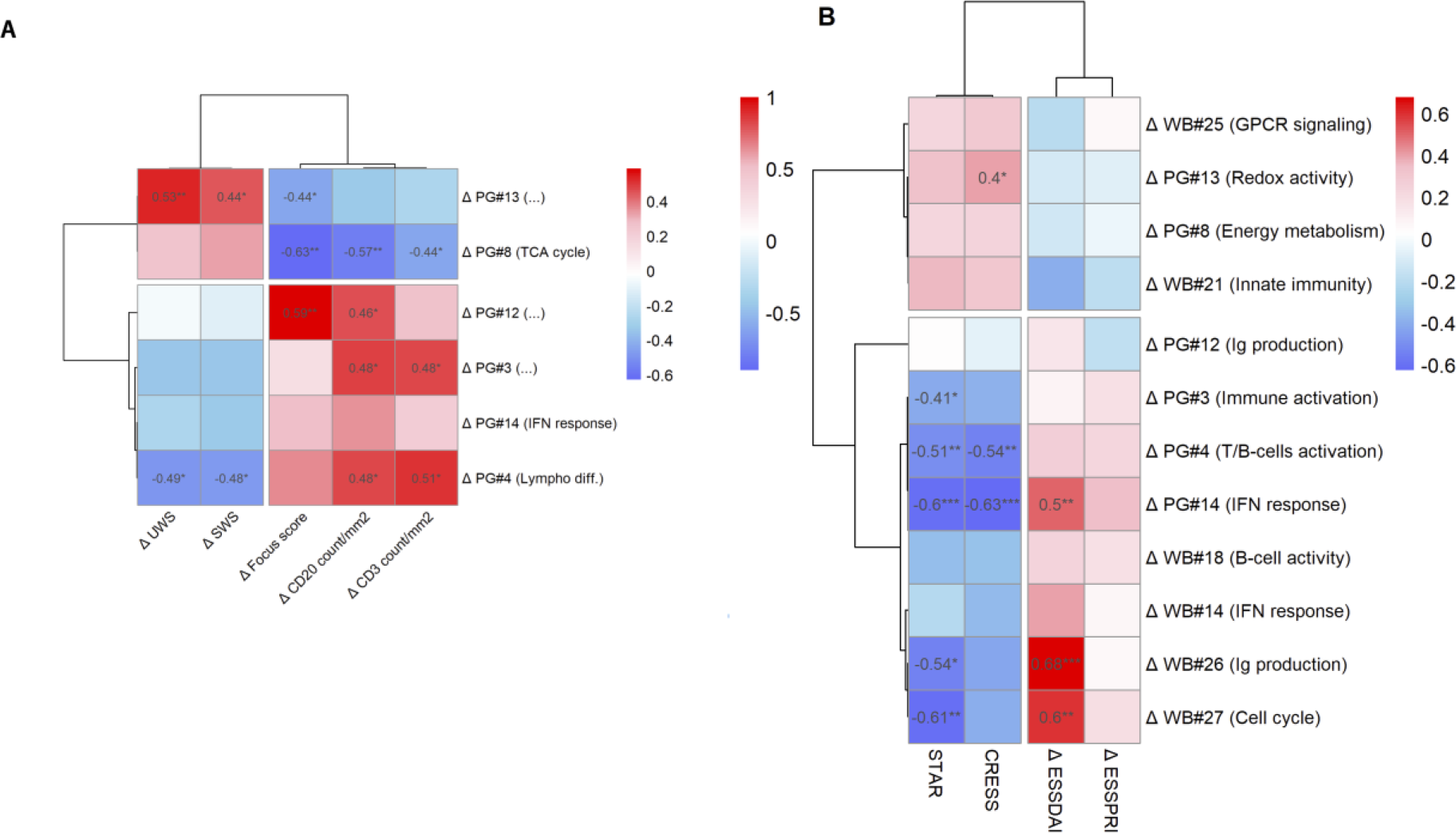
Results: WGCNA identified ten gene co-expression modules, comprising six modules derived from PG and four from WB. Gene expression modules clustered mainly into type I IFN and/or type II IFN, and a proliferation-associated module. Two type I IFN-associated modules (WB14 enriched for interferon responses, WB26 for immunoglobulin production) were significantly increased at baseline in SjD compared to healthy controls and significantly normalized towards control levels after 24 weeks of LEF-HCQ treatment in blood. Also, in the parotid gland, IFN-associated module PG14 was significantly downregulated upon treatment as compared to placebo (all p < 0.05). In line with this, inhibition of glandular type I IFN activity significantly correlated with inhibition of ESSDAI, STAR and CRESS (PG14; Figure 2A). Type II IFN-associated modules derived exclusively from the parotid gland, segregated into pro-inflammatory modules (PG3, PG4, PG12 enriched for immune activation, T-B cell activation, immunoglobulin production) and non-inflammatory modules associated with tissue metabolism (PG13 enriched for energy metabolism, PG8 for redox pathways).
Integration of our data with public single-cell RNA-sequencing data indicated immune cell origins for pro-inflammatory modules, incl. CD4+, CD8+ T cells, NK, while modules involved in tissue metabolism were associated with several stromal cell types (incl. epithelial, endothelial, fibroblasts and mural cells). Placebo-treated patients showed progression of several pro-inflammatory modules over 24 weeks (p = 0.023–0.078), while modules associated with tissue metabolism showed an opposite trend. In contrast, LEF-HCQ halted progression of proinflammatory gene expression (PG4, PG12) and restored gene modules associated with tissue metabolism (p= 0.011–0.039), which aligns with the significantly improved salivary flow at 24wk in the LEF-HCQ group during the RepurpSS-I trial of 10.57uL/5min (95%CI 2.21 to 18.93, p = 0·014). Accordingly, stromal gene expression (PG13) correlated positively with salivary flow (R = 0.44 to 0.53; p < 0.05) and negatively with focus score (R = -0.44, p = < 0.05), while pro-inflammatory gene expression modules showed inverse correlations (salivary flow: R= -0.48 to –0.49; focus scores: R= 0.46 to 0.59, all p < 0.05). This suggests that inhibition of inflammation is accompanied by modulation of gene expression associated with tissue homeostasis and restoration of salivary function (Figure 2A). PG modules enriched for type I and II IFN responses (PG4 and PG14), and WB modules enriched for cell cycle and Ig production (WB26 en WB27) additionally correlated with ESSDAI and novel clinical endpoints STAR, CRESS (Figure 2B; R = 0.5 – 0.68, p < 0.05), including correlations between these modules (R = 0.5 – 0.56, p < 0.05). This reveals a coordinated, system-wide immune activation linking salivary gland pathology to peripheral systemic immune dysregulation and disease activity.
Conclusions: Both type I and type II IFN-associated transcriptional signatures are closely linked to clinical parameters in the SjD cohort of the RepurpSS-I trial. Placebo-treated patients showed progression of pro-inflammatory gene modules, indicative of ongoing inflammatory activity. In contrast, LEF-HCQ targeted several increased pro-inflammatory gene modules. The significant improvements in ESSDAI and salivary flow upon LEF-HCQ therapy in the RepurpSS-I trial is accompanied by reduced local pro-inflammatory activity and increased stromal gene expression involved in tissue homeostasis and glandular function. The observed correlations of blood and parotid gland gene modules highlight the potential of circulating markers as less invasive indicators of glandular disease processes. Together, these findings suggest that leflunomide and hydroxychloroquine treatment modulates gene expression underlying a broad clinical improvement.
Correlation network illustrating associations between clinical and immunological parameters and WGCNA modules from whole blood and parotid gland. Edges indicate average correlations at baseline and longitudinally (week 0 – week 24).
A ) Correlations between longitudinal changes in module expression (ΔT3–T0) and changes in glandular function, histological scores and immune cell infiltrates. UWS = unstimulated whole saliva. SWS = stimulated whole saliva. B ) Correlations between changes in gene modules and changes in clinical endpoints.
REFERENCES: [1] vd Heijden et al. RepurpSS-I. Lancet Rheumatol 2020;2:e260–9.
Acknowledgments: NIL.
Disclosure of Interests: None declared.