fetching data ... 
Background: Juvenile idiopathic arthritis (JIA) is the most common chronic autoimmune rheumatic disease of childhood, with onset before 16 years of age. Despite affecting approximately 1 in 1,000 children worldwide, the biological mechanisms underlying disease susceptibility remain poorly understood. JIA is a complex immune-mediated disorder resulting from interactions between genetic predisposition and environmental exposures, yet current knowledge of its genetic architecture is limited . While recent genome-wide association studies (GWAS) have identified 17 genome-wide significant risk loci, most studies have been constrained by modest sample sizes, restricting power to detect additional variants and to fully characterize shared autoimmune pathways. Large-scale GWAS meta-analyses are therefore critical to expand the catalog of JIA susceptibility loci and to elucidate common genetic mechanisms linking JIA with other autoimmune diseases.
Objectives: The PREVENT JIA project (Prospective Evaluation of Early-Life Modifiable Environmental Factors and Genetic Risk in Juvenile Idiopathic Arthritis) aims to conduct the largest GWAS meta-analysis of JIA to date, comprising more than 8,500 JIA cases and more than 1 million controls, to detect novel genetic associations beyond the power of individual studies, refine established risk loci, characterize shared autoimmune genetic architecture, and identify biologically informative loci with potential therapeutic relevance.
Methods: Genome-wide association analyses were first conducted in two independent Norwegian cohorts: (1) the Norwegian Mother, Father and Child Cohort Study (MoBa), comprising 291 unique JIA cases after removal of related individuals and overlap with other Norwegian datasets, and (2) the Norwegian Registry for Paediatric Rheumatology (NOBAREV), including 206 JIA cases. These results were combined with GWAS summary statistics from multiple international cohorts, including studies from the UK (3,305 cases), Finland (1,631 cases), Estonia (540 cases), Sweden (329 cases), the United States (1,245), and Iceland (569 cases). Together, these datasets constitute the largest JIA genetic resource assembled to date, comprising more than 8,500 JIA cases and over one million controls . Meta-analysis was performed using METAL software under an inverse-variance–weighted fixed-effects model based on standard errors, with rigorous allele harmonization and strand alignment applied across cohorts. Between-study heterogeneity was assessed using Cochran’s Q statistic and the I 2 metric. This large-scale meta-analytic framework substantially increased statistical power to detect novel JIA susceptibility loci beyond those identified in individual studies. Post-GWAS analyses were conducted to prioritize candidate variants and genes and to explore biological mechanisms underlying JIA risk. Downstream analyses comprise completed functional annotation using FUMA, with additional analyses- including statistical fine-mapping, integration with eQTL and GTEx tissue-specific expression data, gene-set enrichment analyses, SNP-based heritability estimation, and genetic correlation analyses with related autoimmune and immune-mediated traits- currently underway. Identified biomarkers would further be cross-referenced with known drug–gene interaction resources to assess therapeutic relevance.
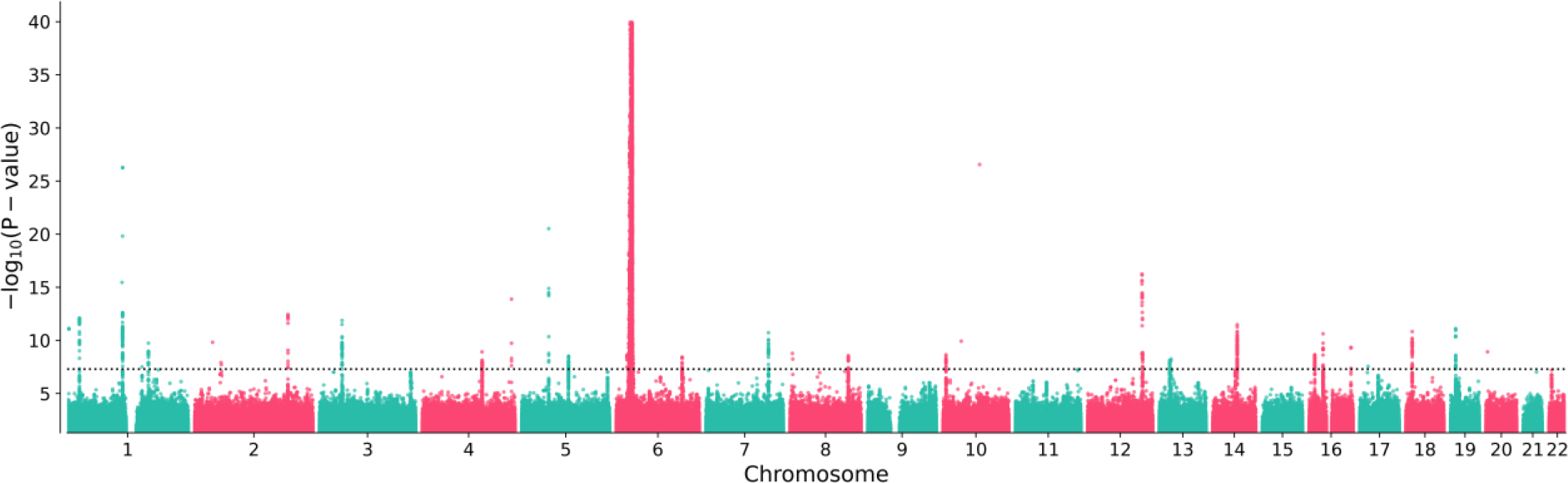
Results: In a genome-wide association meta-analysis of more than 8,500 JIA cases, our results suggest the presence of additional genome-wide significant susceptibility loci beyond those previously identified, including some putative novel loci associated with JIA; however, final validation is ongoing ( Figure 1 ). Compared with earlier studies, increased statistical power allowed multiple loci with previously suggestive evidence to achieve genome-wide significance, confirming and extending known genetic associations . Fine-mapping and functional annotation prioritized genes involved in immune regulation, T-cell activation, and cytokine signaling pathways. Preliminary analysis indicate that several associated genes encode targets of approved immunomodulatory drugs, highlighting potential opportunities for therapeutic prioritization and drug repurposing in JIA. Genetic correlation analyses with other autoimmune diseases are currently underway and will be reported in subsequent study.
Conclusions: This international meta-analysis of GWAS summary statistics represents the largest effort to date in JIA, leveraging increased statistical power to identify genetic associations without the need for direct exchange of individual-level genotype or phenotype data. Early results replicate previously reported susceptibility loci and suggest multiple novel genome-wide significant associations , with validation ongoing. Functional annotation implicates immune-related pathways in JIA pathogenesis, and emerging evidence points to shared genetic mechanisms with other autoimmune diseases. Collectively, these insights enhance our understanding of JIA genetic susceptibility and lay the groundwork for future precision medicine approaches, including early diagnosis, risk prediction, and targeted therapeutic strategies in pediatric rheumatology.
Manhattan plot of the JIA GWAS meta-analysis. Potential novel and previously reported genome-wide significant loci are indicated.
REFERENCES: NIL.
Acknowledgments: NIL.
Disclosure of Interests: None declared.