fetching data ... 
Background: Accumulating evidence suggests that patient expectations may positively influence outcomes across various treatment modalities and health conditions. Exercise therapy has an important role in the stepped care treatment of people with knee osteoarthritis (KOA).
Objectives: This study aimed to examine the association of pre-treatment expectations with clinical outcomes directly after exercise therapy in individuals with KOA.
Methods: This registry-based prospective cohort study (October 2020–September 2024) used data that were routinely recorded alongside the Good Life with osteoArthritis Denmark (GLA:D®) exercise program in one region of The Netherlands. Before the start of the program patients’ age, sex and Body Mass Index (BMI) and their expectations regarding (1) pain relief and (2) physical functioning were recorded using 5-point Likert scales (1= a lot – 5= very little to none). The primary outcome was Pain (Numeric Rating Scale Pain, NRS, 0-10), whereas function (Knee disability and Osteoarthrits Outcome Score-12, KOOS-12) and quality of life (EuroQol-5 Dimensions-5 point Likert, EQ-5D-5L) were secondary outcomes, all measured before and directly after treatment. Expectation scores were categorized into high (scores 1-2) and low (scores 3-5) and four distinct expectation groups were constructed: 1) High pain and function expectations, 2) High pain expectations only, 3) High function expectations only, 4) Low pain and function expectations. Adjusted and unadjusted linear regression models were used to examine the association between expectation groups and the outcomes. Furthermore, logistic regression models were used to examine the proportions of patients reaching a minimal important change (MIC) between the different expectation groups (MIC 2 points on the Pain NRS scale, 15 points on the KOOS-12 and 0.07 on the EQ5D-5L). The group with low pain and function expectations served as reference category in all analyses.
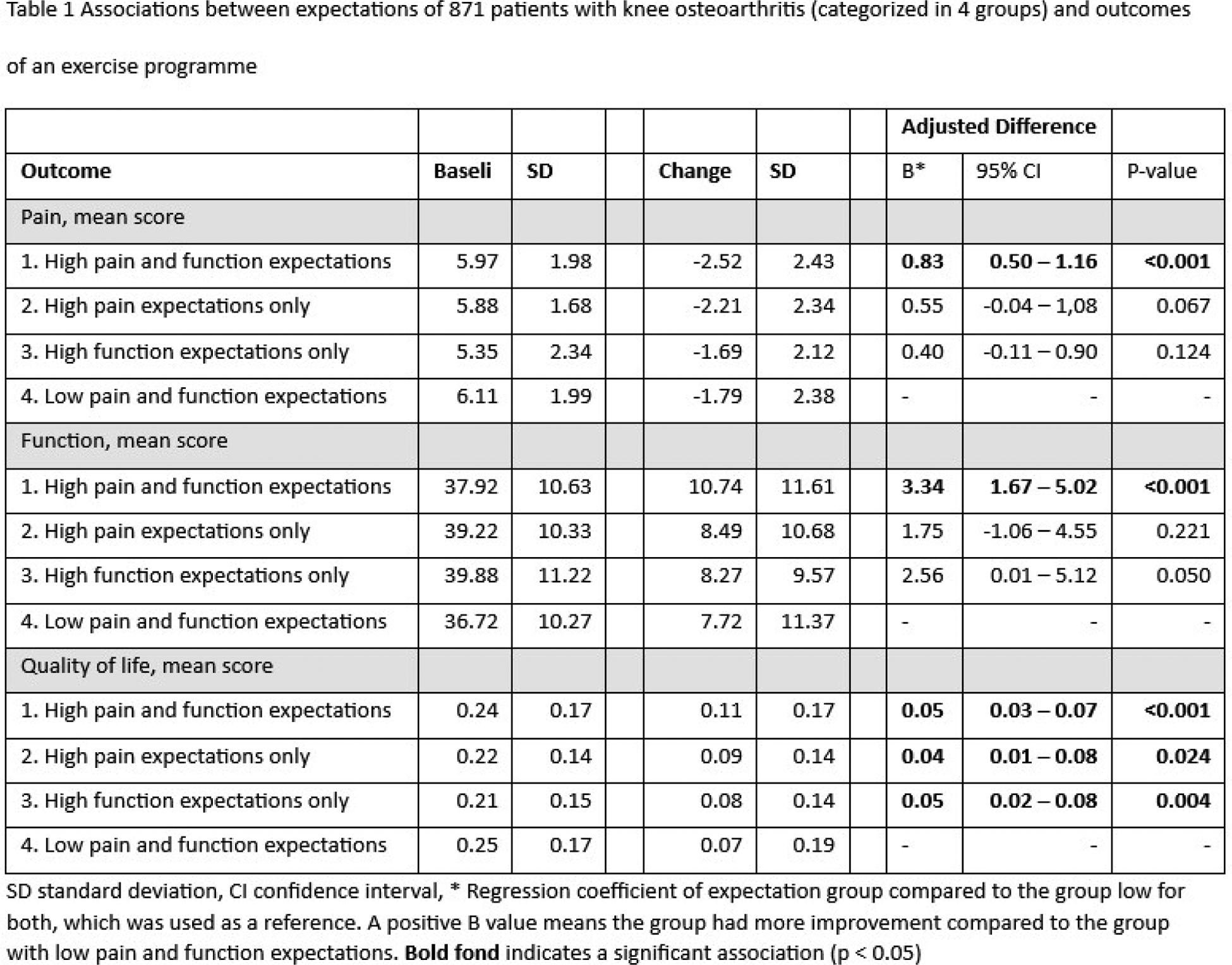
Results: In total, 935 participants with knee as primary affected joint entered the program, whereas data from 871 (93%) were complete and included in the analyses. Their mean age was 66.7 years (95% CI 65.1-66.3), 63% were women and the median BMI was 27.7 (inter quartile range 25.2-31.5). Fifty-seven percent (n= 496) of the participants reported high expectations for both pain and function, 8% (n= 68) and 10% (n= 91) respectively high for either pain or function and 25% (n= 216) had low expectations for both outcomes. Overall, in all groups, there was an average improvement in pain, function and quality of life between before and directly after treatment (Table 1). In the adjusted analysis, the group with high pain and function expectations was consistently associated with a significantly greater improvement in pain, KOOS-12- and EQ-5D-5L-scores compared to the group with low pain and function expectations. For the intermediate groups comparisons with the low pain and function group only showed statistical significantly greater improvement for quality of life. Patients with high pain and function expectations were significantly more likely to achieve the MIC in pain improvement, physical functioning and quality of life than those with low pain and function expectations (OR pain 2.4, functioning 1.8, quality of life 1.5). Patients with high pain expectations only were significantly more likely to meet the MIC for pain and quality of life (OR pain 1.9, quality of life 2.1).
Conclusions: Having higher patient expectations for both pain and function was consistently associated with better outcomes of exercise therapy for KOA. More research into the role of clinicians in assessing and/or modifying pre-treatment expectations is needed.
Funded by the Dutch Research Council (NWO); 023.018.039
REFERENCES: NIL.
Acknowledgments: NIL.
Disclosure of interest: None declared.