fetching data ... 
Background: Systemic Autoimmune Rheumatic Diseases (SARDs) share genetic aetiology, involving both common and rare variants. However, the relationship of rare and common variants at an individual level remains incompletely understood.
Objectives: Our study aimed to evaluate the independent and combined effects of rare variant burden and disease-specific polygenic risk scores (PRSs) across a SARD cohort.
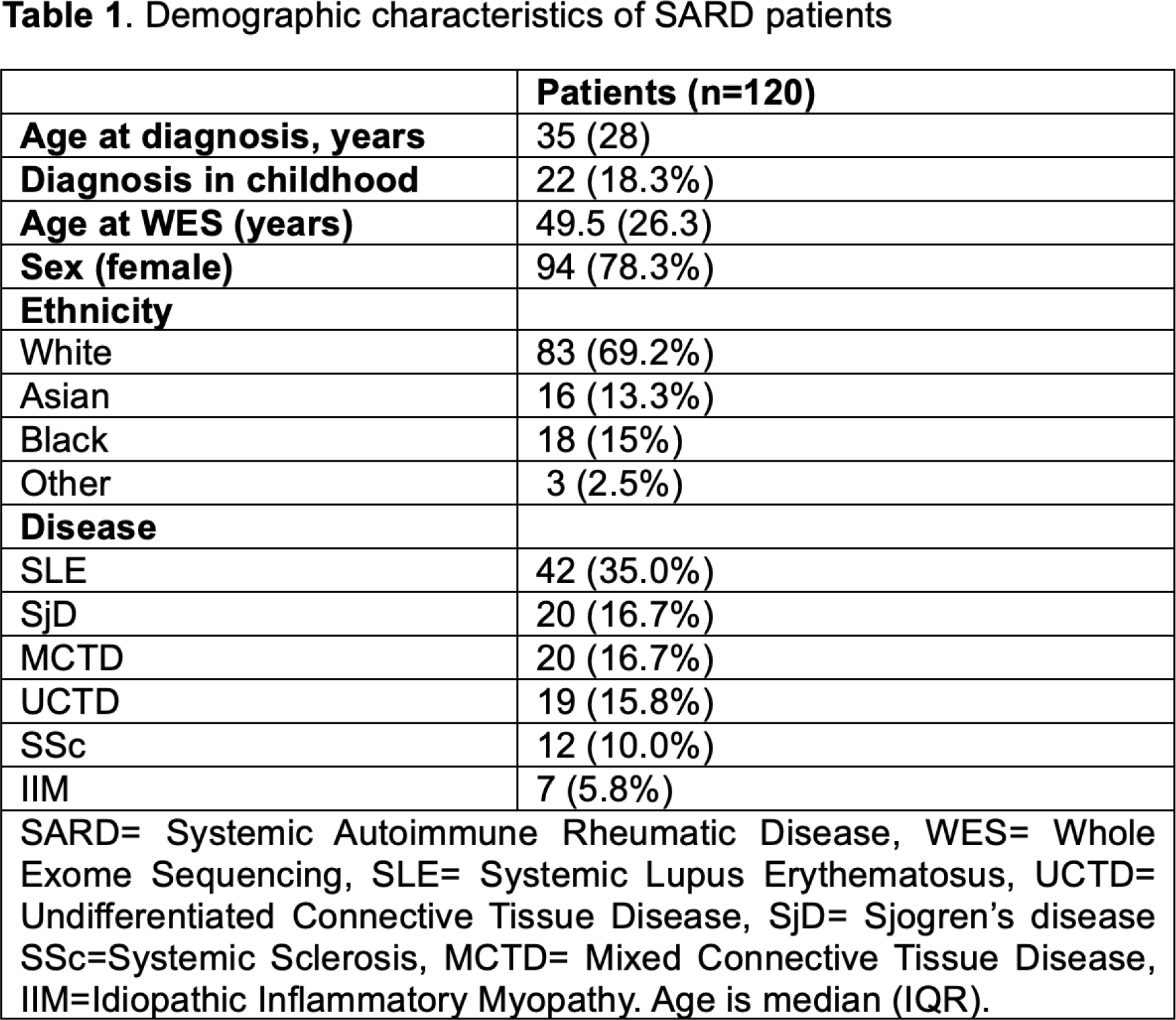
Methods: We analysed 120 patients from the Lupus Extended Autoimmune Phenotype (LEAP) cohort ( Table 1 ). The LEAP cohort is a UK prospective multicentre study of adult and paediatric patients with a diagnosed SARD including systemic lupus erythematosus (SLE), mixed connective tissue disease (MCTD), systemic sclerosis (SSc), idiopathic inflammatory myopathy (IIM), Sjögren’s disease (SjD) and undifferentiated connective tissue disease (UCTD) (ethical approval: 13/NW/0564). Whole-exome sequencing, using the Illumina NovaSeq60004, was performed to identify rare (minor allele frequency <1%), protein-altering variants within lupus-causing genes, and variants were aggregated into per-person rare variant burden scores. PRSs were calculated for SLE, SSc, SjD, and IIM based on publicly available genome-wide association study summary statistics and genotyped data produced with the Affymetrix Axiom assay. Individuals were stratified into genetic risk groups based on PRS distributions and rare-variant carrier status. Associations with clinical features were assessed using regression models.
Results: Rare variants in lupus-causing genes were observed in 25% of SARD patients. Among variant carriers, the most frequent diagnosis was SLE (33.3%), followed by SjD and MCTD (both 23.3%). 16% of patients were in the top PRS quartile of their respective disease. Only 6% of patients were both rare variant carriers and in the top quartile of their disease-specific PRS. Higher disease-specific PRS was associated with significantly earlier age at diagnosis, with individuals in the top PRS quartile diagnosed approximately 12 years earlier than those in the bottom quartile (p<0.05). In contrast, rare variant carrier status was not associated with earlier age at diagnosis. All SLE patients diagnosed before the age of 12 had at least one rare variant, with one patient also being in the top SLE PRS quartile. Higher IIM and SSc PRS scores were significantly associated with MCTD (p<0.05). Over 70% of patients born to consaguineous parents had a rare variant or were in the top PRS quartile.
Conclusions: In this cohort of SARDs, higher disease-specific PRSs were associated with earlier age at diagnosis. All patients with variants in known lupus-causing genes had an age of onset under 12 years, consistent with prior studies. Although the genes in our gene list are typically considered lupus-causing, rare variants were observed across SARDs. PRSs derived from IIM and SSc were significantly associated with MCTD, supporting a shared genetic architecture. Overall, SARD development reflects a complex, non-linear interplay between common variant PRSs and rare variants.
REFERENCES: NIL.
Acknowledgments: NIL.
Disclosure of Interests: Anastasia Madenidou AM has received speaker honoraria from Boehringer Ingelheim, AM is funded by the National Institute for Health and Care Research (NIHR) Manchester Biomedical Research Centre (BRC) (NIHR203308), AM has received grant support from Johnson and Johnson, Gillian I Rice GIR has received grant support from Johnson and Johnson, Sarah Dyball SD has received grant support from Novartis, Ben Parker BP has received honoraria from Fresenius-Kabi and AbbVie and was a speaker for Eli Lilly and Roche, BP has received grant support from Genzyme/Sanofi and GSK, Adam Stevens AS has received speaker honoraria from Merck KGaA, AS has received a research grant from NovoNordisk, Tracy Briggs TIB has received grant support from Johnson and Johnson, Andrew Morris: None declared, Ian N. Bruce INB was a speaker for AstraZeneca, GlaxoSmithKline and UCB, INB has receivecd consulting fees from AstraZeneca, Eli Lilly, GlaxoSmithKline, Merck Serono and UCB., INB has received grant support from Genzyme/Sanofi, GlaxoSmithKline, Roche, Jansen and UCB.