fetching data ... 
Background: CD19-directed CAR T-cell therapies have shown promising clinical outcomes in multiple rheumatologic diseases, including systemic lupus erythematosus (SLE), systemic sclerosis (SSc), idiopathic inflammatory myositis (IIM), and rheumatoid arthritis (RA). Combined CD19 and BCMA targeting may further improve depth, breadth and durability of response across multiple autoimmune indications by eliminating long-lived plasma cells not targeted by CD19-only approaches. AZD0120 is a dual BCMA/CD19 CAR-T manufactured using a <72-hour FasTCAR platform designed to preserve T-cell stemness and proliferative capacity and already demonstrated a promising safety and efficacy profile in clinical studies in Multiple Myeloma [1] and SLE [2].
Objectives: We aimed at assessing the feasibility of generating AZD0120 from patient-derived PBMCs across multiple rheumatologic indications and potential functional and phenotypic differences, using AZD0120 made from healthy donor peripheral blood mononuclear cells (PBMCs) as a benchmark. Furthermore, we explored plasma cell signatures in rheumatologic disease to better understand the potential benefit of dual CD19 and BCMA targeting.
Methods: AZD0120 was generated using PBMCs obtained from donors with rheumatologic disease (SLE, SSc, IIM, RA) and from healthy donors. Transduction efficiency and stemness markers were assessed by flow cytometry. In vitro functional performance was evaluated using CD19- and/or BCMA-expressing target cells to quantify dose-dependent, antigen-specific cytotoxicity, cytokine secretion, proliferation, and serial killing. Publicly available single cell transcriptomic datasets were analyzed to evaluate plasma cell–associated genes.
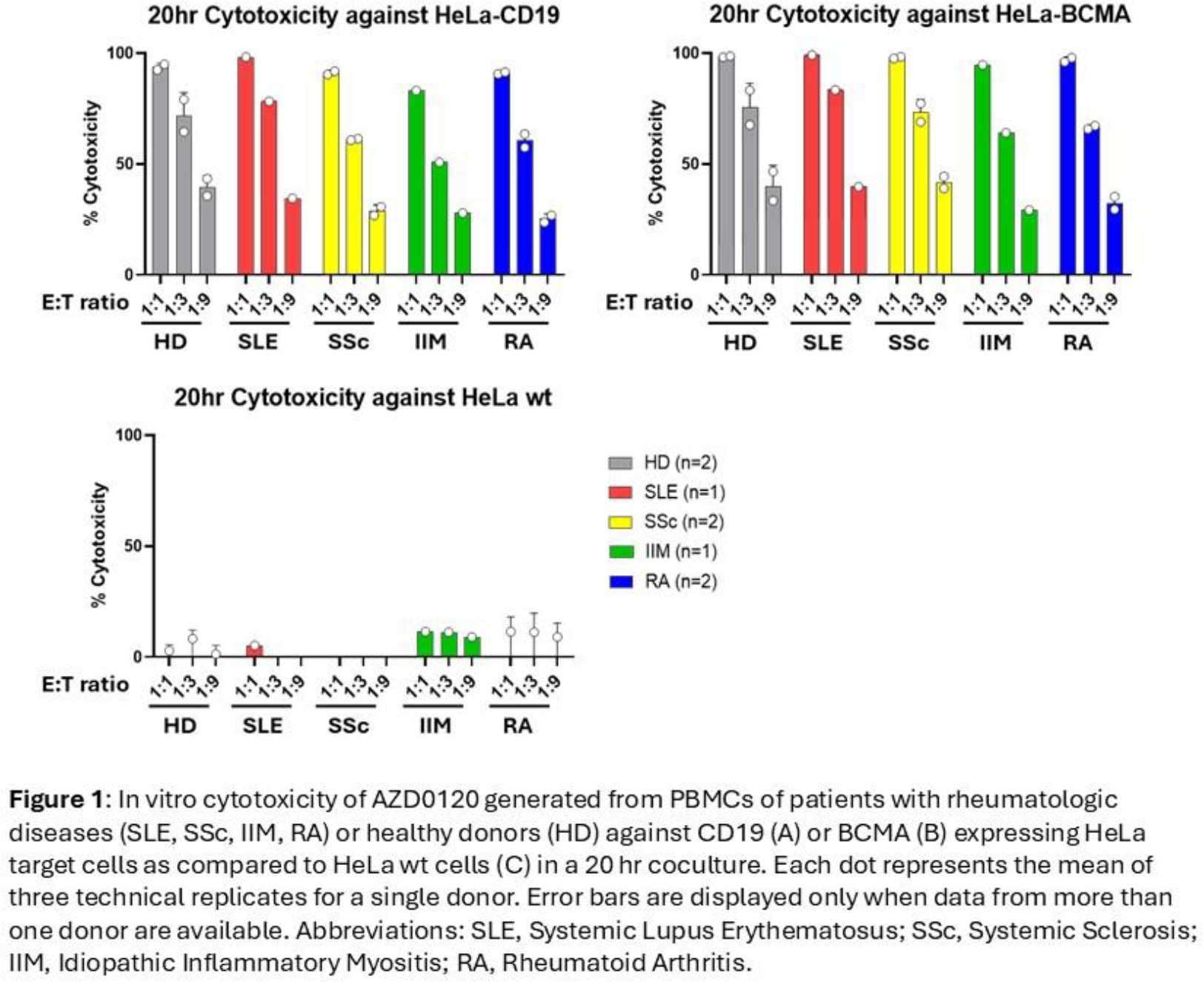
Results: AZD0120 was successfully generated from PBMCs of patients with rheumatologic disease (SLE, SSc, IIM and RA) and showed comparable transduction efficiency and stemness as compared to AZD0120 made from healthy donor PBMCs. Patient-derived AZD0120 demonstrated antigen-specific, dose-dependent cytotoxicity (Figure1) and IFN-γ secretion comparable to healthy donor-derived AZD0120, independent of disease indication. Additionally, patient-derived AZD0120 showed proliferation and serial killing capacity comparable to healthy donor products during repeated stimulation with CD19 and BCMA expressing target cells. Analysis of public scRNA-seq datasets identified plasma cell–associated genes in rheumatologic disease.
Conclusions: The FasTCAR platform reliably produces AZD0120 from PBMCs of patients with rheumatologic diseases (SLE, SSc, IIM, RA), achieving transduction efficiencies similar to healthy donor products with high stemness. Patient-derived AZD0120 exhibits potent antigen specific and dose-dependent in vitro cytotoxicity and cytokine production comparable to healthy donor–derived AZD0120, supporting feasibility for clinical translation across rheumatologic indications. The presence of plasma cells in rheumatologic diseases suggests that simultaneous targeting of CD19 and BCMA may deepen responses and broaden applicability across autoimmune indications.
REFERENCES: [1] Shambavi, R. et al. Safety and efficacy of AZD0120, a BCMA/CD19 dual-targeting CAR T-cell therapy, in relapsed/refractory multiple myeloma: Preliminary Results from the DURGA-1 Phase 1b/2 study. Blood 2025; 146 (Supplement 1): 269. doi:
[2] Wu, C. et al. Annals of the Rheumatic Diseases, Volume 84, 65. OP0074 Preliminary results of CD19/BCMA Dual-Targeting FasTCAR-T Cells GC012F (AZD0120) in patients with refractory Systemic Lupus Erythematosus-an open-label, single-arm study. doi:
Acknowledgments: NIL.
Disclosure of Interests: Royce Ma AstraZeneca, Fay Eng AstraZeneca, Nicola Ferrari AstraZeneca, Pat Gavin AstraZeneca, Naomi Hamada AstraZeneca, Maggie Shen AstraZeneca, Nadia Abutaleb AstraZeneca, Lori Clarke AstraZeneca, Yasuhiro Ikeda AstraZeneca, Lan Cao AstraZeneca, Chantal Kuhn AstraZeneca.