fetching data ... 
Background: Rheumatoid arthritis (RA) in later life is characterized by increasing clinical heterogeneity, progressive functional impairment and accumulation of comorbidities, which may not be fully reflected by conventional measures of inflammatory disease activity. Muscle dysfunction, reduced physical performance and disability contribute substantially to vulnerability in ageing populations and may influence quality of life, fatigue and treatment burden. However, clinically meaningful functional phenotypes in older patients with RA remain poorly defined. Unsupervised machine learning approaches may allow data-driven identification of functional phenotypes beyond traditional inflammatory constructs.
Objectives: To identify muscle functional phenotypes using unsupervised machine learning in patients with RA aged ≥50 years, and to evaluate differences in disease activity, disability, patient-reported outcomes, physical activity and treatment exposure between phenotypes.
Methods: This cross-sectional observational study included 275 consecutive patients with RA aged ≥50 years from a real-world tertiary care cohort. Unsupervised hierarchical clustering using Ward linkage was applied based exclusively on muscle functional variables: SARC-F score, dominant handgrip strength and gait performance. Handgrip strength and gait speed were standardized using sex-adjusted z-scores. Variables were robustly scaled, and missing values were imputed using median values restricted to clustering features. The optimal number of clusters was determined using silhouette index, cluster size balance and clinical interpretability. Identified phenotypes were compared for inflammatory disease activity (DAS28, CRP), functional disability (HAQ), health-related quality of life (SF-12 physical and mental component scores), fatigue (FACIT-F), physical activity levels and exposure to biologic therapy.
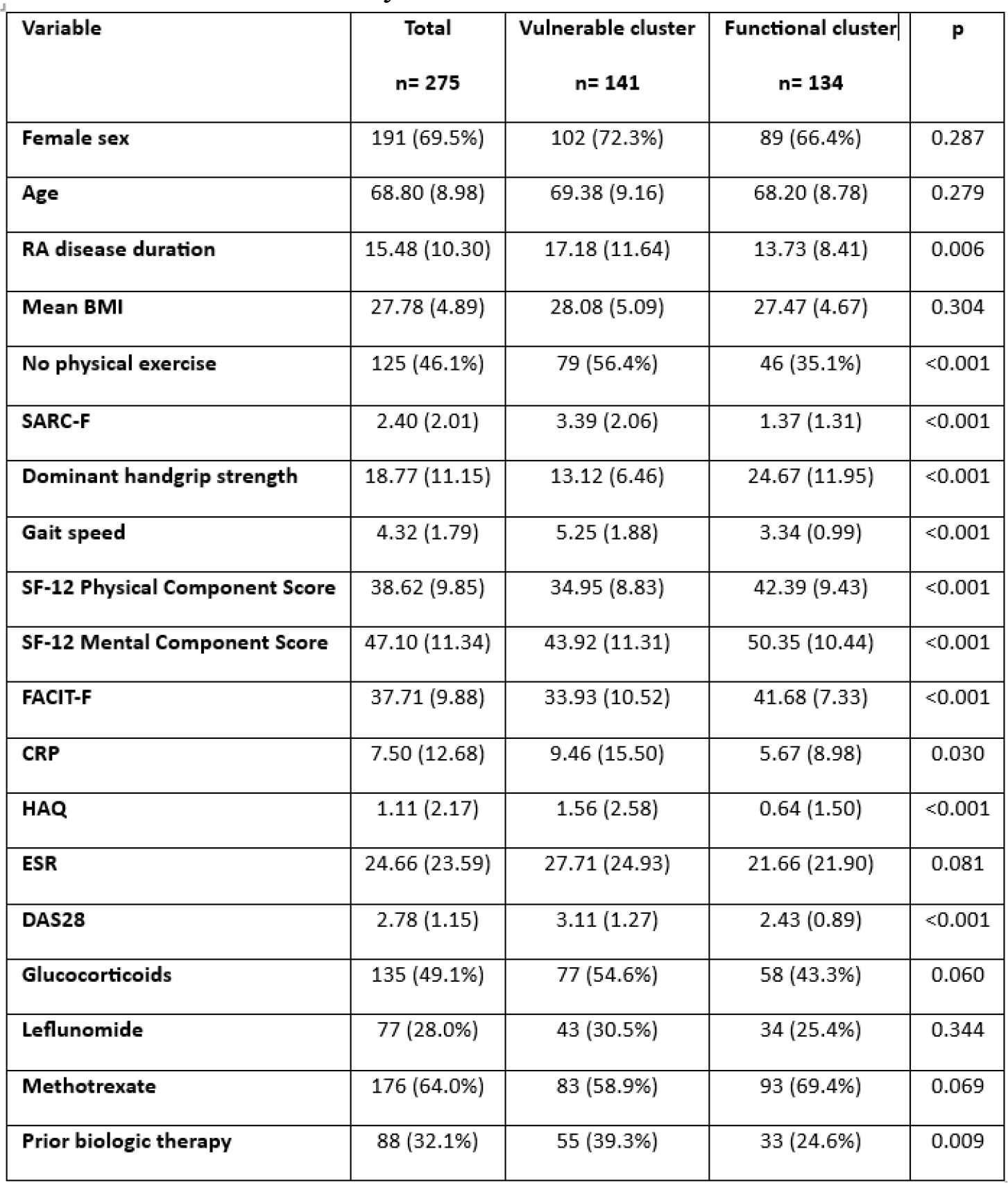
Results: Two distinct muscle functional phenotypes were identified: a vulnerable phenotype (n=141, 51.3%) and a preserved functional phenotype (n=134, 48.7%), with an acceptable cluster separation (silhouette 0.27), as shown in Figure 1. Detailed comparisons are shown in Table 1. Patients classified as vulnerable exhibited markedly worse muscle function, reflected by higher SARC-F scores, lower handgrip strength and slower gait speed (all p<0.001). This phenotype was associated with substantially greater functional disability (HAQ 1.56 vs 0.64; p<0.001), poorer physical and mental health-related quality of life (SF-12 physical 34.9 vs 42.4; mental 43.9 vs 50.4; both p<0.001), higher fatigue burden (FACIT-F 33.9 vs 41.7; p<0.001), and lower engagement in regular physical activity. Inflammatory disease activity was also higher in the vulnerable phenotype (DAS28 3.11 vs 2.43; p<0.001), along with a greater proportion of patients previously exposed to biologic therapy (39.3% vs 24.6%; p=0.009).
Conclusions: Unsupervised machine learning identified a distinct muscle functional vulnerability phenotype in older patients with RA, characterized by impaired physical function, greater disability, poorer quality of life, increased fatigue and higher therapeutic burden. These findings suggest that muscle functional vulnerability represents a clinically relevant dimension of disease impact that is only partially captured by inflammatory activity measures. Incorporating functional assessment into the evaluation of ageing patients with RA may improve clinical stratification and support more individualized management strategies.
Principal component analysis for visualization of clustering results
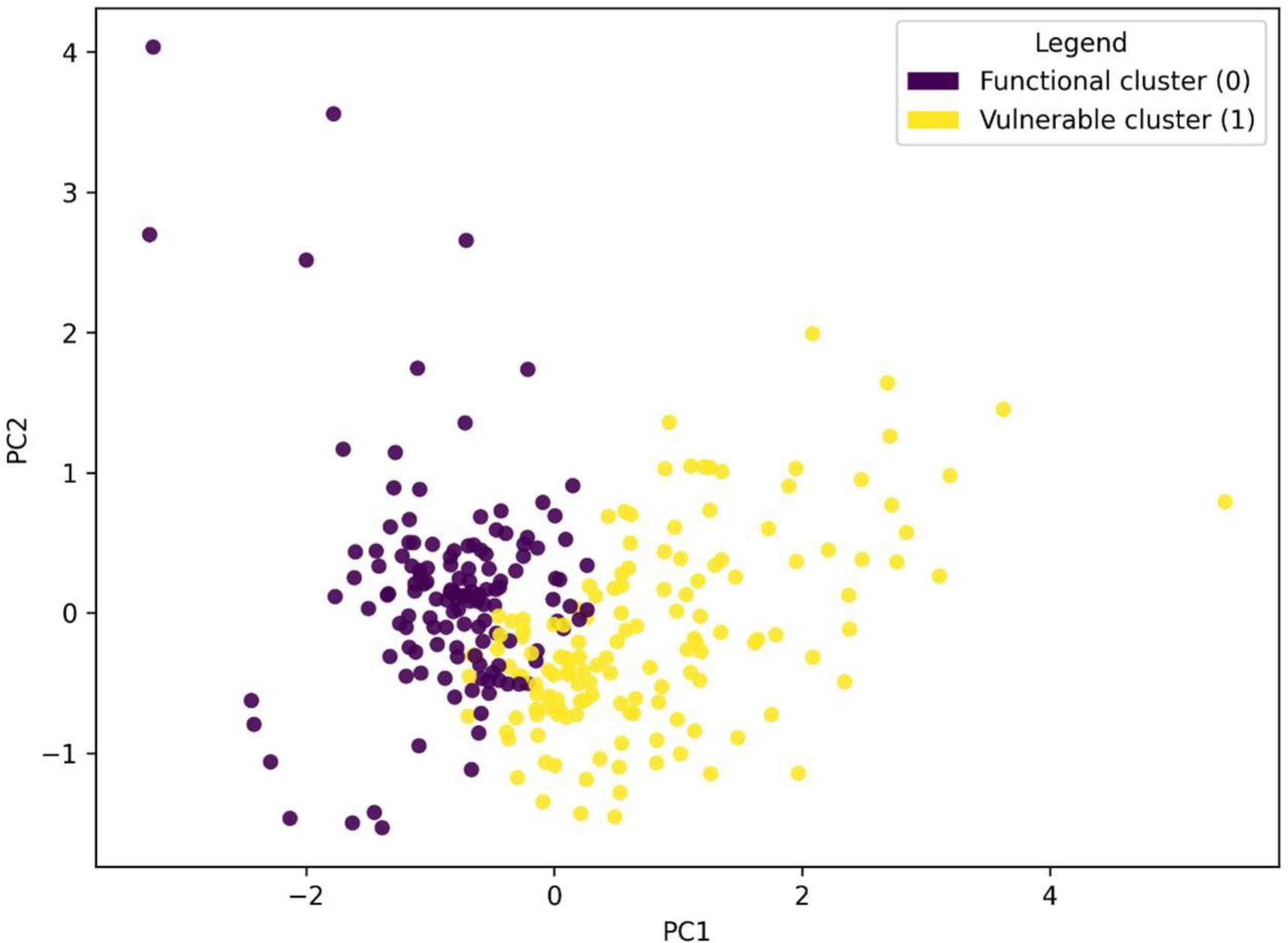
Table 1. Results stratified by cluster
REFERENCES: NIL.
Acknowledgments: NIL.
Disclosure of Interests: None declared.